


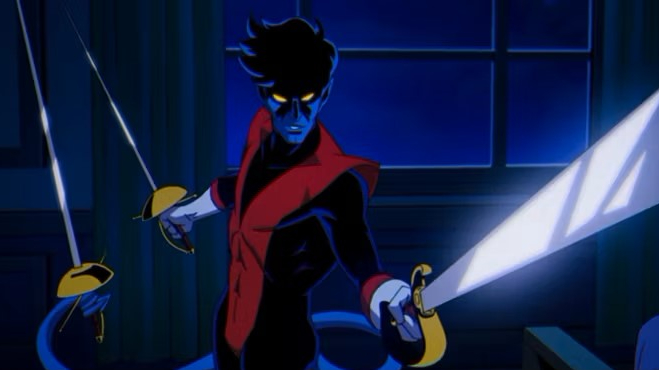
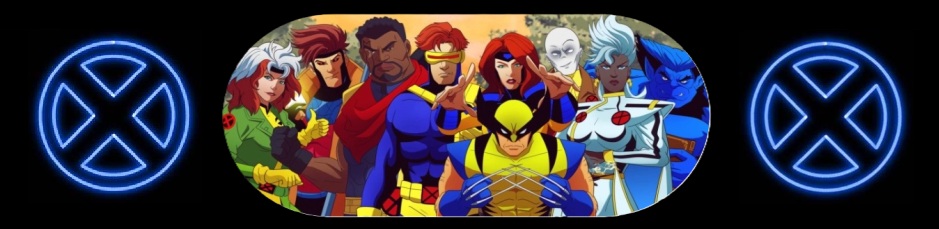
Tolerance Is Extinction (Part 1) launches the final arc of Season 1 with a bang. It deftly introduces Bastion, detailing his origin and world domination plans. In a surprising twist, Bastion is unveiled as a mutant, a living machine, and the pinnacle of the Sentinel program’s evolution.
The episode juggles its narrative elements skilfully, setting the stage for an epic showdown between the X-Men and Bastion’s Prime Sentinels. The action sequences are thrilling, the character development is spot-on, and the tense relationship among Cyclops, Jean and Cable continues to be a central element. Although it may not delve as deeply into the emotional territory of its comic book roots, the series maintains its captivating and unpredictable nature.
The latest episode marks the beginning of the final arc for Season 1, masterfully weaving together elements from the iconic 1996 Operation: Zero Tolerance and 2001’s E Is for Extinction storylines. We’re introduced to Bastion and his army of Prime Sentinels, presenting a conflict that mirrors the existential threat posed by the burgeoning mutant population. The narrative is expansive yet concise, effectively establishing Bastion’s backstory and agenda.
The action scenes are vibrant and captivating, maintaining the episode’s pace and keeping the various plotlines active and engaging. The character development is stellar, and while a deeper exploration of Bastion would be welcome, the episode skillfully fosters the relationship between Jubilee and Sunfire, adding layers to the already rich character interactions. The tense relationship among Cyclops, Jean, and Cable takes center stage, juxtaposed intriguingly against Nightcrawler’s reflections on family and choice. Nightcrawler’s integration into the main cast has been a brilliant move this season.
With a title like Tolerance Is Extinction, the episode promises and delivers an in-depth examination of acceptance and the perils of bigotry. It escalates the suspense and raises the stakes for the X-Men, introducing a novel and more lethal challenge for our heroes to face. It upholds the series’ commitment to tackling pertinent social issues through the mutant metaphor, ensuring a riveting and thought-stimulating viewing experience.
In a stunning revelation by the UN, the world learns that Xavier is still alive, sparking a wave of anti-mutant sentiment right at the school’s doorstep. Amidst the turmoil, Cable imparts a grim truth to the X-Men: the Genosha massacre is a fixed moment in history, unalterable and destined to ignite a centuries-long conflict, culminating in a dystopian future where mutants are subjugated under human rule.
In a desperate bid to alter this dark destiny, Cyclops, Jean, and Cable set out to Harmony, Pennsylvania. There, they uncover the chilling reality of Bastion, a being born from the union of man and the futuristic Sentinel Nimrod, a harbinger of doom for mutant kind.
As the shadow of “Operation: Zero Tolerance” looms, its operatives voice their unease over the Genosha tragedy. Dr. Cooper is tasked with overseeing Bastion, only to discover his sinister plan: using Sinister‘s techno-organic virus to transform unsuspecting humans into Prime Sentinels, echoing the dark legacy of Trask. The activation of these Prime Sentinels triggers a global crisis, as they launch assaults on mutants worldwide and reduce Xavier’s school to ashes.
In the face of this catastrophe, Dr. Cooper, shaken to her core, frees Magneto. His response is cataclysmic — a global blackout ensues, claiming thousands of lives and neutralizing the Prime Sentinel threat. This drastic action leaves Wolverine to grapple with the fear that Magneto has now waged war on humanity itself.
Amidst this chaos, Xavier makes a timely return, calling upon the X-Men to rise once more. The stage is set for a battle that will decide the fate of mutant and humankind alike.
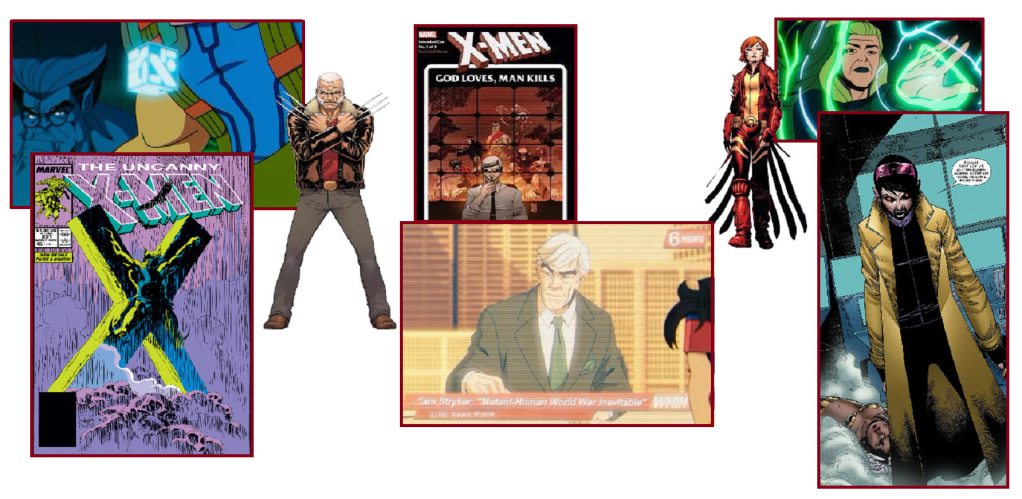
Cable’s future has cameos and references galore: “A dystopia where Wolverine is the last to die” could refer to Old Man Logan, where he’s the last living X-Man in a future wasteland. The time cube ‘Professor’ that Cable uses was first seen in Time Fugitives (Part 1).
The mutant seen altering the Earth’s magnetic poles is none other than Polaris, daughter of Magneto, while the mutant seen rebuilding the Golden Gate bridge is Rachel Summers, the daughter of Scott Summers and Jean Grey from an alt-future, making her Cable’s half-sister. She’s gone by many nom-de-Guerre’s over the years, including Phoenix, Marvel Girl, Prestige, Askani and Mother Askani…
Reverend William Stryker, seen ‘preaching’ on the TV, is a classic X-Men villain from God Loves, Man Kills, which was somewhat adapted into the film X2.
Magneto’s position on the St. Andrew’s cross is similar to Wolverine on artist Marc Silvestri’s classic cover for Uncanny X-Men #251.
Jubilee’s new costume is her all in black vampire uniform. Jubilee spent quite some time as a thrall of Dracula until eventually the Phoenix Force restored her humanity. This all started in the Curse of the Mutants arc.
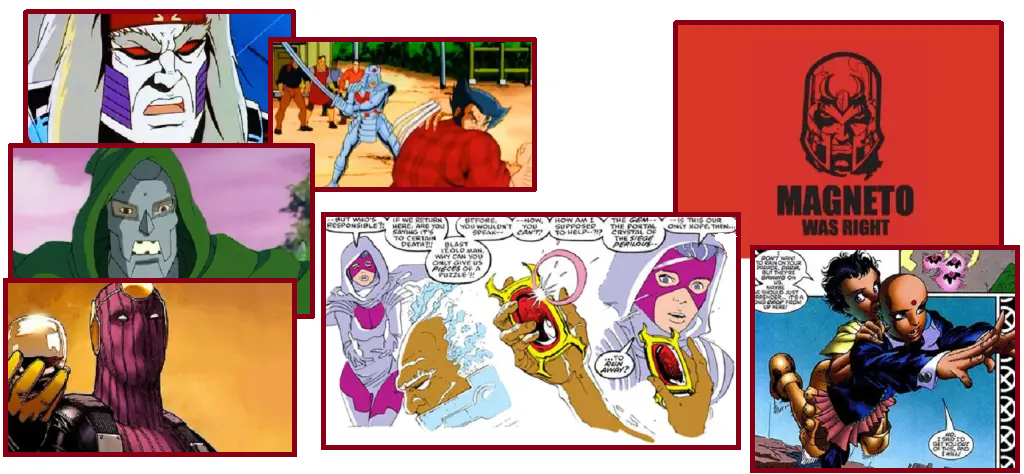
In comics, Bastion was never a human at all – he’s a single being formed of a Master Mold and a Nimrod, who both took a trip through the Siege Perilous, a mystical gateway that gives the traveller a brand-new start in life with no memory of their past. Bastion’s mother has a replica of it around her neck when Jean confronts her. On paper she’s human and took Bastion in. Here she becomes a Prime Unit.
Val says that ‘Magneto was right’ – a phrase that the mutant youth of the X-Universe have displayed prominently in recent years.
The bald woman who aids Bastion is Daria, who helped Jubilee escape torture by Bastion in the comic book version of the story in Generation X #28.
The villains are waiting for their moment. Omega Red somehow got free from his time on the sunken Russian submarine (A Deal with the Devil) and the Silver Samurai seems to have gone up in the world since hounding villagers (Lotus and the Steel). Spider-Man also makes a cameo, as do Doctor Doom and Baron Zemo, all rocking their 90s animated looks.




 X-Cess Minutiae
Leave a comment