


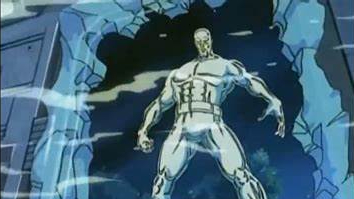

At X-Cess Minutiae, pinning down our favourite X-Man is a tough call – we could narrow it down to a top three or five, but choosing just one is impossible. Each character has unique and defining traits that make them shine within the team. However, Iceman has been a standout for quite some time.
Iceman, a founding member of the X-Men, was created by writer Stan Lee and artist Jack Kirby. He debuted in X-Men #1 in September 1963. His powers revolve around the mastery of ice and cold, enabling him to shape water vapor into ice constructs, solidify objects, and even sheathe his body in ice.
His abilities don’t stop there; Iceman can manipulate anything containing water, including plants and humans. Impressively, he can heal and reform himself if damaged in his icy form. He’s also capable of creating sentient ice golems, a testament to his expansive cryokinetic skills.
Once the comedic relief of his team, Bobby Drake, also known as Iceman, has matured into a courageous and reliable protector. His adventures have leapt off the comic book pages into animated shows, video games, and movies, including the acclaimed X-Men films.
As an Omega Level mutant, Iceman is counted among the titans of the Marvel Universe, alongside the likes of Jean Grey and Cable. His mastery over ice and his versatile powers make him an awe-inspiring ally.
Iceman also navigates personal hurdles, grappling with family dynamics and his own identity. His journey has seen him traverse through adversity and triumph, enriching his character. His charm, formidable abilities, and laid-back demeanour have garnered a loyal following. Recent narratives delving into his sexuality have enriched his storyline, evolving him from the light-hearted sidekick to a multifaceted and impactful champion.
Iceman’s lasting appeal lies in his relatable personal challenges, his constantly developing abilities, and his unique role in the X-Men universe. He embodies more than his frosty powers; he’s a multifaceted hero whose journey remains a source of fascination and inspiration globally.
The episode Cold Comfort excellently portrays Bobby’s character. With flashbacks to the original five X-Men, their formative days, and the bonds they share, along with the debut of X-Factor, it stands out as an exceptional and enjoyable episode—even though it never got the sequel it truly deserved.
Iceman infiltrates a government facility, triggering an alert to Professor X. The X-Men are dispatched to capture their former ally. En route, they debate Iceman’s recent detachment from the team. Upon arrival, they successfully detain Iceman and escort him back to the mansion for confinement.
In a heart-to-heart with Beast, Iceman reveals his departure from the X-Men was spurred by an injury to his girlfriend, Polaris, during a mission. The couple had since cohabitated until Iceman discovered their home desecrated and Polaris missing. His search led him to the very facility from which he was just extracted. Jubilee, empathizing with Iceman’s plight, liberates him.
They venture back to the facility in search of Polaris, only to be incapacitated by X-Factor. The X-Men, in pursuit of their missing comrades, find Iceman and Jubilee post-escape. A subsequent encounter with X-Factor unveils the facility as their training base, government-endorsed no less. In a shocking revelation, Polaris confesses her allegiance to X-Factor and her newfound love for Havok. The X-Men, alongside a disheartened Iceman, return to the mansion.
Despite Professor X’s persuasive efforts, Iceman refuses to re-join the team, choosing instead a solitary path.
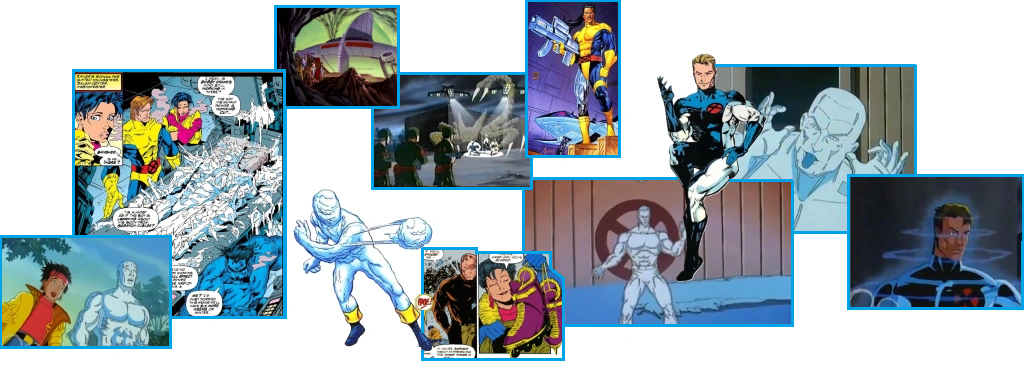
The Kirby Glen Storage Depot pays homage to Iceman and the legendary X-Men co-creator, Jack Kirby.
Bobby Drake’s uniform in his human form is a throwback to his 90s Gold team days.
Over the years, Jubilee and Professor X’s relationship has deepened, revealing a more fatherly bond that both cherish more than they let on. Their interactions in this episode hark back to a touching moment from Uncanny X-Men #297, where Jubilee skates alongside a temporarily ambulatory Charles Xavier.
Bobby, often the joker of the X-Men, displays a level of disrespect in this episode that’s uncharacteristic of him. Yet, this behaviour conceals the insecurities he’s harboured for over six decades, which are only now being explored.
To distract soldiers and facilitate their escape from Kirby Glen, Charles Xavier conjures an illusion of a fearsome Brood Queen.
Beast reveals that the force field containing Bobby was repurposed from the remnants of a Shi’ar ship, which previously held the Spirit Drinker captive in the Morlock Tunnels, as seen in Out of the Past.
Jubilee’s empathy for Bobby grows, echoing their comic book relationship that only developed after Bobby’s consciousness was trapped in Emma Frost’s body, leaving him in a critical state. Jubilee’s vigil by his side until his recovery in Uncanny X-Men #314 is a testament to their bond.
Forge, despite being introduced in season one, makes his first present-day appearance. He will appear several more times throughout the series and, as of 2024, has become a mainstay in the X-Men ’97 line-up.
PREVIOUSLY ON… X-FACTOR?
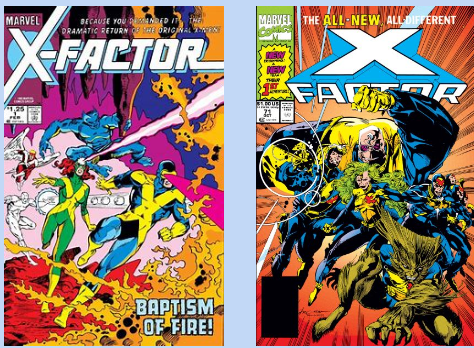
The term ‘X-Factor‘ originally referred to a group formed by the initial X-Men, but it took on a new meaning with the government-backed team created by writer Peter David in 1991. After the Shadow King’s defeat in Uncanny X-Men #280, the victors faced a fresh challenge: an unprecedented gathering of students. With Xavier just back from space, the X-Men dispersed globally, and X-Factor’s base destroyed, they were at a crossroads. Also present were Muir Island’s residents, recovering since the Mutant Massacre concluded in Uncanny X-Men #212, and SHIELD’s Nick Fury, who was all too willing to pass the buck.
Val Cooper, a key figure from the Department of Mutant Affairs and a steadfast supporter of Xavier’s underground movement, transformed X-Factor into the ideal version of what Freedom Force was intended to be. This new iteration was a team of mutant heroes serving as government agents, with full legal authority and public recognition. With genuine heroes and ex-X-Men on board, unlike the previous Freedom Force, it was hoped that this time, Val Cooper’s efforts would be taken seriously.
The eclectic group of mutants burst onto the scene, each member bringing their own unique flair and a palpable tension that was off the charts. Among them was Alex Summers, better known as Havok from the X-Men, determined to show he was every bit the hero his brother Cyclops was. Wolfsbane, the weregirl and former New Mutant, along with Lorna Dane, the magnetic Polaris and daughter of Magneto, had chosen to stick by Alex’s side. They were joined by the celebrity bodyguard Strong Guy Guido Carosella, Jamie Madrox aka Multiple Man, Moira’s right-hand man, and the swift-moving Quicksilver. Under Peter David’s distinctive comedic touch, their misfit escapades won over fans, cementing this team’s place in the annals of X-Factor history from issue #71 right up to its finale in #149.
While Quicksilver made a few more appearances in later episodes, and Forge earned his spot as an X-Man in X-Men ’97, the potential rivalry with the X-Men was left hanging. They’re seen in a brief cameo in Sanctuary, and silent appearances are plentiful. Cyclops never recognizes Alex as his brother onscreen, though he does refer to him in Orphan’s End. The mystery of why their powers negate each other’s—something explained in the comics as a phenomenon among close relatives like brothers or cousins—remains unsolved on the show.

It’s quite disappointing, as Cold Comfort could have laid the groundwork for an intriguing storyline between the two teams, maybe even a spin-off featuring the sibling team. With X-Men ’97 picking up the narrative threads of this timeline, perhaps there’s hope that the rich dynamic from the comics will finally be explored onscreen.




 X-Cess Minutiae
Leave a comment