


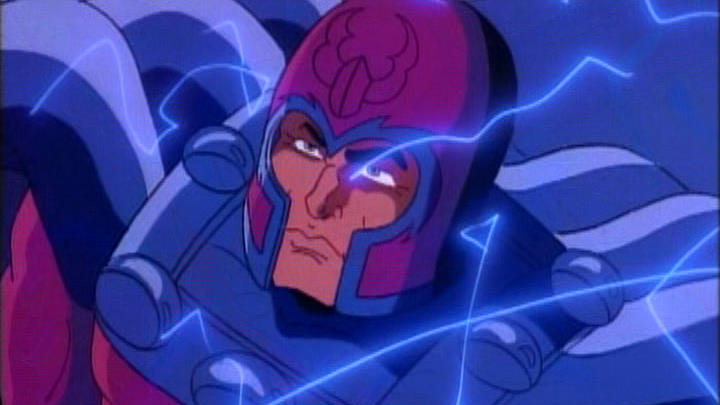

Heroes cannot exist without villains to challenge them – the heroes are invariably honest, and the villains are typically recognizable as such. However, there are exceptions. One antagonist might just embody the X-Men as much as Wolverine does.
From his relentless perseverance in the early days to Claremont’s intricate storytelling, Magneto has been integral from the very start, proving to be as crucial to the X-Men narrative as the original five youngsters in spandex he battled at a naval base over six decades ago. But why is that?
For decades, Magneto has stood as the formidable counterpart to Xavier, embodying the very essence of a mutant supremacist. His ideology, rooted in the belief of mutant dominance, poses a threat that transcends mere physicality. It’s this conviction to safeguard mutant kind at all costs that weaves an enthralling narrative tapestry.
The layers of Magneto’s character are enriched by his harrowing past as a Holocaust survivor. The atrocities he endured have imprinted upon him a resolute vision to avert such horrors from ever befalling mutants.
Straddling the line between villainy and vigilantism, Magneto’s moral complexity and sporadic alliances with the X-Men obscure the traditional lines of heroism. It’s this moral ambiguity that renders him a profoundly compelling figure.
Magneto’s enduring presence in the X-Men saga has cemented his legacy. From the inception of the comics, he has been a pivotal figure, casting a long shadow over the series. His dual role as both nemesis and sometime-ally secures his rank as one of the most iconic X-Men adversaries.
In short: no Magneto, no X-Men…
In the dimness of his cell, Beast finds solace in books, tuning out the guards’ relentless mockery. Suddenly, chaos erupts as bars, walls, and even the guards’ limbs are torn asunder. Magneto, master of magnetism, announces his dramatic rescue. He extends an offer of freedom to Beast, but with unwavering resolve, Beast opts to face his trial. Undeterred, Magneto insists that prejudice against mutants is inevitable. Despite his efforts, he fails to sway Beast and departs dramatically, leaving a trail of destruction in his wake.
As Professor X and Jubilee review the footage from the prison event, Professor X is compelled to share the turbulent history he shares with Magneto. Once allies, they dedicated their efforts to healing soldiers traumatized by war at a psychiatric facility. Their camaraderie strengthened during a crisis when they joined forces to repel an assault on their hospital, saving their fellow soldiers and discovering each other’s remarkable powers. However, their friendship took different directions when Magneto’s desire for vengeance conflicted with Xavier‘s commitment to harmony, leading Magneto to become a militant advocate against human governance, fighting for mutant dominance. Despite Xavier’s early successful peacekeeping efforts, he now confronts doubts about the X-Men‘s ability to thwart Magneto’s growing threat, in contrast to Jubilee’s steadfast hope.
In a tense courtroom, Beast faces the judge, seeking bail amidst a chaotic anti-mutant protest. With Cyclops and Wolverine watching, the judge denies bail, prompting Beast’s lawyer to accuse the court of discrimination. The judge allows Beast to speak, who reveals the mysterious disappearance of eleven registered mutants. The revelation incites uproar, with the crowd turning hostile. As the judge cites the recent violent events to justify his decision, the tension escalates. Logan unsheathes his claws in response to the crowd’s reaction, and a scuffle ensues when a guard assaults Beast. Suddenly, Sabretooth bursts in, causing mayhem until he’s subdued and removed from the scene, leaving the courtroom in disarray.
In the infirmary of the mansion, Sabretooth lies injured as Logan, in a fit of rage, attempts to sever his life support before being halted by Scott and Xavier. Logan argues against aiding Sabretooth, citing unknown dangers, but Storm counters, reminding him of the X-Men’s initial scepticism towards Logan himself. Suddenly, an alarm blares, signalling an assault on a missile base. The team springs into action, with Wolverine cynically noting the irony of fighting Xavier’s foe while aiding his own.
Upon arrival, they find Magneto mid-scheme, initiating missile launch sequences aimed at the base. Initially mistaking the X-Men for allies, Magneto quickly turns hostile when corrected. As battle ensues, Magneto succeeds in launching the missiles, but Storm, summoning her powers, safely redirects them into a nearby lake, only to collapse from the strain. Wolverine catches her in time, and the team retreats, having temporarily thwarted Magneto’s plan. Later, the defeated antagonist laments Xavier’s perceived betrayal of mutant kind.

In the X-Men animated series, there are intriguing inconsistencies, particularly in episodes like Cold Comfort, where Beast’s prior knowledge of Magneto is questioned despite his intermittent absences from the team. It seems improbable that Beast would be unaware of Magneto, and yet Magneto himself appears oblivious to Xavier’s leadership of the X-Men.
The term ‘brotherhood’ is cleverly used by Magneto to persuade Beast, which is ironic given that the ‘Brotherhood of Evil Mutants’ is scarcely represented in the series, except for Mystique’s iteration. It is hinted that there was some form of collaboration, especially concerning Rogue.
Flashbacks omitting critical historical details such as the country (Israel), the conflict (World War II), the adversaries (Nazis), and the individual they help (Gabrielle Haller) are based on the narrative from Uncanny X-Men #161.
Beast’s attorney, Cameron Hodge, is introduced, setting the stage for his return in the episode Slave Island.
Sabretooth’s tenure at Xavier’s school began in X-Men Unlimited #3, where he sought treatment for his violent tendencies. His stay, which lasted until Uncanny X-Men #328, was marked by controversy, as his presence was strongly opposed by team members such as Beast, Cyclops, Jean Grey, and Storm, as depicted in X-Men #28.
The iconic battle at the naval base, a pivotal scene from the very first X-Men comic in 1963, is vividly brought to life in the narrative. Additionally, the phrase “Mutant Liberation Begins,” uttered by Magneto, not only captures the essence of the mutants’ struggle but also serves as the title for the second episode of X-Men ’97.
Magneto’s choice to quote Shakespeare during his initial encounter with the X-Men is laden with irony, given Sir Ian McKellen’s illustrious career on the British stage and his portrayal of Magneto in the X-Men film series. This intertextual reference adds a layer of complexity to the character and the story.
O wonder! How many goodly creatures are there here! How beauteous mankind is! O brave new world, That has such people in ‘t. — William Shakespeare, The Tempest, Act V, Scene I, ll. 203–206.





 X-Cess Minutiae
Leave a comment