


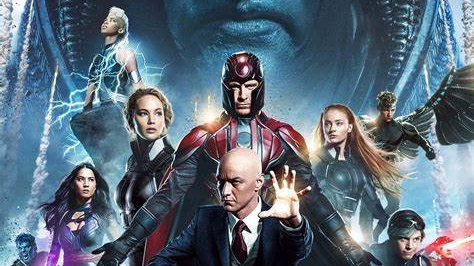
Apocalypse, also known as En Sabah Nur, is the brainchild of writer Louise Simonson and artist Jackson Guice. He debuted in X-Factor #5 in 1986, making his grand entrance into the realm of comic books.
Hailing from ancient Egypt, Apocalypse stands as one of the earliest mutants. His extraordinary powers and long life are derived from extra-terrestrial technology and celestial meddling, setting him apart as a formidable force in the comics world. He subscribes to the “survival of the fittest” philosophy, aiming to transform the world by eliminating the weak. He regards himself as a deity, which only adds to his enigmatic presence.
With immortality on his side, Apocalypse has been a silent witness to centuries of history, subtly steering events from the shadows. His physique is an amalgamation of mutant prowess and alien tech, endowing him with vast strength, the ability to change form, and control over energy. He’s known for assembling mutants into his Four Horsemen, boosting their abilities and ensuring their devotion, highlighting his tactical acumen and manipulative skills.
As a frequent foe, Apocalypse consistently tests the X-Men in numerous narratives. His schemes are often apocalyptic in nature, like the Age of Apocalypse saga, reflecting his grandiose ambitions and readiness to push boundaries. His influence permeates beyond his direct confrontations; his deeds have a lasting impact on mutant kind’s saga, cementing his status in X-Men mythology.
On the small screen, Apocalypse took centre stage as a prime adversary in X-Men: The Animated Series, with John Colicos’ voice lending a chilling touch. He re-emerges in the season one finale of X-Men ’97, hinting at a more significant part in the following season. He also appears in X-Men: Evolution and Wolverine and the X-Men, with the latter series ending just as it was set to bring the notorious Age of Apocalypse to television. His recurring roles in these series underscore his influence and enduring appeal among viewers.
In X-Men: Apocalypse, the character of Apocalypse is introduced as the original mutant, emerging in the 1980s with Oscar Isaac bringing him to life. While the movie streamlines his complex origin story, it retains his divine ambitions. This adaptation highlights the evolution of his character on the silver screen.
Apocalypse emerges as a multifaceted, legendary entity within the X-Men lore, embodying both destruction and progress. His presence echoes through various forms of media, cementing his status in the lore of mutants. Continually fascinating viewers, Apocalypse remains an unforgettable force within the X-Men narrative.
In the year 3600 BC, En Sabah Nur, an ancient and powerful mutant, reigned over Egypt. During a ritual to transfer his consciousness into a new body and acquire its regenerative abilities, he and his loyal Horsemen of Apocalypse were treacherously overthrown. His disciples perished, and he was buried alive.
Fast forward to 1983, when Scott Summers discovers his ability to emit powerful energy beams from his eyes. His brother Alex brings him to Professor Charles Xavier‘s school, where Xavier and Hank McCoy are expected to help Scott control his newfound powers. There, Scott encounters Jean Grey, a fellow mutant with telepathic and telekinetic abilities, sparking a mutual fascination.
Meanwhile, in Egypt, worshippers resurrect En Sabah Nur. He encounters Ororo Munroe, a mutant with the power to manipulate weather. As he learns about the modern world, En Sabah Nur decides to reshape it, believing it has gone astray. Munroe joins his cause, her abilities amplified by his power.
In the shadowy corners of East Berlin, the shape-shifting mutant known as Raven uncovers the existence of Kurt Wagner, a remarkable mutant with the ability to teleport. She enlists the help of the underground dealer Caliban to smuggle Kurt to the safety of America. Meanwhile, the ancient and powerful En Sabah Nur is gathering his forces, enhancing the abilities of mutants like Psylocke and Angel to serve his dark agenda.
On the other side of the Iron Curtain, in the heart of Communist Poland, Erik Lehnsherr leads a contented life with his family, far from the chaos of his past. But when global upheaval triggered by En Sabah Nur’s actions forces Erik to reveal his powers, the Polish authorities take notice. A tragic confrontation in the forest, meant to exchange Erik’s freedom for his daughter’s safety, goes horribly wrong. The sudden manifestation of his daughter’s mutant abilities leads to a deadly misunderstanding, resulting in the loss of his family. Overcome with grief, Erik exacts vengeance on those responsible.
En Sabah Nur reveals his true power to Erik at Auschwitz, leading to Erik’s allegiance with him. The plot thickens as En Sabah Nur hijacks Cerebro and coerces Xavier into a global nuclear disarmament. Chaos ensues when the Four Horsemen abduct Xavier, and an attempt to save him by Alex results in a catastrophic explosion at the mansion. Peter Maximoff arrives just in time to rescue the inhabitants with his super-speed, but tragically, Alex perishes. Meanwhile, Colonel William Stryker detains Hank, Raven, Peter, and Moira MacTaggert, only for Scott, Jean, and Kurt to mount a daring rescue with the help of Weapon X (Wolverine), whose memories Jean begins to restore.
The stakes are higher as Erik manipulates the Earth’s magnetic field, wreaking havoc worldwide. En Sabah Nur’s sinister plan to possess Xavier’s psychic abilities unfolds. In response, Xavier sends out a desperate telepathic SOS, prompting Jean and the team to confront En Sabah Nur and his Horsemen in Cairo. After a fierce battle, they manage to save Xavier and escape by plane. However, their victory is short-lived as Angel and Psylocke launch an aerial assault. In a tense moment, Nightcrawler manages to teleport the team to safety, while Psylocke escapes unharmed. Angel, however, meets his fate in the ensuing plane crash.
Erik and Ororo switch sides to confront En Sabah Nur. With Scott’s assistance, they engage him in a fierce physical battle, while Xavier launches a simultaneous telepathic assault in the astral plane. In a desperate plea, Xavier calls upon Jean to tap into her vast powers, resulting in her obliterating En Sabah Nur. Meanwhile, Psylocke seizes the moment to slip away. Amidst the chaos, Xavier and Moira find their way back to each other, rekindling their romance. The school begins to rebuild with Erik and Jean at the helm, yet Erik declines Xavier’s invitation to stay on as a teacher. Peter harbours a secret, choosing not to reveal to Erik that he is his son. In a bold move, Hank and Raven utilize seized Sentinels to train the next generation of X-Men, including Scott, Jean, Ororo, Kurt, and Peter, heralding a new era for the team.
Some time later, men in black suits visit the Weapon X facility to retrieve an X-ray and a blood sample marked “Weapon X” on behalf of the Essex Corporation.
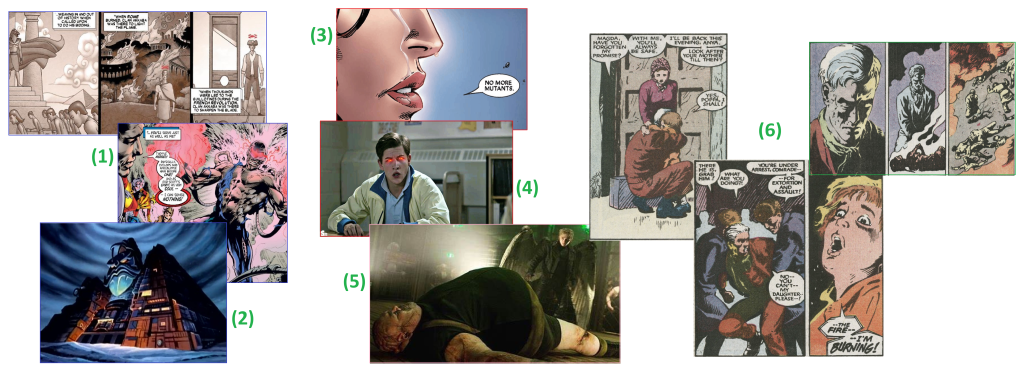
(1) In the film, Apocalypse aims to transfer his consciousness into another mutant, thereby acquiring their abilities. This plot point echoes the events from the Adventures of Cyclops and Phoenix mini-series and is further developed when he takes over Cyclops’ body in The Twelve. Apocalypse’s plan includes targeting Charles for this transfer. Charles, maintaining continuity with the first movie, provides the opening narration.
(2) Apocalypse’s temple bears a striking resemblance to the Lazarus Chamber featured in the X-Men episode of the same name.
(3) The film introduces ‘M-Day’, a day celebrated worldwide, marking the anniversary of Magneto’s assault on Washington as depicted in X-Men: Days of Future Past. However, in the comic book world, M-Day refers to the catastrophic event when nearly all mutants lost their powers overnight.
(4) Scott’s powers emerge while he is at school, a detail that aligns with his backstory in X-Men Origins: Wolverine.
(5) In the altered timeline, The Blob, Angel, and Nightcrawler appear to have been born earlier. The Blob is glimpsed fighting in a German cage match, while Kurt’s origins remain tied to the Munich circus, consistent with X2.
(6) In the comic books, Erik Lehnsherr led a tranquil life with his spouse Magda and their offspring Anya. Tragedy struck when soldiers, suspecting Erik, declined to aid Anya during a house fire, leading to her demise and the emergence of Magneto. A terrified Magda fled, later giving birth to the twins Wanda and Pietro, also known as Peter. The origins of this narrative are traced back to Classic X-Men #12.
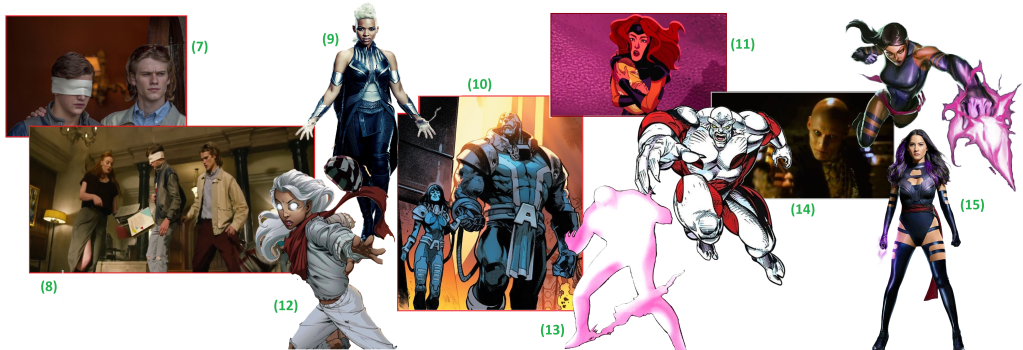
(7) Within this particular narrative, Alex and Scott find themselves adopted together, a scenario not paralleled in the comic series. Contrary to the films where Scott is portrayed as the youngest, other adaptations present him as the eldest sibling. The parental figures depicted are likely foster parents, with their father not resembling the space pirate he is in other stories.
(8) Scott Summers’ initial encounter with Jean Grey, set in a school corridor, is also an event exclusive to the X-Men ’97 continuity, absent from the comic book pages.
(9) Ororo Munroe, recognized as Storm, graces the screen throughout the film, yet her name is never explicitly mentioned. Following the intervention of Apocalypse, her hair transforms to a stark white.
(10) Moira MacTaggert, maintaining her undercover guise from X-Men: First Class, inadvertently unleashes Apocalypse by exposing his tomb to sunlight. This act raises questions about her intentions, as in one of her comic book lifetimes, she deliberately freed him and aligned with his ambitions.
(11) Jean and Charles’ vision of impending destruction has a similar counterpart in X-Men ’97‘s To Me, My X-Men, where ‘Jean’ foresees the fate of Genosha.
(12) Ororo is depicted as a street thief in Cairo, where Charles Xavier first encounters her in a flashback in Uncanny X-Men #117.
(13) Moira is well-versed in Xavier’s works and appears to be an expert on mutation, possibly due to her son Kevin, who is the powerful mutant Proteus in the comics.
(14) Caliban possesses the ability to track other mutants. He has also served as one of the Horsemen of Apocalypse on several occasions.
(15) In this film, Psylocke, portrayed as Kwannon, works as a mercenary. Despite her comic-book accurate appearance and powers, her background remains largely unexplored, contributing to the frustrating complexity of the X-Men‘s extensive cast.
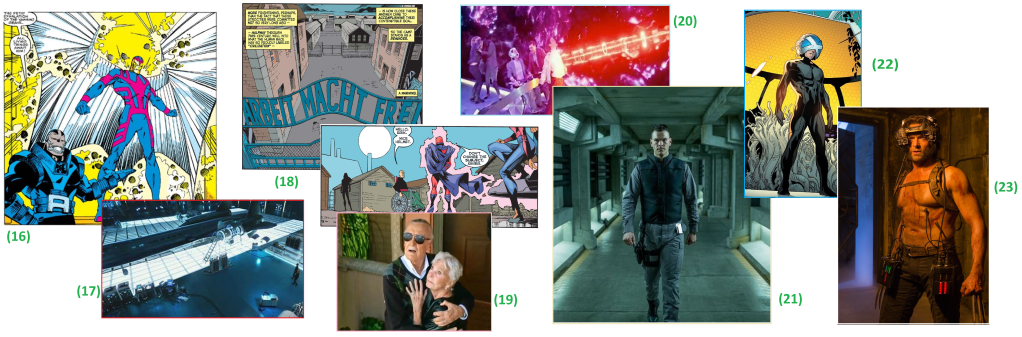
(16) Angel’s struggle with depression is depicted after his wings sustain damage. In the comic series, his wings were surgically removed following an injury, and Apocalypse replaced them with techno-organic ones, a transformation also portrayed in the Come the Apocalypse episode of X-Men. During these scenes, blue markings emerge on his face, and the lighting renders his skin a comic book-like blue.
(17) Beast, the creator of the Blackbird and its launch hatch, faces the task of rebuilding it, as the jet is frequently destroyed in the X-Men ’97 series as well as here.
(18) Magneto experiences flashbacks to earlier X-Men days and X-Men: First Class upon revisiting Auschwitz, where he also encountered Charles Xavier just before the formation of the X-Men, in X-Men #-1.
(19) Stan Lee and his wife Joan are seen during the nuclear weapons launch.
(20) Alex survives a similar explosion in X-Factor #149 that initially suggests his demise.
(21) Mystique’s last appearance showed her impersonating Stryker at the conclusion of X-Men: Days of Future Past, leading to his pursuit of Raven in this film and the subsequent detainment of mutants at Alkali Lake, as seen in X2.
(22) Xavier conveys a unique message to the world using Cerebro in the House of X series.
(23) Wolverine’s cameo features a re-enactment of his escape from the Weapon X facility, enhanced by Jean Grey’s intervention, although he is absent from X-Men: Dark Phoenix.
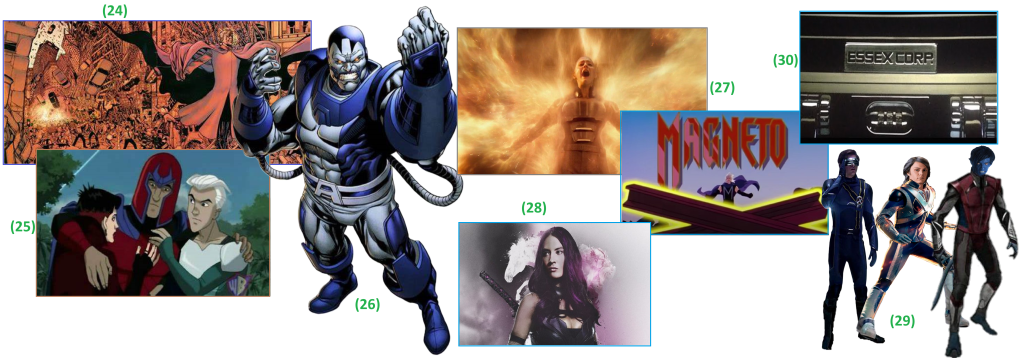
(24) Erik’s manipulation of the planet’s magnetic field, causing global devastation, mirrors his actions in the Planet X storyline, notably affecting the bridge in New York.
(25) Peter is aware that Magneto is his father, a revelation made between films, while Erik remains oblivious by the film’s end. In the comics, their relationship is even more complex, with initial unawareness followed by a false confirmation of their connection.
(26) During Charles’s psychic plane duel with Apocalypse, the latter morphs to increase his size, as is his ability in the comics.
(27) Jean Grey’s display of power, marked by the emergence of a Phoenix raptor, teases the Phoenix Force’s recognition of her, setting the stage for X-Men: Dark Phoenix. The ‘X’ symbol Magneto forms with the girders is echoed in his title card in X-Men ’97.
(28) Apocalypse’s reaction to the Phoenix’s revelation is one of apparent relief, though the reasons remain undisclosed. Psylocke’s departure from the scene is marked by a piercing glare, raising questions about Apocalypse’s potential transfer to another powerful mutant in proximity.
(29) Erik’s remark about Charles’ nocturnal preoccupations with the safety of his ‘children’ echoes a conversation from the climax of the inaugural X-Men film. The X-Men don comic-accurate attire as they confront Sentinels in the Danger Room.
(30) A post-credits sequence reveals covert operatives from Essex Corporation collecting Wolverine’s blood, likely foreshadowing events in Logan. Yet, the enigmatic ‘Essex’ lingers as a sinister enigma.
THE HORSEMEN OF APOCALYPSE
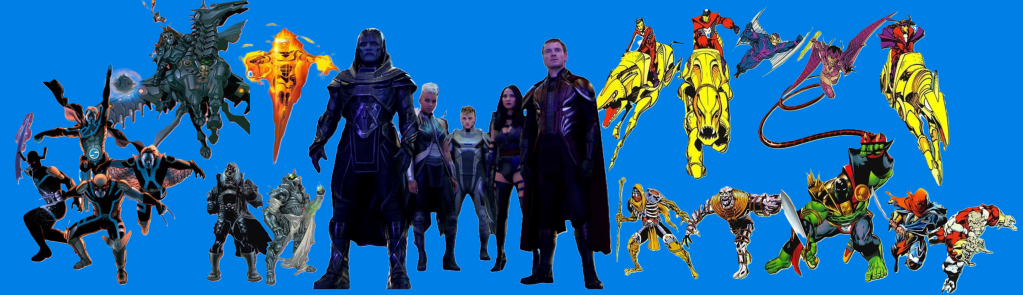
The Horsemen of Apocalypse, notorious supervillains in Marvel Comics, are led by the ancient mutant known as Apocalypse and are inspired by the Biblical Four Horsemen. They boast a storied history within the comics and have made the leap to the silver screen, albeit with some notable differences from their print counterparts.
First introduced in X-Factor #10 in 1986 and debuting fully in issue #15 the following year, the original Horsemen were revealed to be based on Apocalypse’s own offspring, each representing War, Famine, Pestilence, and Death. This twist on the biblical harbingers brought a fresh dynamic to their comic book incarnation.
Over the years, the Horsemen’s line-up has grown to include various mutants, some of whom are household names like Angel, Wolverine, and Gambit. These additions have enriched the narrative, offering complex character arcs as they struggle with their Horsemen identities.
In the cinematic portrayal, Apocalypse assembles a new team: Magneto as War, Storm as Famine, Psylocke as Pestilence, and Angel as Death. Despite deviations from the source material, the films retain the essence of the Horsemen as Apocalypse’s powerful enforcers.
Differences between the comic and film Horsemen are evident, particularly in their visual representation and backstory. The movies opt for a simplified approach, focusing on popular characters such as Magneto and Storm, likely to capitalize on their fan appeal.
The comics continue to explore the Horsemen in greater depth, delving into their complex origins and intricate relationships, offering a richer narrative tapestry for fans to enjoy.




 X-Cess Minutiae
Leave a comment