


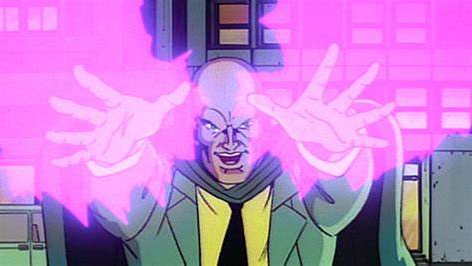

In the gripping second chapter of the Phoenix Saga, we plunge headfirst into a world of psychological intrigue. Professor Charles Xavier unwittingly becomes the epicentre of chaos when a psychic probe unleashes his shadow self – a sinister manifestation that threatens the X-Men’s very existence. As they grapple with this unforeseen menace, the team confronts not only external adversaries but also their own inner struggles.
Wolverine, in particular, battles primal instincts, mirroring the broader conflict within him. The X-Men’s unity is put to the test as they navigate the fallout from this psychic apparition. Trust, dialogue, and collective support become their lifelines.
Amidst the psychic showdown, a powerful theme emerges: in a world rife with conflicts, mutants must stand together – accepting their flaws and embracing unity.
Jean Grey, having volunteered to pilot the stolen X-Men shuttle through a radiation storm, is on the brink of death when the Phoenix Force emerges in the cockpit, saving her. She manages to land the shuttle in New York’s East River. As the shuttle begins to sink and water floods in, Wolverine creates an escape route for the team. Surfacing, they witness Jean, donning a new costume, rise from the water declaring herself as the Phoenix before collapsing into a coma.
At the hospital, Jean regains consciousness with no recollection of the Phoenix or the recent events. Meanwhile, Beast encounters Cyclops and Professor X in a heated debate over the mission. Post-argument, as the Professor departs for the mansion, he’s struck by a mysterious energy, rendering his body lifeless and unleashing an evil astral form. This malevolent Xavier confronts Wolverine in the subway, tricking him into battling illusions of his foes until Logan discerns the truth.
Elsewhere, Gambit and Jubilee are ambushed by the astral Xavier while queuing for a movie. Storm intervenes, and a battle ensues. Realizing they’re the only ones who can see this adversary, the X-Men flee to avoid arrest for the chaos caused. The astral Xavier later confronts Jean and Cyclops at the hospital, but Jean, detecting its true nature, repels it with a psychic blast. Upon locating the real Xavier, the team learns that his darker persona has attained consciousness.
In the midst of these events, footage of the team is captured and transmitted to Eric the Red, stationed on a spacecraft encircling Earth. Driven by a quest for answers, Xavier sets course for Muir Island to rendezvous with Moira MacTaggert and her companion, Sean Cassidy. Attempting to connect with the enigmatic psychic presence beckoning him, Xavier’s call is answered by Lilandra Neramani, who materializes before him. She unveils the peril posed by the M’Kraan Crystal. However, their exchange is abruptly interrupted as Juggernaut bursts into the room…

In Classic X-Men #8, the Phoenix entity is granted permission to possess Jean, leading to a transformation where Jean’s true form is left to recuperate in a cocoon beneath Jamaica Bay. The narrative takes a different turn in the animated series, portraying the event as a form of cosmic possession, likely a creative twist to alter the finale. The film X-Men: The Last Stand interprets it as a manifestation of mental health issues, bordering on a personality disorder.
The collision of the shuttle with the Chrysler Building must have been a source of great irritation for Wilson Fisk, as it’s known as the Kingpin’s headquarters in the Spider-Man series.
The iconic scene of Jean emerging from the water, reborn and declaring herself as the Phoenix, originates from Uncanny X-Men #101.
In this episode, Beast dons a shirt featuring Howard the Duck and delivers some of the best lines, such as “The capsule appears to have lost its watertight integrity,” which is particularly amusing as gallons of water pour past. His two perfectly timed “Fascinating” interjections and a downbeat “Science can wait” also elicit smiles.
The Dark Shroud story arc is taken straight from issue Uncanny X-Men #106. Wolverine experiences illusions of Yuriko (from Out of the Past), Sabretooth (last seen in Cold Vengeance), and a conspicuously quiet Deadpool.
Eric the Red observes the X-Men from afar, replicating his actions in Uncanny X-Men #104, among others.
A FOX network poster, the broadcaster of the show, is visible in an alleyway.
Lilandra’s helmet reveal and the unveiling of her face are derived from Uncanny X-Men #105. Her flashbacks mirror Xavier’s dreams in Sacrifice and Uncanny X-Men #97.
PROFESSOR XAVIER IS A JERK?
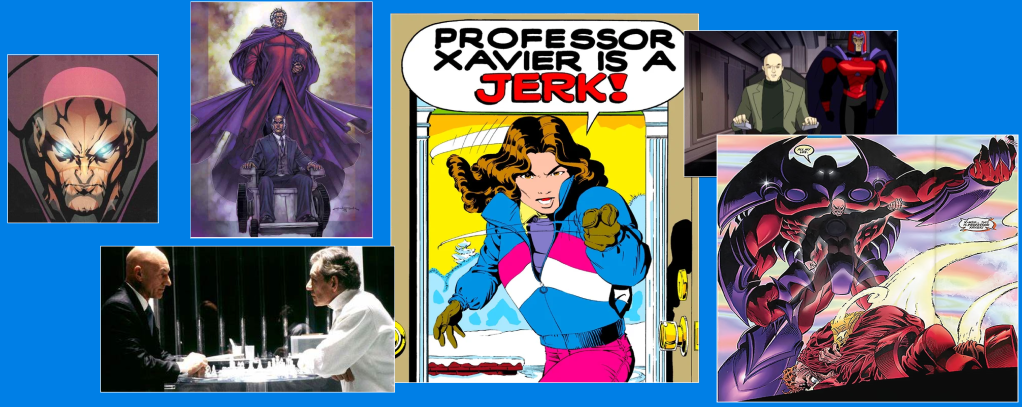
Charles Xavier, the visionary founder of the X-Men and the Xavier School for Gifted Youngsters, stands as a paragon of complex morality in the Marvel Comics universe. His steadfast dedication to fostering peaceful relations between mutants and humans distinguishes him from his old friend and rival, Erik Lehnsherr, also known as Magneto. Xavier champions the use of mutant powers for the betterment of humanity, while Magneto veers towards self-preservation, dominance, and at times, supremacy.
The bond between Xavier and Magneto was forged during their time working together at an Israeli psychiatric hospital, caring for Holocaust survivors. Despite sharing an interest in mutants, their opposing ideologies often led to heated debates. Xavier believed in a harmonious coexistence of humans and mutants, while Magneto favoured mutant supremacy. Their alliance was tested when Gabrielle Haller, a patient, was kidnapped by Baron Von Strucker and Hydra. They joined forces to rescue her, revealing their powers to each other in the process. However, Magneto’s disillusionment with humanity deepened after the mission, leading him to sever ties with Xavier and begin his anti-human campaign, culminating in the establishment of his space station, Asteroid M.
The escalation of tensions led Magneto to declare war on humanity, prompting clashes with the X-Men, led by Charles Xavier. During a critical battle, Xavier’s telepathic assault incapacitated Magneto, inadvertently creating Onslaught, a malevolent psychic force. Onslaught’s brief possession of Xavier caused chaos, threatening the existence of mutants. To quell this menace, the X-Men and other heroes had to collaborate. The fallout from Onslaught’s destruction heightened anti-mutant sentiments and persecution.
Onslaught’s emergence warns of the dangers inherent in pushing mutant powers beyond their limits. Xavier’s well-intentioned yet sometimes dubious actions echo in a society where mutants seek both acceptance and equality.
Xavier’s ethical certainty is not absolute. His conviction in knowing what is best for all leads to morally grey choices. The relationship between him and his son, David Haller, or Legion, is a complex mix of conflict and collaboration. Legion’s struggle with dissociative identity disorder complicates their interactions, leading to both destructive and heroic deeds. A touching instance occurs when Xavier, observing the psychic sanctuary Legion crafted for mutants, acknowledges pride in his son but also regrets their estrangement. However, Xavier’s scheming tendencies and cynicism lead to a betrayal that renders Legion almost catatonic from a psychic virus. Nonetheless, their bond is a pivotal element of their stories.
Moreover, Xavier has wiped memories of his own existence to protect secrets and individuals. Although his motives are usually well-intentioned, the act of memory manipulation brings up ethical concerns. The question arises: is it justifiable to modify someone’s memories without their permission? Xavier contends with this issue, attempting to weigh the benefits to society against the rights of the individual. His capacity to alter memories highlights the intricate interplay of power, duty, and ethics within the realm of mutants. As with any potent tool, Xavier’s choices have the potential to forge futures or burden the consciences of those involved.
The Phoenix Saga (Part 1): Sacrifice | The Phoenix Saga (Part 3): Cry of the Banshee




 X-Cess Minutiae
Leave a comment