


Few episodes of X-Men: Evolution capture the shifting tides of human-mutant relations as starkly as Uprising. With the revelation of mutants to the general populace, fear spreads rapidly — not just of individuals with extraordinary abilities, but of the apocalyptic vision associated with the recently thwarted threat of Apocalypse himself. That fear is visceral, immediate, and deeply unsettling, leading to societal fractures that escalate with terrifying speed.
Humanity’s instinct for self-preservation manifests in the worst ways. SHIELD, despite having previously arrested Bolivar Trask, suddenly sees the Sentinel Program as a necessary safeguard and releases him to spearhead its revival – a decision that history has repeatedly proven will only end in disaster. And while institutions scramble to fortify their defences, individuals take matters into their own hands, abandoning reason for violence.
One of the most shocking transformations comes from Duncan Matthews, the former jock whose biggest concerns once revolved around high school popularity and his pursuit of Jean Grey. Now, he is an armed aggressor, driven by a fanatical hatred for mutants, willing to fire upon a child without hesitation. His fall from trivial rival to full-blown extremist is chilling in its rapid escalation – a consequence, perhaps, of the show’s shorter season, but no less effective in highlighting the dangers of unchecked prejudice.
The episode does not shy away from painful truths. The laundromat scene, where an entire crowd turns on a child simply for looking different, captures the raw intensity of discrimination. Even when informed that the boy is not a mutant, the hostility does not subside, fueled further by Evan’s defiant presence. Evan himself quietly reinforces another layer of societal reflection – despite being refused service, he still leaves payment for his items. Whether this moment carries additional racial allegory given his transformation is open to interpretation, but it remains a striking detail nonetheless.
As Uprising unfolds, the distinction between fear and outright terrorism becomes clear. Duncan and his allies may face arrest, but the damage is done – an entire community has revealed how easily it will turn against those it does not understand. In its commitment to mature storytelling, X-Men: Evolution delivers one of its most harrowing narratives, forcing viewers to confront just how quickly society can shift when fear dictates its course.
Following Apocalypse’s emergence, humanity’s fear of mutants spirals into open hostility. In Bayville, young Dorian Leech struggles with unexplained headaches while his mother dismisses his concerns. Meanwhile, tensions reach a boiling point at a grocery store when Spyke is denied service for making the customers uncomfortable. As he leaves, a woman urges him to take Dorian with him, exposing the child to the mob’s growing aggression. Even after his mother insists that Dorian is not a mutant, the crowd refuses to relent, forcing Spyke to intervene and create an escape route.
While the situation in Bayville deteriorates, Duncan Matthews takes advantage of rising paranoia, turning his personal vendetta against mutants into full-blown violence. Armed with electric weapons, he and his friends bomb the sewers, targeting Spyke and the Morlocks. Their attacks nearly hit Spyke directly, pushing him to retaliate and chase them through the streets. The battle leads to an abandoned building, where Duncan’s group attempts to corner Spyke, only for Callisto and the Morlocks to emerge and stand beside him. The confrontation escalates as the X-Men, alerted by Cerebro, arrive to intervene.
With Cyclops deflecting Duncan’s attacks and Jean, Wolverine, and Storm subduing his allies, the fight quickly turns against the aggressors. Jean confronts Duncan directly, overwhelming him with a psychic blast as police helicopters arrive. Dorian watches the events unfold, unknowingly placing himself in danger. Duncan fires at him, but Spyke blocks the shot, shielding the child. In that instant, an unforeseen phenomenon occurs – Bayville loses all power, mutant abilities suddenly cease, and even the X-Men’s technology fails.
Spyke’s mutation temporarily reverts, Jean falls from the air, Scott’s visor malfunctions, and the Velocity stalls mid-flight. Dorian collapses, but Spyke catches him, reassuring him that his headaches have stopped. His mother arrives, horrified, as the truth becomes clear Dorian’s mutation suppresses energy, nullifying mutant powers. Though relieved that his suffering has ended, his mother remains furious that his abilities have been exposed. As Duncan and his allies are arrested, the fragile balance between mutants and humans grows ever more uncertain.
With the immediate conflict resolved, Storm urges Spyke to return to the Institute, but his duty lies with the Morlocks. Proud of his conviction, Storm watches as he disappears into the tunnels, leaving the surface world behind. Later, outside the Leeches’ apartment, Professor Xavier approaches Dorian’s mother, offering sanctuary when the time is right. He leaves his contact information, knowing that in a world driven by fear, Dorian’s journey has only just begun.
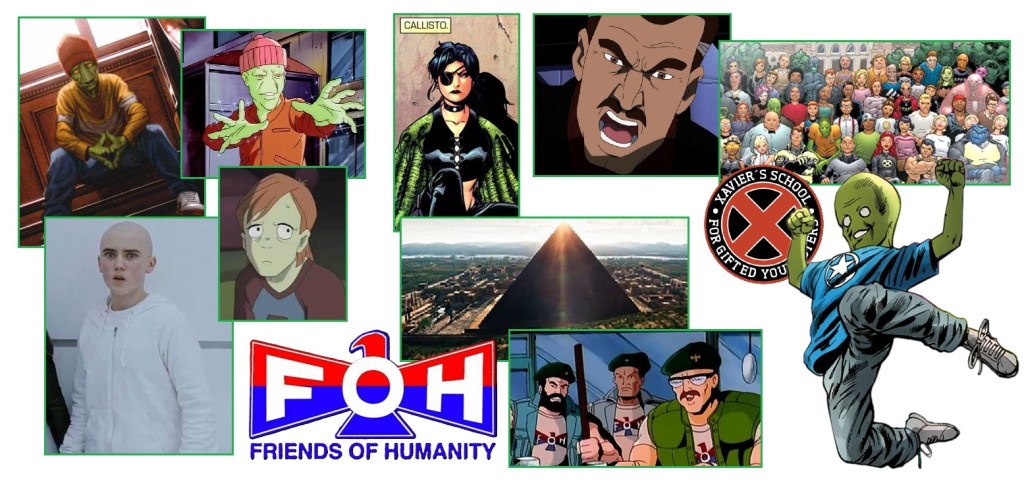
At the of the episode, Dorian’s surname is revealed to be Leech. His green skin and power-dampening abilities confirm him as this series’ take on the Morlock Leech, though with a reimagined appearance. The original Leech first appeared in the X-Men episode Captive Hearts but was later killed by the Tri-Sentinel in X-Men ’97‘s Remember It. Additionally, Jimmy from X-Men: The Last Stand was also inspired by this character, with his abilities in film the source of “the cure.”
Beast mentions that the pyramids encased within the domes are identical to those from 3000 BC, echoing his statement in X-Men’s Beyond Good and Evil (Part 3).
Duncan and his friends now have more in common with X-Men‘s Friends of Humanity than the jocks they have been portrayed as up until now.
Trask has been in SHIELD custody since his Sentinel protype ran amok in Day of Reckoning (Part 2).
The Xavier Institute remained private to the public for much of the X-Men’s existence until New X-Men in 2001. The school became a public school for mutants and, alas, protestors at the gates, such the ones seen in this episode, became more common, such as in New X-Men #118.
Callisto’s relationship with the young Morlock girl is similar to her protectiveness over the X-Man Marrow in the comics (See Box Out).
Unlike his comic book counterpart, this version of Leech can absorb all energy, including electrical, which makes him even more powerful. The comic book version, and other onscreen counterparts, only have him disrupt mutant abilities – an awfully strange mutant ability to have.
BAD TO THE BONE!
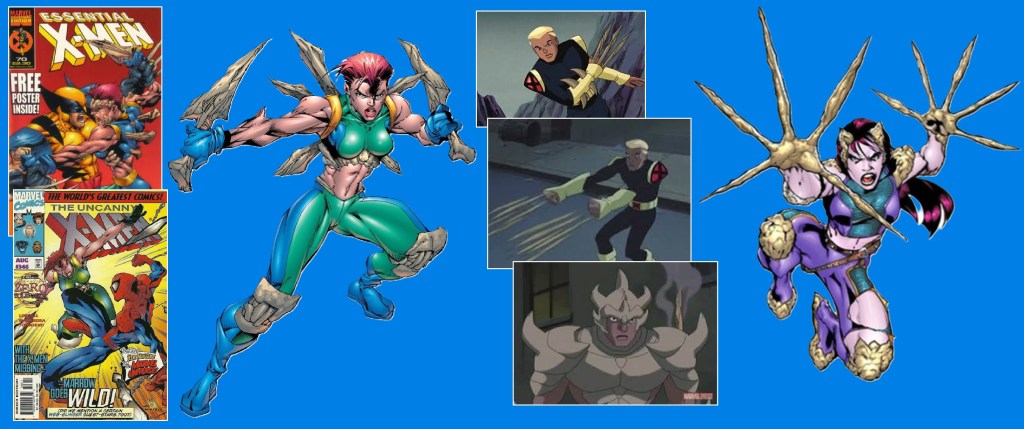
Marrow, the bone-wielding mutant with a turbulent past, has had one of the most fascinating arcs in X-Men comics. Created by Jeph Loeb and David Brewer, she first appeared as a child in Cable #15 (1994) before making her full debut as an adult in X-Men Prime (1995). Raised among the Morlocks, Marrow’s mutation caused painful, uncontrollable bone growths, making her appearance grotesque by human standards. Her early life was defined by hardship, witnessing the horrors of the Mutant Massacre and later being thrust into Mikhail Rasputin’s brutal survivalist society. By the time she returned to Earth, she had become the leader of Gene Nation, a militant faction determined to make humanity suffer for its treatment of mutants.
Marrow’s initial characterization was aggressive and unstable. She clashed with the X-Men, particularly Storm, whom she blamed for failing to protect the Morlocks. Her violent tendencies made her a difficult ally, but over time, she began to soften. Under the X-Men’s guidance, she learned to control her powers, though her journey was far from smooth. She eventually left the team, later resurfacing in various roles, including as a member of Weapon X and S.H.I.E.L.D. Despite her rocky history, Marrow has found a degree of stability in recent years, proving that even the most volatile mutants can evolve.
Her story bears striking similarities to Evan Daniels, aka Spyke, from X-Men: Evolution. While Evan was created specifically for the animated series, his arc mirrors Marrow’s in several key ways. Both characters developed mutations that caused painful bone protrusions, making them visibly different from other mutants. Both struggled with resentment toward humanity, feeling rejected and alienated due to their appearances. And both, at their lowest points, lashed out – Marrow through Gene Nation’s terrorist acts, and Spyke through his aggressive defense of the Morlocks.
Spyke’s transformation in X-Men: Evolution is particularly telling. Initially a confident, athletic teenager, his mutation spiralled out of control, forcing him into exile. Like Marrow, he found refuge among the Morlocks, embracing his role as their protector. His decision to remain underground rather than return to the X-Men mirrors Marrow’s own struggles with identity and belonging. While Marrow eventually rejoined the X-Men after years of instability, Spyke’s fate remained tied to the Morlocks, reinforcing the idea that his character was heavily inspired by her.
The parallels between Marrow and Spyke suggest a deliberate attempt to adapt her narrative for a younger audience. While Marrow’s story in the comics is darker and more violent, Spyke’s arc follows the same emotional beats – mutation as a curse, rejection by society, anger-fueled rebellion, and eventual acceptance of his role. Whether intentional or not, Spyke serves as a more accessible version of Marrow, bringing her themes of struggle and redemption to a new generation of X-Men fans.




 X-Cess Minutiae
Leave a comment