


“The Evolution is upon us.”
Mesmero’s words may have been about Apocalypse, but as X-Men: Evolution reaches its finale, they take on an ironic weight. The series, once rooted in high school drama with superpowers on the side, has transformed into something far greater. It changed. It grew. It evolved.
In its early days, it was about teenagers navigating crushes, bad hair days, and social struggles – just with mutant abilities thrown into the mix. Kitty stressing over her hair, bullying, vanity – it all felt real because it was real. By season two, those same kids had become mentors, guiding the next generation. The stakes kept rising. By season four, the tension had boiled over, setting the stage for all-out war.
And none of it came out of nowhere. X-Men: Evolution built its narrative brick by brick, episode by episode, refusing to stay stagnant. It understood that real growth means real consequences. This wasn’t the endless reset loop of Saturday morning cartoons – characters changed, matured, carried their histories forward.
Fifty episodes later, these young mutants aren’t just students anymore – they’re adults, ready to take on the world. And for long time fans who remember the formulaic repetition of the ’80s, X-Men: Evolution was a breath of fresh air. Stories moved. Stakes mattered. Growth wasn’t just hinted at – it was woven into the very DNA of the show.
Because X-Men: Evolution never just gave us mutant teenagers. It let us watch teenage mutants grow up. And that, more than anything else, is what makes it the cream of the crop.
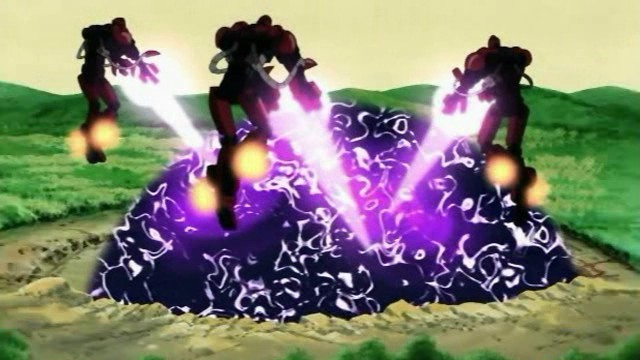
The countdown to Apocalypse’s ultimate vision begins. Across Egypt, three immense energy domes form around ancient structures, including an Egyptian pyramid and the Sphinx, as Apocalypse prepares the final phase of his plan – to force evolution upon the entire human race, mutating them whether they survive or perish in the process.
The X-Men, desperate to uncover his intentions, seize Mesmero, demanding answers. The reluctant servant reveals the chilling truth: Apocalypse is not seeking conquest – he is rewriting existence, reshaping the planet in his image. Professor Xavier and Storm, believing diplomacy may be the only option, depart for Egypt, seeking reason amid impending chaos. But moments after their arrival, Apocalypse seemingly erases them from existence, leaving the team stunned.
At the mansion, Nick Fury arrives with urgent news – the government has deployed Sentinels in a last-ditch effort to stop Apocalypse and dismantle his domes before irreversible damage spreads. But Apocalypse is ready. He sends his Horsemen – Magneto, Mystique, Storm, and Xavier – to intercept the mechanical army. To the X-Men’s shock, their fallen allies are alive, but no longer themselves. Their power and conviction belong to Apocalypse now.
The battle is ruthless. The Horsemen annihilate the Sentinels, proving their mastery over combat and destruction, but not before the domes themselves are obliterated. With the battlefield shifting and their former mentors standing against them, the X-Men rally their forces, calling on the New Mutants and all available allies.
The team splinters into four strike squads, each designated to face a different Horseman, determined to restore their lost leaders and end Apocalypse’s reign before evolution turns into extinction.
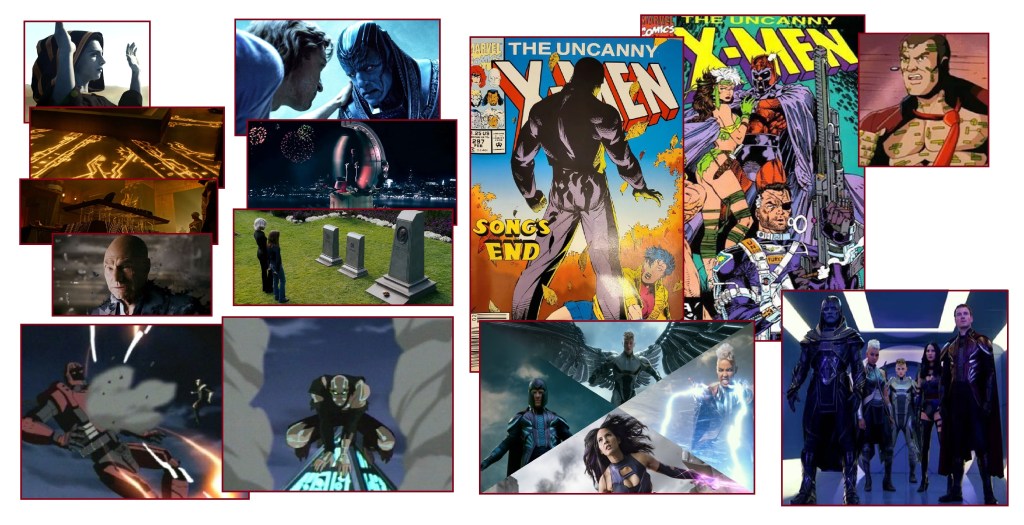
Apocalypse uses his Celestial tech to move his pyramids and technology around – just as he would later do on the big screen in the post credits scene of X-Men: Days of Future Past.
Some of the Charles versus Apocalypse scenes in this episode seem to be a direct inspiration for a similar battle in the movie X-Men: Apocalypse.
There are similarities between Apocalypse’s plan to activate dormant X-Genes and Magneto plan to change humanity in 2000’s X-Men.
Charles and Storm are believed dead when they disappear. The Professor was also ‘killed’ in front of his students in X-Men: The Last Stand.
Nick Fury and his antagonistic relationship with the X-Men is similar to his role in Chris Claremont’s final story arc from X-Men #1-3 in 1991, as well as the parallel universe tales from X-Men: Forever.
Three out of the four Horsemen in this episode are also chosen as Apocalypse’s Horsemen in X-Men: Apocalypse. The shapes on their faces are the markings of the techno-organic virus, also similar to the patches on victim’s skin in Time Fugitives (Part 1) and (Part 2) from X-Men the animated series. Apocalypse is the villain on both occasions.
As a Horseman, Charles regains the use of his legs. In Uncanny X-Men #297, recovering from techno-organic infection, Charles, temporarily, could walk unaided. His psychic bolts used in this episode are similar to Psylocke’s comic book psychic knives or bolts – bolts Psylocke herself used as a Horseman in X-Men: Apocalypse!




 X-Cess Minutiae
Leave a comment