


It opens with a television spat. Ben Grimm wants Frankenstein. Johnny rolls his eyes. What seems like harmless bickering soon pulls back the curtain on something bigger. Frankenstein is no throwaway choice. It’s literature’s most enduring riddle: Who is the monster, and who is the man? And in Ben Grimm – the Thing – we find Marvel’s answer walking in rocky skin, bruised by his own transformation. This question was explored brilliantly in the classic This Man, This Monster (Fantastic Four #51) – where Ben’s identity and inner worth were put to the test in the shadow of scientific envy.
But here, that same question is reborn at cosmic scale.
Galactus arrives – not with malice, not with vengeance. Merely with hunger. He says it plainly: he has no wish to harm any species. But he must eat. He exists to survive. Just like us. The moral calculus shifts. This isn’t good versus evil. It’s life versus life.
The Watcher’s haunting question pierces the episode’s core: “Do you greet the cockroaches on your kitchen floor?” It’s unsettling. It’s intimate. And it holds a mirror to the audience, asking us to consider the value of life beyond personal context. How many of us kill without reflection? Smash bugs. Swat flies. Flush spiders. Would Galactus see us the same way?
It’s a staggering question to ask in a cartoon designed for Saturday mornings. But that’s what Lee and Kirby always understood – the best hero stories are morality tales wearing capes.
Galactus isn’t a monster. He’s a force. And in this episode, the Fantastic Four confront something not just powerful – but unknowable. We’re not fighting evil. We’re negotiating with scale. With instinct. With the uncomfortable truth that survival – ours or his – comes at a price.
So yes, who is the monster?
And perhaps more pressingly – are we brave enough to ask?
Johnny and Ben squabble over the TV in typical fashion – until it breaks. At Reed’s lab, the repair attempt is side-lined when Reed detects a new energy signature eerily similar to the cosmic rays that gave them their powers. Then the skyline ignites – flames rippling across Manhattan’s rooflines like the city itself is combusting.
As Johnny rockets through the blaze, New Yorkers panic. Whispers rise: is he to blame?
Back at the Baxter Building, Reed isolates himself, analysing the anomaly. The flames vanish… replaced by a silent debris field that blankets the heavens. The sky has become space.
And then – him.
The Watcher manifests in Reed’s lab, revealing he created the illusion in a desperate attempt to hide Earth from the Silver Surfer. The Surfer, he explains, is no rogue agent. He’s the scout – herald to Galactus, devourer of worlds.
But the illusion fails. The Surfer pierces the debris field, locates Earth, and lands atop the Baxter Building. His signal calls for Galactus.
The FF race to intervene. Ben barrels into the Surfer – but it’s already too late.
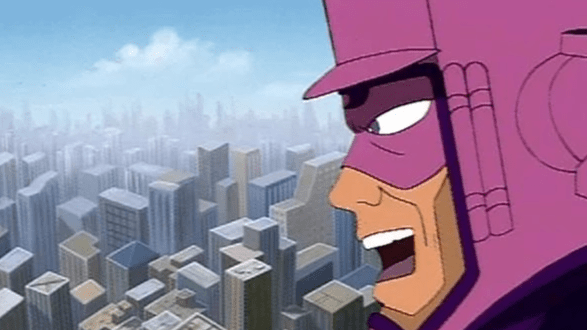
Above Manhattan, Galactus descends. Monumental. Impassive. Unstoppable. The sky opens… and the end begins.

The conversation between the Torch and Reed at the episode’s beginning confirms that the streaking object that Reed was pursuing when they raced into space and received their powers is the same streaking object he detects here: the Silver Surfer. In the Heroes Reborn timeline, this was also Reed’s initial reasons for going into space.
This episode is based on the events seen in the original Coming of Galactus story (see Box out) from Fantastic Four #48-50.
The voice stars just keep coming to the table:
The Silver Surfer is voiced by the late Robin Sachs, an actor more well known for his live action roles in Galaxy Quest and Buffy the Vampire Slayer. Alan Oppenheimer, who voices Uatu the Watcher, was villain Skeletor for a generation of Masters of the Universe fans and Tony Jay, an actor mostly associated with Disney, in particularly the scarily childhood-trauma inducing villain Frollo from The Hunchback of Notre Dame, voices Galactus himself!
A trio of villains indeed…
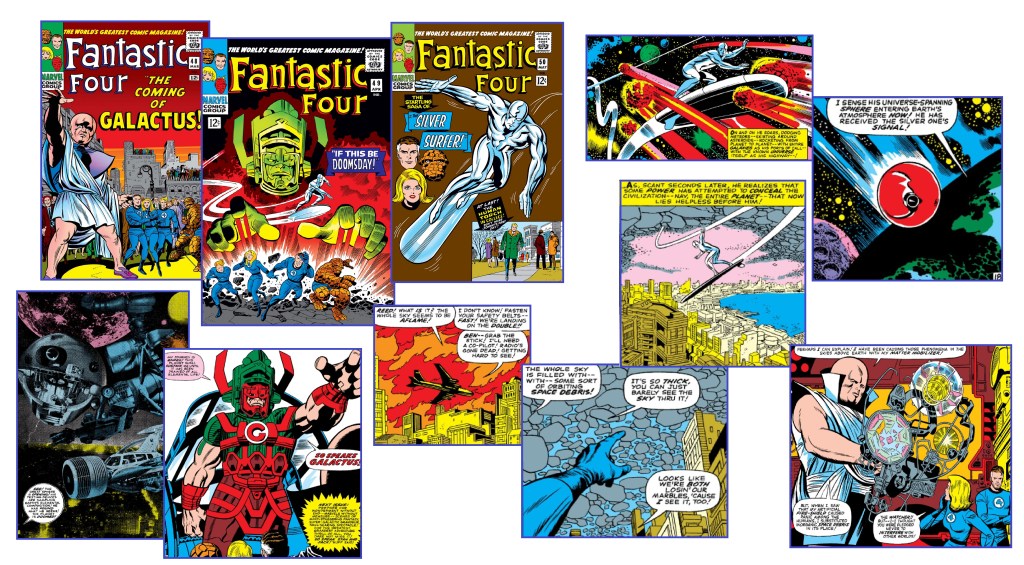
“THE COMING OF GALACTUS” : Fantastic Four #48-50
It arrived like myth wrapped in Kirby dots.
Fantastic Four #48–50 wasn’t just a story arc – it was a rupture in the boundaries of what superhero comics could be. “The Galactus Trilogy” didn’t just introduce a celestial being who devours worlds; it introduced something more audacious. A Marvel comic that dares to ask what happens when gods walk among men – and don’t care if we survive the encounter?
The arrival of the Silver Surfer – aloof, tragic, sublime – shifted the mood of superhero storytelling from punch-ups to operatic existentialism. He didn’t fight for glory or vengeance. He floated. Observed. Delivered. A being of conscience tangled in servitude. And through him, readers weren’t just observers – they were witnesses to an ethical collapse, the moral gray of cosmic obligation and personal awakening.
What mattered wasn’t how Galactus could be stopped – because he couldn’t, not really. It was the way he functioned as metaphor. Cold inevitability. A system too vast for protest. A threat too grand to hate. It mirrored our fears of nuclear annihilation, ecological collapse, and industrial consumption. And in that moment, Stan Lee’s grandiosity and Jack Kirby’s cosmic geometry fused into something larger than the sum of its genius parts.
Panels crackled. Dialogue trembled. And for the first time, superheroes didn’t just save the day – they negotiated with fate.
This trilogy paved a golden path for creators who wanted myth and metaphor in their fiction. Without it, we wouldn’t have had Darkseid with his anti-life equation. We wouldn’t have had Watchmen’s unease or Morrison’s poetic threats in JLA. Even Marvel itself kept circling back to the echoes – Annihilation, Infinity Gauntlet, Earth X. All found their origin in that moment Galactus stood over Earth and simply… judged.
And maybe most haunting of all: it gave birth to the Surfer’s loneliness. A silver figure streaking across voids with melancholy baked into his cosmic wave. He didn’t ask to be tragic – he was written that way. And generations of readers saw in his shimmer the beauty of regret and the cost of obedience.
In the end, Galactus left Earth alive. But he left the genre different. Bigger. Stranger. Bolder.
And none of us were the same.
Incursion of the Skrulls | The Silver Surfer and the Coming of Galactus (Part 2)




 X-Cess Minutiae
Leave a comment