


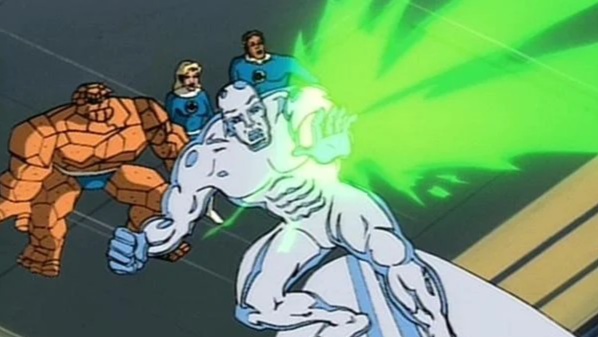
The Silver Surfer and the Coming of Galactus (Part 2) isn’t just a battle against a world-ending god. It’s a meditation on choice, consequence, and how one voice — unpowered, undaunted — can echo louder than celestial force.
Here, the Silver Surfer doesn’t switch sides because someone punched harder. He chooses Earth because someone spoke softer. Alicia Masters reaches into him not with tactics, but with compassion. And that’s where this episode transcends spectacle: it shows that humanity’s strength isn’t brawn, but empathy.
This chapter reframes the scope of heroism. The Watcher, once passive, ignites a solution. Johnny burns brighter than physics allows. Reed dares to believe in a single chance. And Galactus — the cosmic constant — is shaken not by science or violence, but regret.
It’s pivotal because it asks: what happens when the most powerful beings in the universe see humanity not as food… but as worthy?
The answer? They leave.
And the Earth spins on.
Galactus doesn’t flinch. The Watcher tries diplomacy. Ben and Johnny try brute force. None of it matters. The Devourer keeps building — quiet, relentless, apocalyptic.
At Alicia’s apartment, the Silver Surfer stirs. He’s the Herald. The warning. And Alicia, calm and fearless, speaks to him. Not of war — of mercy. Something shifts.
Above, the device nears completion. Reed calculates extinction. There’s one chance: a relic aboard Galactus’ ship. The Watcher turns to Johnny. He amplifies his powers — and the Human Torch ignites beyond limit.
The Fantastic Four fight back. Firelord and Terrax answer Galactus’ call — cosmic distractions. But while chaos reigns below, Alicia’s words take root. The Surfer rises.
Galactus prepares the final blow — and the Surfer takes the hit. He pleads: spare Earth. He’ll find lifeless worlds rich in energy. He’ll serve, as always. Galactus refuses. The hunger is too great.
Then the Surfer chooses. He breaks ranks. Stands with Earth.
Galactus strikes — but the Surfer deflects it. The blast throws Galactus from his perch, crashing into Manhattan. Then Johnny arrives with the weapon: the Ultimate Nullifier – the only thing that can destroy the Devourer. Defeated and betrayed, Galactus withdraws, giving his word that he will spare Earth. But punishment follows. His Herald is cast out — grounded, stripped of power. The board remains. Space does not.
The Surfer turns to Alicia. Her voice saved a world. He lifts into the sky — slower now, quieter — but ready to discover what Earth has to offer.
And the Fantastic Four watch him go.
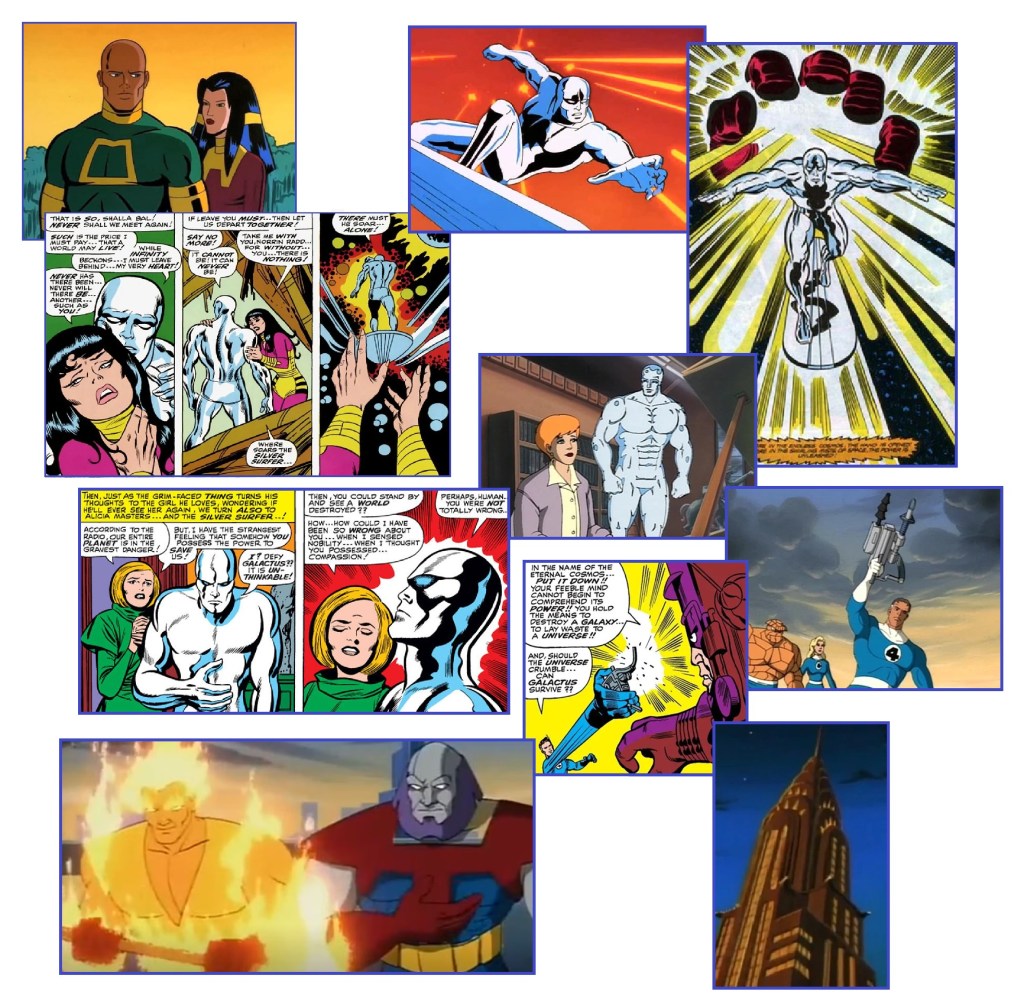
The Silver Surfer doesn’t mention his origins to Alicia, but they are covered in the later Silver Surfer animated series. While the series is supposed to be in this continuity, season one of Fantastic Four has several continuity issues that effect season 2 and the Surfer continuity, such as Frankie Raye becoming Nova in different ways. Indeed, the Surfer’s first encounter with the Earth in his series omits the Fantastic Four plot completely.
Another continuity example: Terrax the Tamer, Herald of Galactus in later episodes is briefly featured in this episode: Ben even battles him for a moment. In season two, Terrax is reintroduced – and the Four don’t recognise him.
Line of the week again goes to Ben, inadvertently caused by Reed: after a scientific explanation of what’s happening, Ben asks Reed to translate what he just said into Swahili for him. When Reed reminds Ben that he doesn’t understand Swahili, Ben tells him that he didn’t understand what he said in the first place!
Despite the weapon being featured as an important part of the plot, it is only named as the Ultimate Nullifier at the end of the episode. It’s the only weapon capable of destroying Galactus – which, may we point out, is not the best idea Reed has ever had.
Galactus’ size is inconsistent throughout the episode, but this is a key issue in every single Galactus appearance ever. His size, we’re told by narration in the comics, is derived from the person who sees him. Other races see him appear in their own visage, the humanoid brain unable to process the sheer size of Galactus. So it’s either a continuity error, an artist’s interpretation or our own brains.
The Silver Surfer is thrown into the Chrysler Building, which in this continuity is the hidden-in-plain-sight base of the Kingpin of Crime, as seen in the Spider-Man series.
In the comics, Alicia and the Surfer travelled through space for a time, when she and Ben were estranged. There was even a brief romantic interlude between them.
THE CONSCIENCE OF THE COSMOS: THE RISE OF THE SILVER SURFER
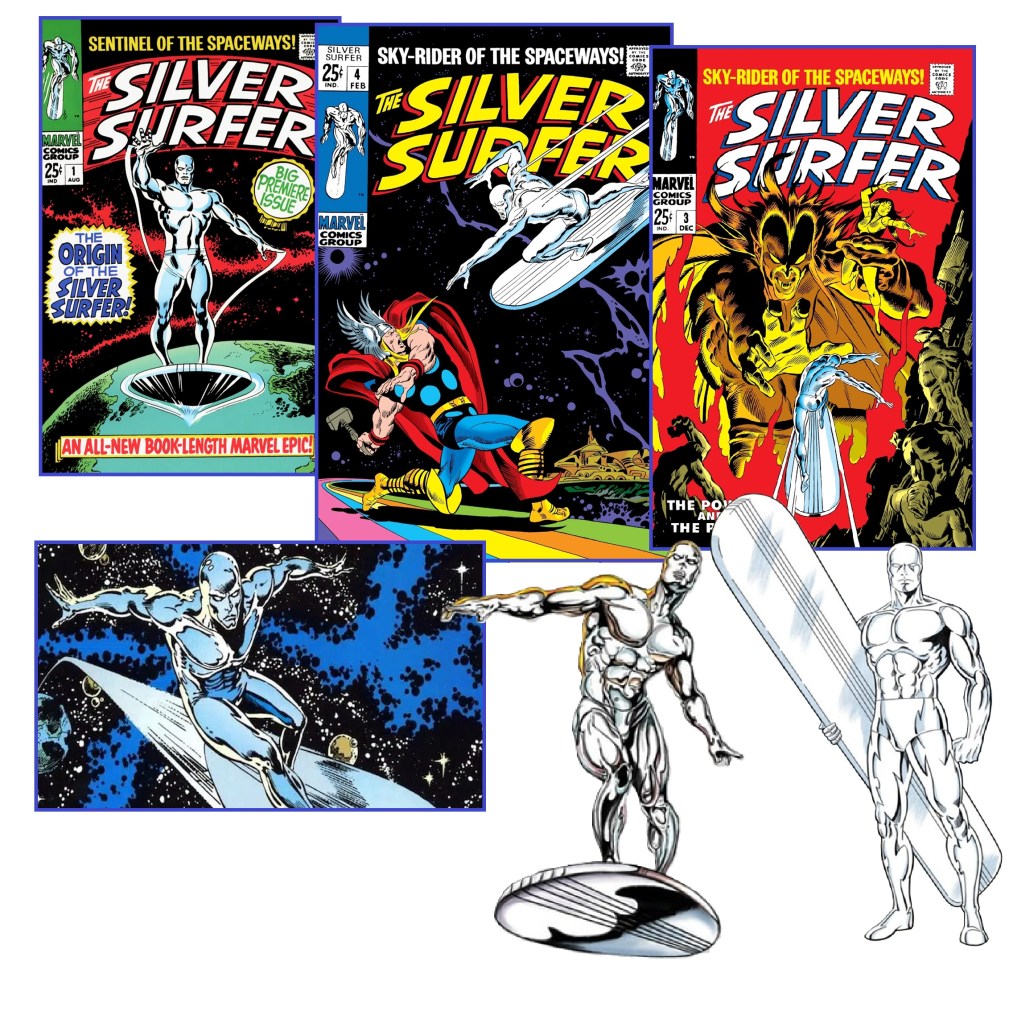
The Silver Surfer first appeared in Fantastic Four #48 (1966), sketched into existence by Jack Kirby as a last-minute addition to the Galactus saga. Kirby’s cosmic imagination gave the Surfer his sleek form and silent nobility — a chrome sentinel gliding through space like a mythic wanderer. Stan Lee was instantly captivated, calling him “the most philosophical” of Marvel’s heroes.
Lee wrote the Surfer’s solo title in 1968, layering it with introspection, moral conflict, and spiritual weight. Kirby’s visual storytelling — bold, kinetic, and mythic — gave the character grandeur. Lee’s prose gave him soul. “Ever since I first saw our gleaming sky-rider,” Stan said, “I felt he had to represent more than the typical comic book hero.”
Though the series lasted only 18 issues, the Surfer endured. He became Marvel’s conscience — a tragic figure shaped by Kirby’s cosmic scale and Lee’s moral clarity. A herald no longer, but a seeker of truth among the stars.
The Silver Surfer and the Coming of Galactus (Part 1) | Super Skrull




 X-Cess Minutiae
Leave a comment