


There’s something gleefully comic-book about an alien empire retaliating against Earth… by creating the ultimate shapeshifting nemesis who can punch, flame, stretch, and shield himself into victory — all at once. And yet, Super Skrull doesn’t just go big. It goes symbolic.
This episode marks the Skrulls’ formal graduation from “those aliens from Issue #2” to full-blown mythic adversaries. Their answer to past failures? Forge a warrior who channels the Fantastic Four’s exact abilities, right down to choreography. It’s less impersonation, more weaponised echo — and it raises thematic stakes far beyond the battlefield.
What unfolds is not just global combat (though there’s plenty of that), but a mirror match, with identity and trust taking centre stage. Reed Richards shines here, not as a power wielder but as a strategist — reminding us that adaptation, not aggression, defines true heroism. The Super Skrull may look unstoppable, but his power is a tether — one Reed knows how to cut.
There’s also delicious meta sprinkled throughout. Stan Lee pops in to cheekily translate alien gibberish, keeping the fourth wall comfortably ajar, while Ben Grimm’s end-credits rap — yes, performed alongside punk band Green Jellÿ — doubles down on the chaos with a thumping “It’s Clobberin’ Time” refrain that’s half parody, half party. If your eyebrows aren’t raised by then, you may need to check you’re not a Skrull yourself.
Visually kinetic, thematically sharp, and packed with narrative resonance, Super Skrull doesn’t just retread old battles. It reframes them — through imitation, infiltration, and the terrifying idea that your worst enemy might already be you.
Vengeance rarely arrives quietly — and the Skrulls, licking their wounds after a failed Earth invasion, decide subtlety isn’t on the menu. Instead, they conjure something far worse: a soldier engineered to wield all the powers of the Fantastic Four. One entity. Four powers. No mercy.
Enter the Super Skrull — a living weapon connected via energy beam to his homeworld, allowing him to replicate strength, stretch, flame, and forcefield with brutal precision. He doesn’t impersonate the team — he embodies them, battling across continents like a one-alien army. From cityscapes to coastlines, chaos follows in his wake.
But Reed Richards watches closely, thinks faster. Realizing that the Skrull’s abilities are remotely fed, he devises a plan — one part science, one part strategy — and lures the creature to a volcanic mountain peak, its caverns vast enough to host a final stand. While the team delays their copycat adversary, Reed blocks the power source.
The result? A flicker, a stumble, a collapse.
Depowered and disoriented, the Super Skrull is sealed inside the volcano by the Human Torch — a fiery exclamation mark to end the conflict.
For now.
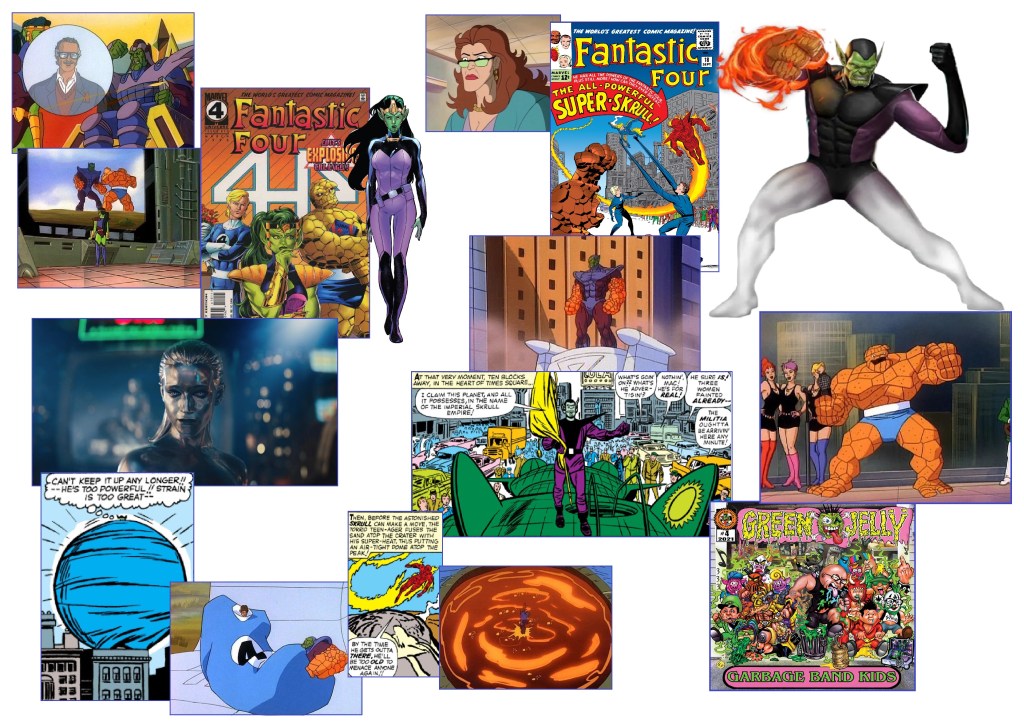
As in their first appearance in Incursion of the Skrulls, the World Trade Centre is seemingly destroyed in the opening of this episode – this time in a movie clip.
Stan Lee, just as he did in that previous episode, not only uses his translator to change the Skrull language to English, but also handily recaps the entire plot of Incursion of the Skrulls, including the title. The episode itself is based on Fantastic Four #18 (1963).
Lyja plays a bigger role here than she did in her first appearance. At the time this episode was made, she featured prominently on the main team in the comic book.
Despite seeing Galactus, Mrs. Forbes calls him a ‘fairy tale’ here. Sue mentions that the Baxter Building was damaged in that battle, seen in the previous episode.
In what will become a Fantastic Four tradition it seems, the Super Skrull first arrives on Earth in Times Square, where he announces that they are to be enslaved by the Skrulls. In a similar vein, the Silver Surfer also arrives in Times Square and proclaims the end of the world to humanity in Marvel Studios’ The Fantastic Four: First Steps.
Ben keeps coming up with these one-line zingers: “The yutz expects New Yorkers to take orders? He’s out of his gourd!”
The syndication censors have a day off again: Forbes orders her dog to ‘kill’ Ben – and assaults a police officer at one point! Super Skrull makes proclamations of approaching ‘death’ rather than ‘destruction,’ and Ben is actively shown punching the enemy in the face – which Spider-Man wasn’t allowed to do on his network show!
Speaking of Spider-Man, the Super Skrull is voiced by character actor Neil Ross, who among many, many, other familiar roles in animation, also voices Norman Osborn, aka the Green Goblin in more than one Spidey animation – including the one set in continuity with Fantastic Four.
The Fantastic Four’s way of dealing with Super Skrull seems particularly harsh. They throw him unconscious into a lava bed – which they assume won’t harm him due to his power – and then seal him in, cutting him off from the signal that seems to give him those powers! Wouldn’t that kill him? Either way, he breaks out of the volcano in season two.
Ben’s rap with real life rock band Green Jellÿ replaces the usual theme music on the end credits. It’s title: the apt “It’s Clobberin’ Time!”
“THE FANTASTIC FOUR MEET THE SKRULLS FROM OUTER SPACE!”
They don’t knock. They don’t announce. They infiltrate.
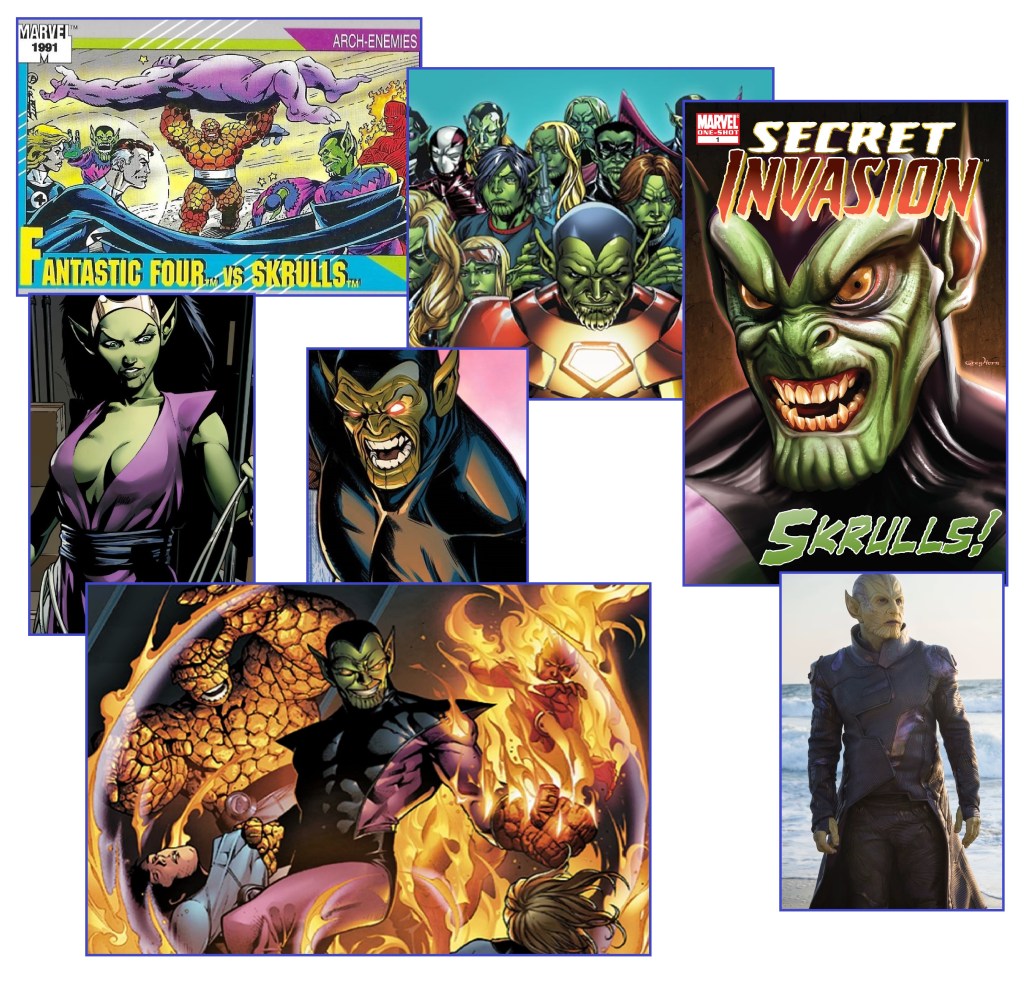
First surfacing in Fantastic Four #2 (1962), the Skrulls entered Marvel canon with all the subtlety of a trapdoor opening beneath a trusted friend. Created by Lee and Kirby, their deceptively simple debut — posing as the FF to turn public opinion — barely hinted at the mythic scope they’d eventually inhabit.
The Skrulls come from Skrullos, nestled in the Andromeda Galaxy. Originally peaceful, their evolutionary schism came courtesy of the Celestials: three branches spawned — Eternals, Primes, and Deviants. It was the Deviants, with their chameleonic physiology, who took control. Thus began an era of espionage, shadow wars, and identity theft on a cosmic scale.
In the early ’70s, Roy Thomas and Neal Adams dropped the curtain on what many still consider Marvel’s first true space opera: The Kree-Skrull War (Avengers #89–97). A cold war between two empires turns hot, and Earth — as usual — becomes the battlefield. The Avengers get dragged into it, navigating shapeshifter plots, cross-species politics, and the emergence of the Destiny Force (a concept so powerful it borders on philosophical).
At stake: trust, identity, and humanity’s place in the galaxy. It’s messy. It’s mind-bending. And it leaves emotional shrapnel in its wake.
2008’s Secret Invasion takes the paranoia dial and rips it straight off the console. Queen Veranke leads a movement that infiltrates Earth’s defences, government, and even the superhero community. The catch? The reader doesn’t know who’s been replaced. Neither do the characters.
The Skrulls resonate not just because they’re cool sci-fi creeps — it’s because they weaponise the familiar. They turn trust into currency and make the reader complicit in every reveal. You think you know your team, your friend, your hero… until you don’t.
They’re narrative mirrors. And sometimes, what you see looking back is uncomfortable.
The Silver Surfer and the Coming of Galactus (Part 2) | The Mask of Doom (Part 1)




 X-Cess Minutiae
Leave a comment