


This is the episode where the series shifts. Where the Fantastic Four stop reacting to threats and begin confronting something far more personal, far more mythic. The Mask of Doom (Part 1) doesn’t just introduce a villain — it unveils a presence. Victor Von Doom doesn’t enter the story; he asserts himself into it, with the kind of deliberate theatricality that makes every moment feel preordained. From the first pulse of his voice to the final frame of his lair, Doom is not just an antagonist — he is the show’s most retractable opponent, a figure who will return again and again, reshaping the narrative around his obsessions, his intellect, and his need to dominate.
There’s a different unknown quantity to Doom than any threat the team has faced before. He is not elemental, not monstrous, not chaotic. He is precise. His mask — and the face beneath it — are withheld not for suspense, but for control. Doom decides when he is seen. Doom decides what is revealed. The viewer is not granted access until Doom bids it necessary, and even then, it is never a gift. It is a tactic. That control of image, of identity, becomes a central theme of the episode. Doom’s power is not just technological or mystical — it is psychological. He weaponizes perception.
The episode also begins to sketch the deeper rivalry between Reed and Doom, a tension rooted not just in intellect but in legacy. There is history here, unspoken but felt, and it adds a layer of personal stakes to every exchange. Doom is not just a threat to the world — he is a threat to Reed’s sense of self, a mirror held up with contempt. Where Reed builds, Doom conquers. Where the Four rely on unity, Doom stands alone, cloaked in isolation and superiority. That contrast — between collaboration and control, between openness and secrecy — drives the emotional undercurrent of the story.
This is not just the arrival of a villain. It is the arrival of the show’s philosophical spine. Doom is the shadow that will stretch across the series, the figure who forces the Fantastic Four to define themselves not just in opposition, but in reflection. And from the moment he speaks, the tone shifts. The stakes rise. The game changes.
Taking advantage of some downtime, the Fantastic Four are engaging in personal pursuits: Reed and Sue prepare for a formal dinner and dance; Johnny listens to tunes and Ben tries yoga, with mixed results.
Above the Baxter Building is an technological craft of unknown origin. It’s occupant speaks in a dread voice, hardened through mechanical synthesisers. A web of energy incapsulates the building.
The Four, unaware of the intruder, stop what they’re doing to stop Ben and Johnny from having another argument, which is already in danger of destroying their home. But then a voice speaks to them, demanding that Sue Richards, the Invisible Woman, agree to become his prisoner. He graciously offers her passage aboard his craft and eventually beams the four aboard. Reed recognises the threat’s voice despite years of time having passed: the voice belongs to an old college student he knew: Victor von Doom.
Now encased in a heavy metal suit of armour, Doom welcomes the Four and keeps them imprisoned for their journey.
As Doom’s craft descends to a castle in European Latveria, Victor, calling himself Doctor Doom, greets his guests to individual prisons: designed to negate their individual powers. He has a mission for the three men of the team and, if they are successful with their mission, they will be released without harm. He takes Sue to dinner while the three men consider his wishes.
Reed realises that Doom’s plan is time-sensitive and, using strategy and quick thinking, he manages to free himself and his companions with Johnny’s flame. They silence the guards before they can set off any alarms.
Meanwhile, in a long hall, Sue sits at a table, the dinner guest of Doom, who uses a straw to drink wine from a goblet. He’s attracted to Sue, but thinks his appearance without his mask is horrifying. Sue feigns interest in the monarch of Latveria and asks to know everything about him.
Doom is flattered and tells her of his father, a local Gypsy man and a doctor, who travelled between villages, rendering aid to women and children. But some townsfolk grew suspicious of Werner von Doom‘s scientific methods, calling them magical. He was chased away into the night.
Elsewhere, Mr. Fantastic, the Human Torch and the Thing find themselves in a maze of catacombs beneath the castle. As they resolve to rescue Susan no matter what, the remaining members of the FF are unaware that Doombots are watching them…
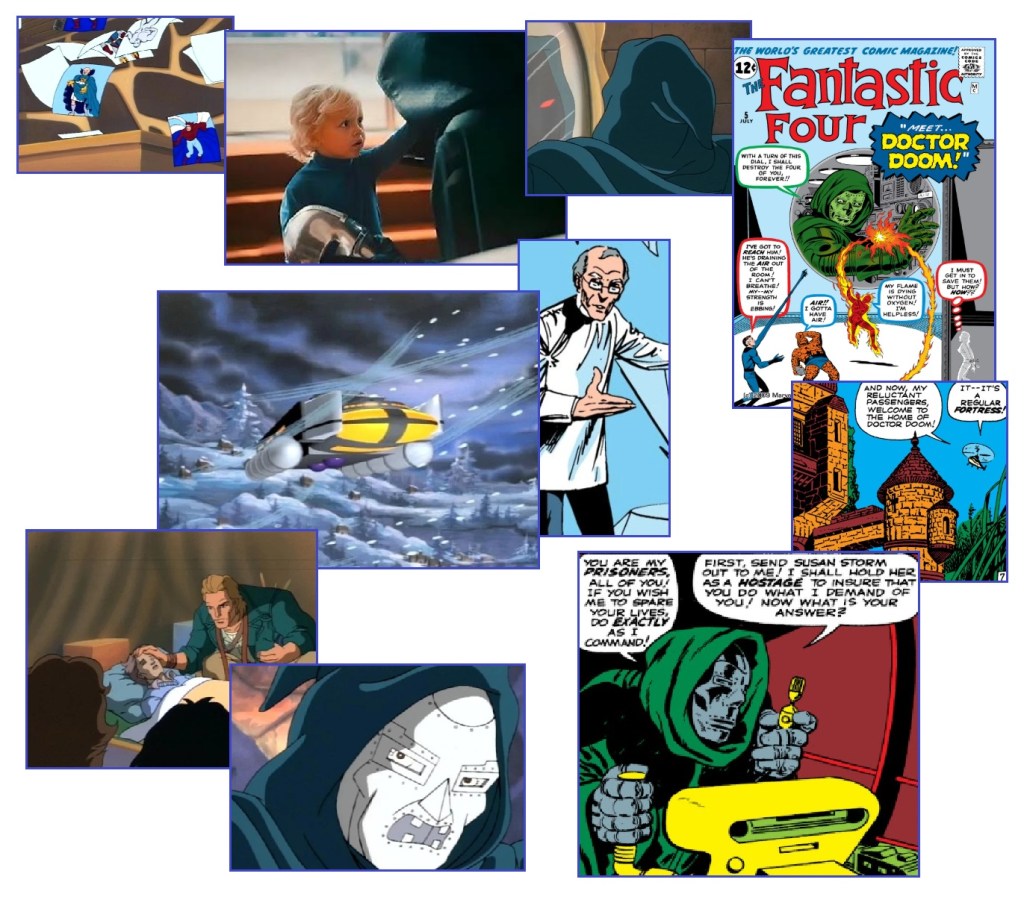
While Johnny is listening to music, he’s also arranging his Flair Marvel Trading cards: indeed, it must be a FF edition as the images on the cards contain Namor, the Silver Surfer, Terrax and the Watcher.
As in Marvel Studio’s Fantastic Four: First Steps, we initially only see Doom’s hood from behind until he reveals his mask.
The opening part of this story is based on Doom’s first appearance in Fantastic Four #5, but also from Fantastic Four Annual #2, when Victor explained his origins to servant Boris.
Speaking of servants, Hauptmann, Doom’s servant and butler in these episodes, made his first appearance in comic book form in Fantastic Four #196.
A notable use of early digital inking is seen when Doom’s ship arrives in Latveria.
For some reason, while in Doom’s water trap, a chain around Johnny’s neck can be seen disappearing and reappearing during shots.
The shot of Doom sucking wine through a metal straw from an ornate goblet is unintentionally hilarious.
Ben gets another quip when Johnny and Reed speak in pig Latin: “Sheesh, now I can’t understand either of them!” Later, when Reed goes more scientific, Ben tells him he understood the Latin better!
THE MASK THAT RULES!
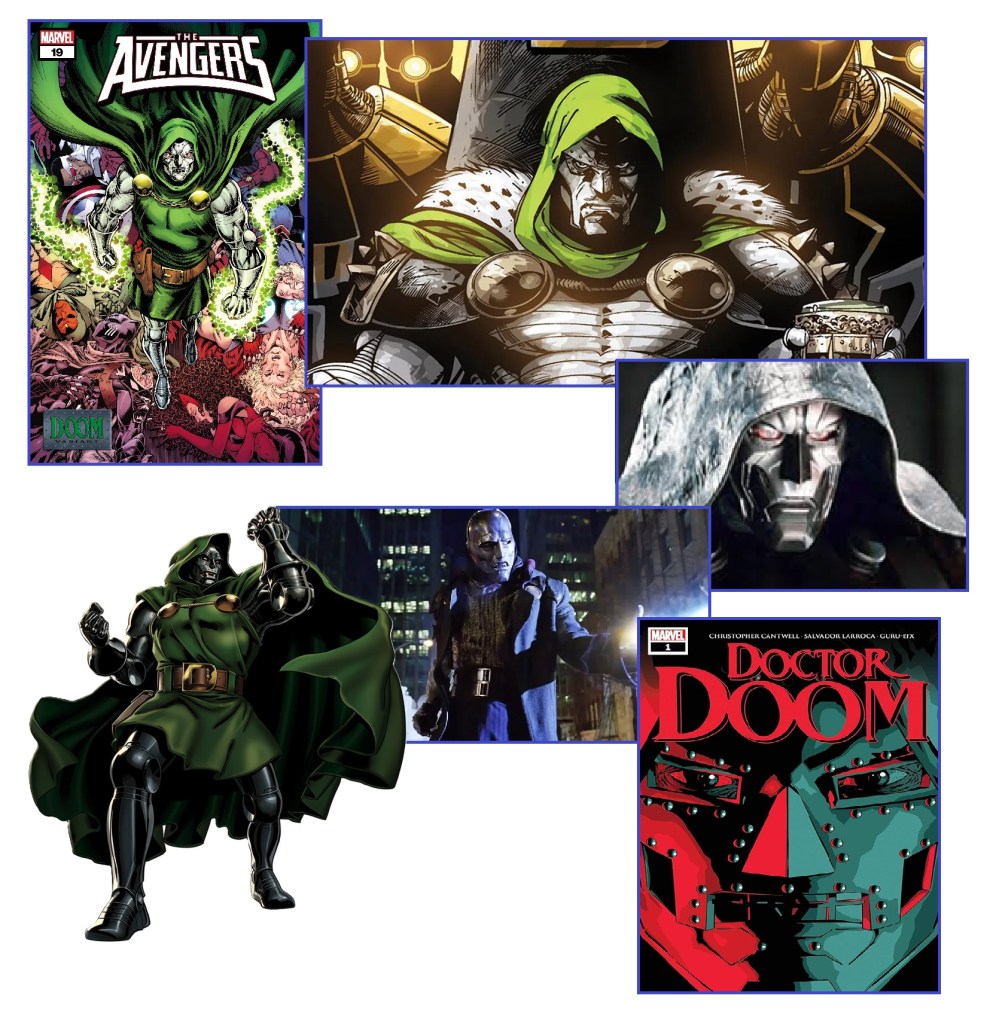
Victor Von Doom doesn’t enter the Marvel Universe — he claims his place in it. From his first appearance in Fantastic Four #5 (1962), Doom was never just another villain. He was a monarch, a genius, a sorcerer, and a man whose tragedy was matched only by his pride. Created by Stan Lee and Jack Kirby, Doom was designed to be the ultimate nemesis — not just for the Fantastic Four, but for the very idea of unchecked freedom. He didn’t want chaos. He wanted control.
Born to a Romani healer in Latveria, Doom’s early life was marked by loss and persecution. His obsession with rescuing his mother’s soul from Mephisto led to a failed experiment, a scarred face, and a lifelong grudge against Reed Richards, who had warned him of the flaw. Expelled from university, Victor vanished — only to return in armour, in legend, and in power. He overthrew Latveria’s government and crowned himself ruler, transforming his homeland into a dystopian utopia. And with that crown came one of his most potent weapons: diplomatic immunity.
Doom’s immunity makes him untouchable. He can threaten, invade, and manipulate — all while protected by international law. But he isn’t lawless. He operates by a strict code of honour, one rooted in chivalry and warped nobility. He keeps his word. He respects strength. He doesn’t harm without reason. In his own mind, Doom is not a tyrant — he is the world’s rightful guardian. Latveria thrives under his rule. Its people live in fear, yes, but also in peace.
This is Doom’s paradox: he is monstrous, but not mindless. He believes himself to be the hero of his own story — the only one willing to shoulder the burden of saving humanity from itself. His rivalry with Reed Richards is not just personal; it’s philosophical. Reed represents collaboration and curiosity. Doom represents certainty and control. Their conflict is not just about science — it’s about who should shape the future.
Beneath the armour lies pain. Doom’s mask is not just a symbol of power — it’s a shield against vulnerability. He believes his face is hideous, though some versions suggest only a minor scar. He refuses to show weakness, even to those he admires. His interactions with Sue Storm are laced with tragic yearning — not for romance, but for recognition. He wants to be understood. He wants to be right.
Doctor Doom is Marvel’s greatest villain — and his upcoming return to the big screen will create waves. With diplomatic immunity, a tragic origin, and a worldview forged in fire and intellect, Doom doesn’t just challenge heroes. He redefines what it means to be one. The mask is back. And the world may never be the same.




 X-Cess Minutiae
Leave a comment