


There are few things more dangerous than Victor von Doom with a captive audience.
The Mask of Doom (Part 2) shifts from the mechanical menace of Castle Doom to something far more intimate: a dinner table, a story, and a man who believes his pain is proof of destiny. This episode adapts, almost verbatim, the origin of Doctor Doom as first revealed in Fantastic Four Annual #2 (1964) – a tale of fathers, failure, and the forging of identity. It’s a rare moment where the animated series leans fully into its source material, lifting Doom’s backstory with reverence and precision.
The themes here are classic Doom: legacy, transformation, and the myth of control. Werner von Doom is portrayed as a tragic idealist, a Romani healer whose brilliance isolates him. His death in the snow becomes the crucible that births Victor’s obsession – not just with power, but with rewriting fate itself. Doom’s journey from Empire State University to the Himalayas is a pilgrimage of ego, culminating in the forging of his mask – a symbol not of concealment, but of self-declared truth.
While Sue Storm listens, hoping to glean insight or advantage, the rest of the team battles through Doom’s fortress – a gauntlet of traps that reflect his psyche: elegant, cruel, and inescapable. Their confrontation with Doom ends not with triumph, but with revelation. The man they fight is a Doombot. The real Doom remains untouchable, orchestrating their next trial: a time-travel mission to retrieve a lost artifact from ancient Greece.
This episode doesn’t just tell Doom’s story – it believes it. And in doing so, it invites us to consider the cost of myth-making, the seduction of narrative control, and the terrifying clarity of a man who sees his scars as sacred.
Victor von Doom does not dine. He performs theatre with silverware.
As Sue Richards sits across from him in the cold opulence of Castle Doom, she listens – not just to the words, but to the rhythm beneath them. Doom recounts the story of his father, Rudolph von Doom: a Romani healer, scientist, and idealist whose brilliance was matched only by his tragic miscalculations. Werner’s efforts to aid the sick made him a target for thieves, and his refusal to serve power over people led to his exile. When a baron’s wife could not be saved, Werner and young Victor fled into the mountains. The snow claimed Werner. The silence claimed Victor.
It is not a tale told for sympathy. It is a tale told for legacy.
Sue absorbs every detail, hoping to understand the man who has taken her hostage – and perhaps, the man her teammate once called friend. Doom’s narrative winds through Empire State University, where Victor met Reed Richards. Their collaboration was brief, brilliant, and doomed. Victor’s reckless experiment exploded, scarring him physically and emotionally. He left America behind, seeking not healing but transformation. In the Himalayas, monks helped him forge a mask – not to hide his face, but to reveal his destiny.
While Doom speaks, the rest of the Fantastic Four navigate the labyrinthine horrors of Castle Doom. Ben Grimm breaks through walls. Johnny Storm dodges flame-resistant traps. Reed stretches past the limits of physics and patience. Their goal: rescue Sue. Their obstacle: Doom’s mind, made manifest in steel and circuitry.
They reach him. They fight. But the man they confront is not Doom – it is a Doombot, a mechanical echo of his will. The real Doom appears, regal and remorseless, and ensnares the team in an energy field. His voice is calm. His plan is not.
He sends them on a mission – not for treasure, but for proof. A coffin lost to time, buried in the sands of myth. Doom activates his time platform and hurls the Fantastic Four into ancient Greece, where gods and tyrants once walked. The past is not a refuge. It is a crucible.
And Doom watches, as ever, from the shadows of his own legend.
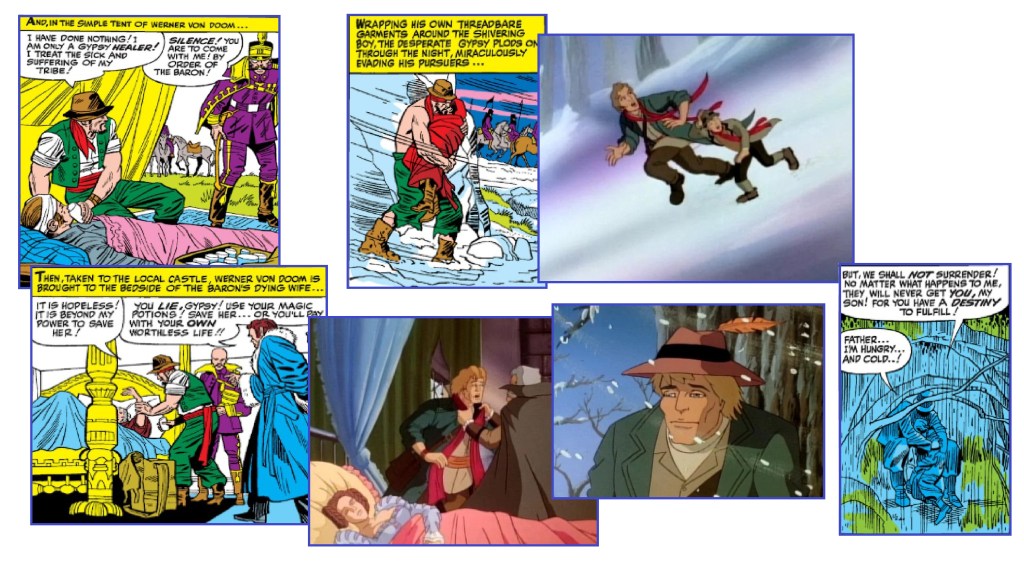
Doom’s origin is retold here, a direct adaption from Fantastic Four Annual #2. It’s remarkably violent, once again, with the censor rules being different for this show. There’s a blatant shot of armed villagers firing guns at a young Victor von Doom and his father, in this adaption called Rudolph, rather than the original Werner.
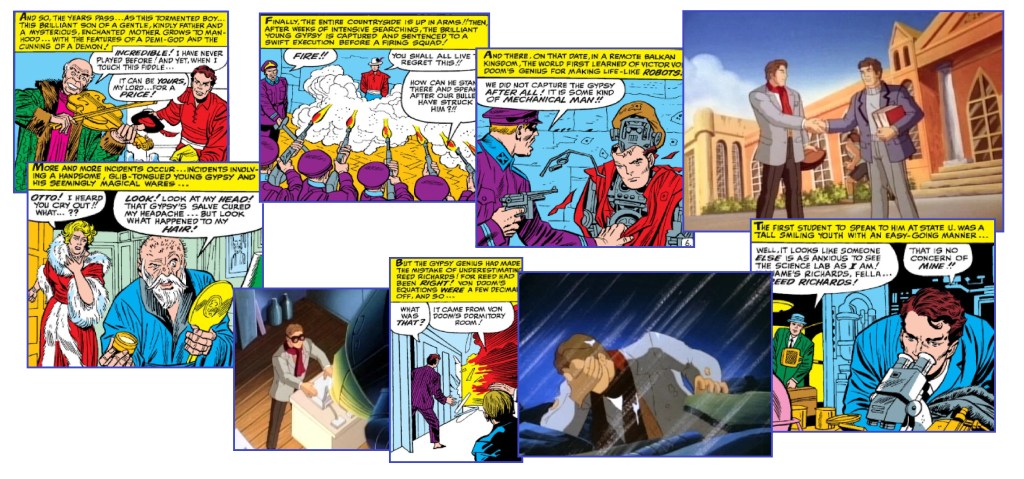
One of Doom’s lines is “They believed we were dead, the merciless jackals!!” and we actually see his father die in one shot. Victor’s hair restorer, his violin scam and Victor’s ‘death by firing squad’ all come from the Kirby/Lee classic.
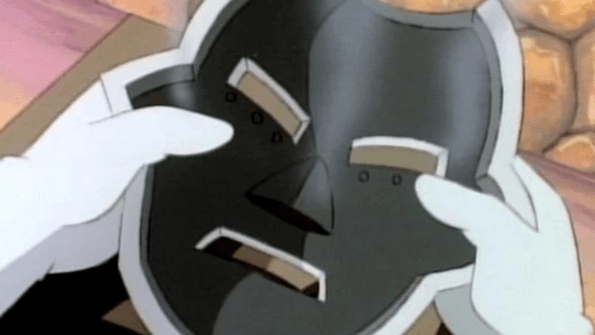
As he puts on his still-cooling mask, Doom screams, implying it’s done more damage to his face than the initial explosion. The comic books have hinted at this many times.
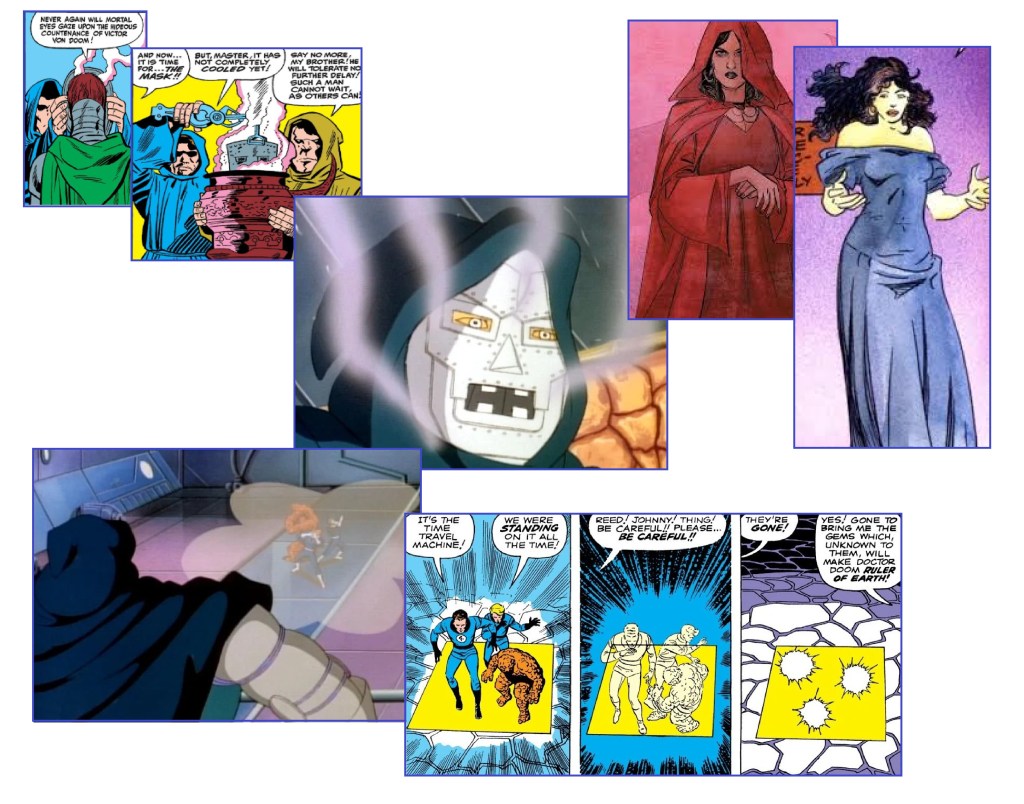
Although Cynthia von Doom is referenced as a magic user, her name itself is not mentioned.
Doom’s time machine makes the three FF members fade at the climax to this episode, on a mission to Greece rather than Fantastic Four #5‘s Blackbeard. In the comics, the time platform traditionally rises from the ground, as if the user is slipping into it.
There’s references, both verbally and visually, to the Indiana Jones movies, as well as perennial 80’s favourite, The Goonies.
Ben’s line of the week: “I got a can-opener with your name on it, fender face!” Or there’s another rhyme: “One for the money, two for the show, we gotta save Suzie, which way do we go?”




 X-Cess Minutiae
Leave a comment