


Victor von Doom does not simply seek victory – he seeks validation, sculpted through spectacle. In The Mask of Doom (Part 3), the Fantastic Four are hurled into ancient Greece, not to rewrite history, but to perform within Doom’s curated myth. The battle between Greeks and Persians becomes a stage, and the heroes are cast as reluctant actors in a drama of legacy. Doom watches from afar, believing that even time itself can be bent to his narrative. But control is not conquest. It is illusion.
Sue Richards, held captive in Castle Doom, does not wait passively. She studies the rhythms of her prison, the architecture of ego, and the cracks in Doom’s performance. Her quiet resistance mirrors the team’s defiance in the past. Reed adapts, reshaping himself into survival. Johnny burns through traps and timelines. Ben nearly chooses to remain in antiquity, tempted by a life untouched by Doom’s shadow. Each act of rebellion chips away at the mask Doom wears – not the metal one, but the myth he’s built around himself.
This episode marks a tonal shift in the series – from psychological tension to mythic spectacle – while deepening the central question:
Is Doom the author of destiny, or merely its most theatrical reader?
Ben Grimm, Johnny Storm, and Reed Richards tumble through the shimmering veil of Doom’s time platform, landing in the dust and din of ancient Greece. Spears clash. War cries echo. The Persian Empire advances like a tide of iron, and the Fantastic Three – strangers in a myth – choose to stand with the defenders.
Armour is offered. Trust is tentative. The Greeks lead them to Delphi, where the Oracle speaks not in riddles, but in warnings. She names the coffin Doom seeks, a relic buried near a river that remembers gods. Reed becomes the vessel – quite literally – stretching into a makeshift boat to carry them downstream. But the journey is not gentle. Vapours rise from the tomb, and the heroes fall unconscious, claimed by the very mystery they were sent to retrieve.
They awaken in chains. Persian guards jeer. But Doom did not send weaklings. Flame, force, and elasticity break the prison. The trio turns the tide of battle, scattering the invaders and earning the gratitude of a civilisation on the brink. The Greeks offer sanctuary. Ben Grimm, ever the soldier and the soul, considers staying. For a moment, history holds its breath.
But Doom does not wait. The time platform reactivates, wrenching them back to the present – and into Doom’s grasp.
They return with the coffin. Doom receives it with reverence. But reverence turns to rage. The artifact is a fake, a decoy wrapped in prophecy. In the chaos, with Sue having escaped from Doom herself using her invisibility fields, the Fantastic Four seize their moment. The Fantasti-Car roars to life, and they escape into the Latverian sky.
Doom watches them flee, his mask unreadable.
He does not shout. He does not chase.
He recalibrates.
Because the past was never the goal.
It was the test.
And Doom always learns.
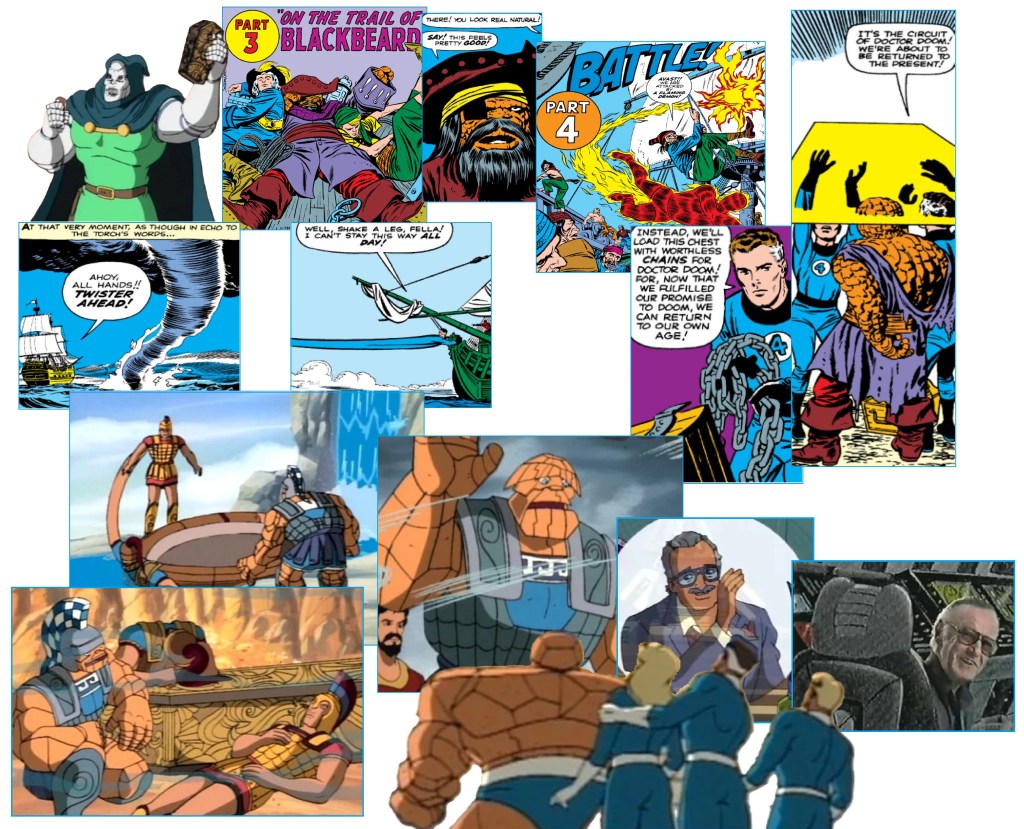
Stan Lee makes another cameo in this episode, this time in person, to recap the events of the last two episodes. Extremely fitting, since he wrote the issue adapted for the episodes.
Reed uses the translators used in Incursion of the Skrulls and Super Skrull – translators first introduced by Stan himself so that viewers would understand the alien dialogue!
In the comic version of this story, from Doom’s first appearance in Fantastic Four #5, the Fantastic Three are sent not to Greece, but for a trinket from Blackbeard’s pirate treasure. In this episode, the Persians are used instead. In the original story, Ben discovered his passion for pirating and almost stayed behind, but changed his mind – as he does at this episode’s conclusion.
Despite the time platform looking different from the comics in the previous episode, and at the beginning of this one, by the end of the story, it resembles the one from the comics.
Ben’s references this week include Popeye and The Wizard of Oz (he calls for ‘Aunty Em’ as he wakes up). His nickname for the Coffin of Argos (‘The Whatchamacallit of Wozzit?”) is particular interesting as is his best, if not risqué, line of the episode: “Bondage makes me nervous.”
How did that one get past the censors?




 X-Cess Minutiae
Leave a comment