


It’s an accepted rite of passage for older comic book fans: learning to love the creaky charm of early American comics. For every dazzling costume redesign or planet-shaking villain reveal, the real magic of early Marvel lay in its grounding. These heroes lived in our world – New York, not Metropolis – and their anxieties mirrored ours. The Vietnam War loomed. Nuclear annihilation wasn’t just a metaphor. And often, the greatest threat wasn’t Doctor Doom – it was the Cold War.
But those stories are also time capsules. Sue Storm fretting over her hair curlers. Jean Grey fainting like clockwork. The portrayal of women in comics has come a long way – and thank Galactus for that! Still, there’s something oddly delightful about revisiting the sheer, unfiltered absurdity of those early tales. And this episode of Fantastic Four, Mole Man, leans just far enough into the nonsense to be genuinely entertaining.
Real-life cameos abound. Prince Charles (yes, that Prince Charles) mutters “Oh crumbs” as Britain collapses beneath him. Miss Lavinia Forbes kicks her knees up to “Hava Nagila” while the Earth Suction Generator hums ominously in the background. Johnny Storm debuts a chart single so catastrophically bad it deserves its own Negative Zone. It’s camp. It’s chaos. It’s canon.
Gone is the tragic Mole Man of later reinterpretations – the lonely, ridiculed genius who fled underground to escape humanity’s cruelty. Here, he’s just an angry scientist with a crystal-powered drill and a grudge against architecture. The episode strips away sympathy in favour of spectacle, and honestly? It works.
Did the writers embrace the wackiness of Lee and Kirby’s original run? Or did they simply lose the plot? We’ll leave that up to you. But one thing’s certain: when the Earth opens up and swallows Rockefeller Center whole, you’re not watching prestige television.
You’re watching comic book chaos at its most gloriously unhinged.
In Paris, the fashion season collapses as the Champs-Élysées disappears into the Earth. Models scatter. Designers scream. The runway becomes a sinkhole.
In Westminster, Prince Charles’s press conference halts mid-sentence as the Houses of Parliament are swallowed whole. From the crater, monstrous creatures emerge – blind, clawed, and ancient.
In Egypt, the Pyramids fall.
And in Manhattan, Sue Richards is impatient. She’s due at Rockefeller Center for a gala featuring composer George Gee. The Fantastic Four have been requested to attend. Ben brings Alicia. Johnny escorts Melinda, Miss Forbes’s niece. Sue is meant to arrive with Reed – but Mr. Fantastic is buried in seismic data, convinced Manhattan is next.
But Sue will not be late. She drags Reed from his lab, heels clicking with purpose.
At Rockefeller, Ben literally puts his landlady on a pedestal – dancing with her chair aloft his head – while Johnny tries to impress the snooty Melinda with a debut single titled “Flame On!” The mood is light. The music swells.
Then the ground opens and Rockefeller Center drops into the Earth.
While Alicia and Miss Forbes sing to calm the panicked crowd, the Four – plus a clingy Melinda – venture into the caverns below. They’re split when Reed, Johnny, and Melinda fall into a trap, saved only by Reed’s quick thinking as he stretches his torso into a makeshift parachute.
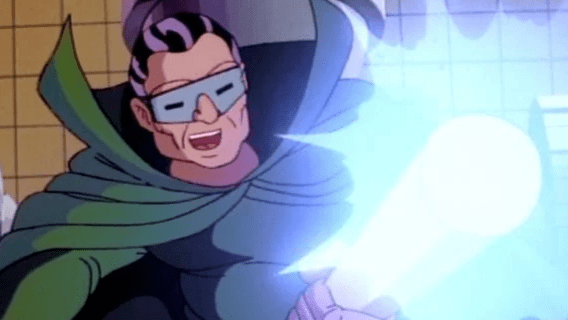
But the welcome is short-lived. Blind Moloids swarm. The heroes are overwhelmed. Their captor steps forward: the Mole Man.
He wants revenge on the surface world that mocked him. Now, he will rule – not by rising, but by dragging the world down to meet him. His Earth Suction Generator, powered by crystalline energy mined from the planet’s core, is already at work – lowering landmarks, leaders, and legacies into his subterranean kingdom. He sets the device to maximum and leaves the Fantastic Four behind.
But Sue and Ben arrive in the nick of time. They free their partners. Reed directs Johnny to overheat the generator, overloading the system. The landmarks return. The heroes rise. And Mole Man is sent spiralling deeper into the Earth – out of sight, out of reach, and out of trouble… for now.
Johnny thinks better of dating Melinda. The party resumes. And Johnny reprises his song.

This episode is a veritable mash-up of some Stan Lee and Jack Kirby classics! The Mole Man’s first encounter with the Fantastic Four is from their inaugural #1. His plan to lower cities to the planet’s core is directly his plan in #22, and he brings the party down, literally, when he buries an entire New York City block in #31!
One would assume that the oxygen masks that appear on Mr. Fantastic and the Human Torch when exposed to the possibly poisonous gas are part of their uniform – so who slipped one on Melinda Forbes?
Speaking of the Forbes’, perpetually annoying landlady Miss Lavinia Forbes actually helps in this episode! She helps Alicia with keeping the crowd in Rockefeller calm during the crisis (with a hilarious take on Jewish tune ‘Hava Nagila’), while real life conductor George Gee appears as himself.
Speaking of celebrity cameos, Prince Charles (now King Charles III) appears in this episode addressing the British press. This is a canny piece of work this one: in reality at the time, Charles was dealing with press questions regarding his relationship with his mistress (now Queen) Camilla Parker-Bowles – while he was married to Lady Diana Spencer, the Princess of Wales.
In this episode, not only does he deny an affair, but it’s one with US Celebrity and sitcom star, gay rights activist Roseanne Barr.
Talk about aging badly…
Greg Berger voices the Mole Man in this episode. He went on to voice Kraven over in Spider-Man. If he seems familiar to 80’s fans, he was Grimlock in Transformers, but to more tech-savvy citizens, he’s the voice of Jecht in the Final Fantasy series of games.
Ben has been reading Baum again, or at least is a Judy Garland fan, as he once again references The Wizard Of Oz. When Lavinia enters, his line of the week is brilliant: “Quick! Tell Dorothy and Toto to hide! It’s the Wicked Witch of the West!”
Less brilliant is Jonny’s debut single ‘Flame On!’ sung to Melinda at the party. It’s a ghastly sounding noise – that comes complete with MTV-Style Jem and the Holograms music video!
KING OF SUBTERRANEA!
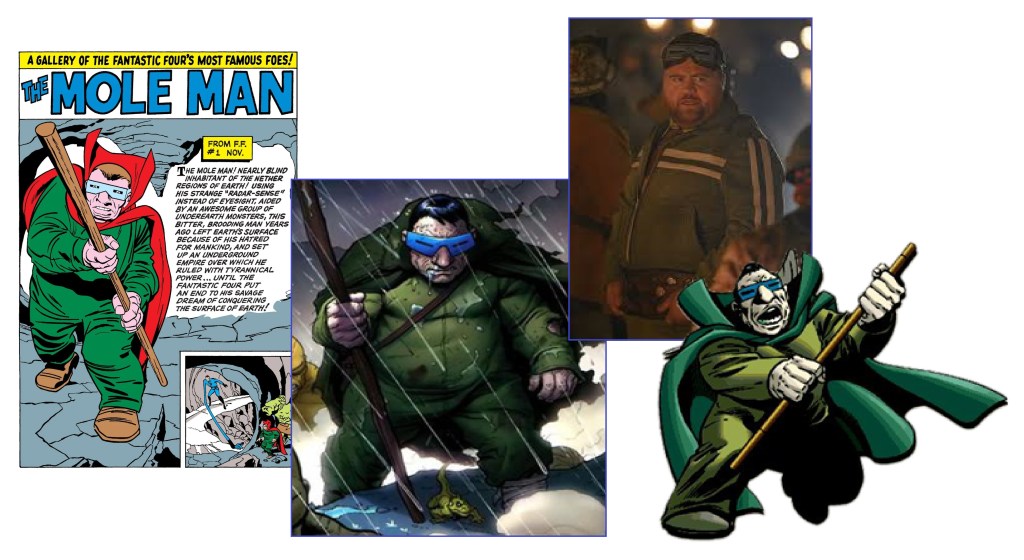
Harvey Elder, better known as the Mole Man, holds the dubious honour of being the very first villain the Fantastic Four ever faced. Debuting in Fantastic Four #1 (1961), Mole Man was introduced by Stan Lee and Jack Kirby as a bitter, ostracised scientist who discovered a vast underground world after being rejected by society for his appearance and eccentric theories. Beneath the Earth’s crust, he found monsters, power, and purpose – declaring himself ruler of Subterranea and launching an attack on the surface world. His origin, steeped in loneliness and vengeance, set the tone for Marvel’s more psychologically complex villains.
Throughout the Silver and Bronze Ages of comics, Mole Man returned frequently, often with schemes to collapse cities into the Earth or unleash subterranean beasts on unsuspecting civilians. His plans ranged from the absurd to the apocalyptic, including lowering entire city blocks into the ground (Fantastic Four #31) and attempting to conquer the surface world with seismic weaponry (Fantastic Four #22). Despite his recurring defeats, Mole Man became a symbol of Marvel’s fascination with misunderstood monsters – less a megalomaniac than a tragic figure seeking recognition.
The character received a major reimagining in the 2025 MCU film Fantastic Four: First Steps, where he’s portrayed by Paul Walter Hauser. This version of Mole Man leans into the anti-hero archetype, casting him as a unionist and protector of Subterranea rather than a pure villain. His motivations are tied to environmental collapse and the unchecked expansion of surface civilization. While Galactus looms large in the film, Mole Man’s ideological clash with Reed Richards adds emotional weight and political nuance to the story.





 X-Cess Minutiae
Leave a comment