


And so ends Marvel Animation’s first season of Fantastic Four – a season that walked the tightrope between 1960s comic book absurdity and the punchy bravado of 1990s beat-’em-ups. That might sound like a backhanded compliment, but it’s anything but. It’s high praise.
Any long-running IP evolves over time, but the producers of this show, by design, infused it with Stan Lee and Jack Kirby’s gleeful chaos from the word go. The dynamic between the married Reed and Sue, the bickering rivalry of Ben and Johnny – it’s all remarkably faithful to the original 1962 comics run.
The season works because it knows what it is: a well-made show that’s self-aware, steeped in its roots, and unafraid of meta-humour. There are moments that would genuinely shock adults – simply because they exist at all.
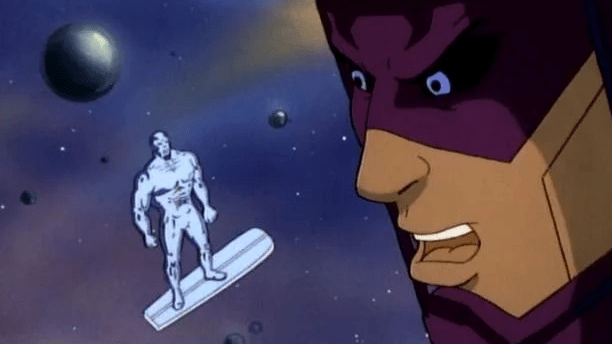
The finale is no exception. The title may tease the return of the World Devourer, but truth be told, the reappearance of Galactus and the Silver Surfer isn’t the point. In fact, they’re not even the villains you’re led to expect.
Enter Doctor Doom – now wielding stolen cosmic power. It’s not a new beat; comics and live-action adaptations have played this card more than once. But here, it’s not about novelty. Doom doesn’t need introduction or fanfare. He simply is.
And while some of the season’s sillier elements – Ms. Forbes, the catchy theme tune – fade after this week, season two picks up the mantle. It continues the tradition, bringing Marvel’s First Family to life with even stronger tales, written by the very kids who grew up with them and who now could shape the mythos themselves.
It begins with date night in Manhattan. Reed and Sue are off to a lecture, Johnny’s chasing guitar solos, and Ben Grimm is settling in for a quiet evening with Alicia Masters. But the cosmos has other plans. Above the city, an electrical storm brews – unnatural, intense, and quietly surveilling the Baxter Building through a satellite pulsing with elemental energy.
Plans unravel. The storm cancels the night’s outings, and one by one, the Fantastic Four return home. Johnny’s Iron Man serial is hijacked by living images. Reed’s science channel unleashes dinosaurs. The television has become a weaponised portal. Something is watching – and scripting chaos.
The team traces the signal to a satellite in orbit, and launches in the Fantasti-Car. But Alicia receives a visitor: the Silver Surfer, spectral and urgent. The satellite is a trap.
In space, the Four confront the satellite, finding what seems to be Galactus‘ ship. Expecting the World Devourer. Instead, they find Victor Von Doom, who promptly steals the Power Cosmic from the Surfer with a device of his own design. He escapes, leaving the Surfer drained and the team stunned. Doom now wields godhood.
Back on Earth, Doom declares dominion over the planet, daring global powers to defy him. At the Baxter Building, Reed attempts to restore the Surfer’s energy. A stray comment sparks a plan.
The team lures Doom into deep space, where his use of the Power Cosmic draws the attention of Galactus himself. The Devourer arrives, furious at the theft. He reclaims the stolen power, restores the Surfer, and banishes Doom – casting him adrift in the void, alone and powerless.
The Fantastic Four return to Earth, victorious but shaken. The Surfer resumes his role, burdened once more by the cosmic barrier. Doom floats endlessly, a monarch dethroned by the very forces he sought to command.

The episode itself is based on the arc from Fantastic Four (1961) #57-60, although Galactus does not appear in the comic book story. Beats of the arc were also used in live action in Fantastic Four: Rise of the Silver Surfer.
As noted this episode marks the final appearance of Ms. Lavinia Forbes. Perhaps the Four bought the Baxter Building off her and then converted in into Four Freedoms Plaza – which is traditionally the same building, renovated and redeveloped – and where the team live in season two?
The extremely catch-theme tune – we dare you not to sing along – also makes it’s final appearance in this episode.
The episode of Iron Man that Johnny’s watching is clearly the episode Rejoice! I Am Ultimo, Thy Deliverer – the titled villain comes out of the TV! The Iron Man theme can also be heard.
Ben mentions the Flintstones – including their famous ‘Yabba Dabba Doo! catch phrase – while fighting the dinosaurs. He even calls one Dino!
There’s an extensive recap of the Silver Surfer’s origin, taken straight from The Silver Surfer and the Coming of Galactus.
While boarding Galactus’ ship, the Four dress in their space suits, first seen in the pilot episode.
Doctor Doom is voiced by future Spider-Man Green Goblin Neil Ross for this appearance, replacing John Vernon.
Doom’s announcement is very similar to one given in the 2025 crossover, One World Under Doom.
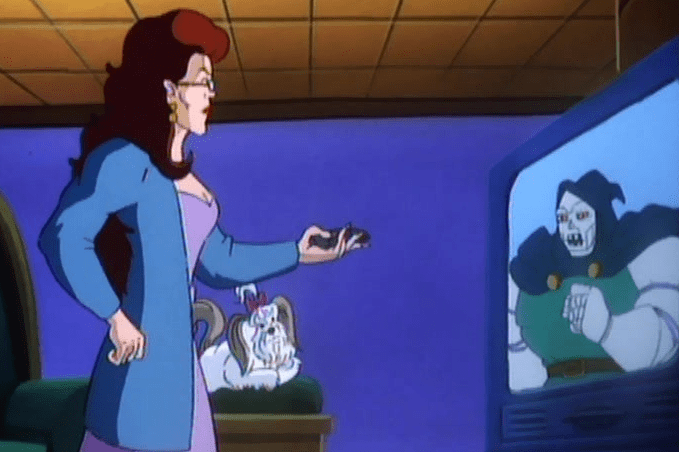
The Surfer hologram gives Ben this gem: “Yeah. He came in, flew through Alicia’s head and then out through the wall.” But it’s Mrs. Forbes last episode, and, upon seeing Doom on every channel, turns to the dog and describes the would-be leader as the “tacky man covered with aluminium siding.” Best line ever.
COSMIC THEFT: DOOM VERSUS THE SILVER SURFER!
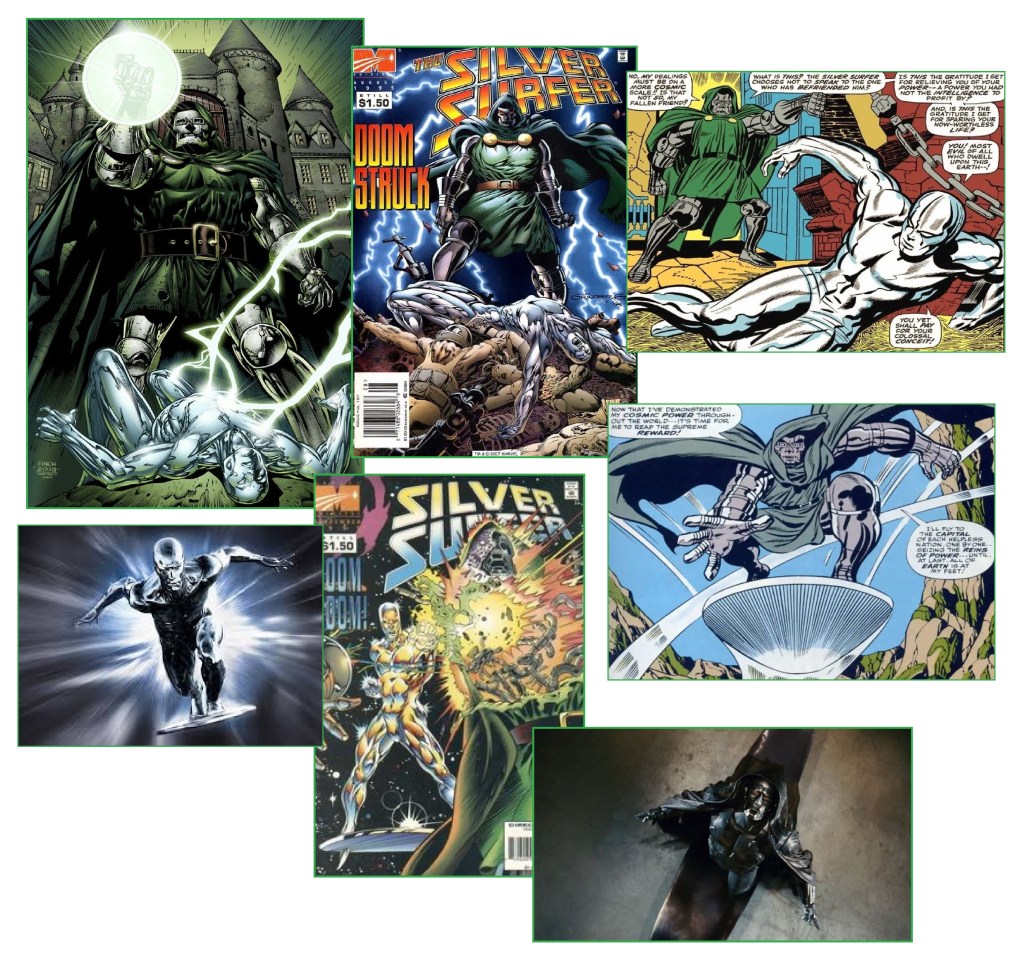
Some rivalries are built on ideology. Some on vengeance. And some – like Doctor Doom versus the Silver Surfer – are forged in the quiet, calculated theft of godhood.
Their first encounter is pure Kirby-era madness. Fantastic Four #57–60 (1966) sees Doom do what Doom does best: exploit a moment of vulnerability. The Surfer, stranded on Earth by Galactus, is still adjusting to humanity’s noise and nuance. Doom, ever the opportunist, lures him in with feigned curiosity – then steals the Power Cosmic right out from under him. No war, no duel. Just theft. Doom becomes a walking apocalypse, and the Fantastic Four scramble to contain a man who now bends reality with a thought. It’s not just a fight – it’s a warning: Doom doesn’t need to understand the cosmos to weaponize it.
Years later, in Silver Surfer Vol. 3 #6 (1987), the tables turn. The Surfer, now free from Earth’s orbit, confronts Doom again – this time in Latveria. Doom has upgraded, of course. He’s built a device to siphon cosmic energy, and once again tries to claim the Surfer’s power. But this time, the Surfer doesn’t fall for it. The battle is brutal, philosophical, and deeply personal. Doom sees the Surfer’s restraint as weakness. The Surfer sees Doom’s ambition as rot. Neither wins, but the clash leaves scars.
Then comes Silver Surfer Vol. 3 #112 (1995), a quieter, stranger encounter. Doom, having survived countless defeats, seeks the Surfer not to fight – but to understand. He wants to know what it means to be truly free. The Surfer, ever the reluctant sage, offers no easy answers. It’s less a battle than a meditation, but the tension is still there. Doom doesn’t want enlightenment. He wants control.
Across these stories, the pattern holds. The Surfer is power tempered by conscience. Doom is ambition unbound. Their battles aren’t just physical – they’re ideological. Doom wants what the Surfer has, but refuses to pay the emotional cost. And the Surfer, for all his strength, can never quite stop Doom from trying.
They don’t clash often. But when they do, it’s never just about energy blasts and force fields. It’s about what it means to wield power – and what it costs to keep your soul intact.




 X-Cess Minutiae
Leave a comment