


Comic books have long embraced the trope of heroes fighting heroes – not out of malice, but misunderstanding. It’s a tradition rooted in identity, loyalty, and the chaos of first contact. When the Fantastic Four collide with the Inhumans, it’s not just a clash of powers – it’s a collision of cultures. One team is built on exploration and invention. The other, secrecy and survival. Both are families. And that’s what makes the fallout hurt.
The Inhumans aren’t just a new set of superpowers – they’re a society. A hidden kingdom with its own rules, rituals, and emotional fault lines. Black Bolt doesn’t speak, but his silence carries weight. Karnak sees weakness in everything. Gorgon charges forward, hooves first. And Crystal? She’s the heart. The one who reaches across the divide.
As tensions rise and fists fly, Johnny Storm finds himself caught in something deeper than battle. His connection with Crystal isn’t just romantic – it’s mythic. A Romeo and Juliet spark in the middle of a superhuman standoff. Two families, two worlds, and one fragile thread of trust.
This isn’t just a fight. It’s a test. Of empathy. Of loyalty. Of what it means to be a team – and what it means to belong.
And when Black Bolt enters the fray, everything changes.
At Four Freedoms Plaza, Ben Grimm innocently teases Johnny Storm about his failure to catch Medusa after their clash with the Frightful Four. Johnny, already stung by Reed’s disapproval, storms off. Sue defends her brother, but Johnny’s had enough – he’s tired of being treated like the junior member of the team.
Hoping to clear his head with a drive in his new car, Johnny gets an unexpected passenger: Medusa, hiding in the back seat and holding a blaster. She hasn’t gone far – and she’s not done running.
Back at headquarters, a sudden earthquake interrupts the team’s worries. A large, hooved man is climbing the side of the building! Ben gives chase, but the intruder steals one of the team’s vehicles and disables the Fantasticar, ensuring they can’t follow.
Outside the city, Johnny confronts Medusa. She explains that she has no memory of her origin – only that she was recruited by the Wizard in Paris. But she’s always felt watched, even across continents. That watcher is the same hooved man – Gorgon – who attacks Johnny and demands Medusa return with him to the Great Refuge, where their people live in secrecy.
As Johnny tries to protect Medusa, the rest of the Fantastic Four track the stolen chopper via a hidden beacon. Despite Johnny’s efforts, Gorgon escapes with Medusa. Johnny follows alone, finding the downed vehicle at a dockside warehouse – and a shy girl waiting nearby. She introduces herself as Crystal of the Inhumans, and her teleporting dog, Lockjaw, quickly earns Johnny’s attention.
Crystal takes Johnny underground to meet her people. He’s introduced to Karnak, and stunned when Crystal is reunited with her sister – Medusa – now accompanied by Gorgon. Johnny is thrilled by the discovery of a hidden race, but the reunion is short-lived.
When the Fantastic Four arrive at the dockside, they’re ambushed by the Inhumans, who distrust outsiders. And then, through a wall, emerges Black Bolt – silent, regal, and devastating. Without a word, he delivers a single punch to the Thing, and the battle begins…
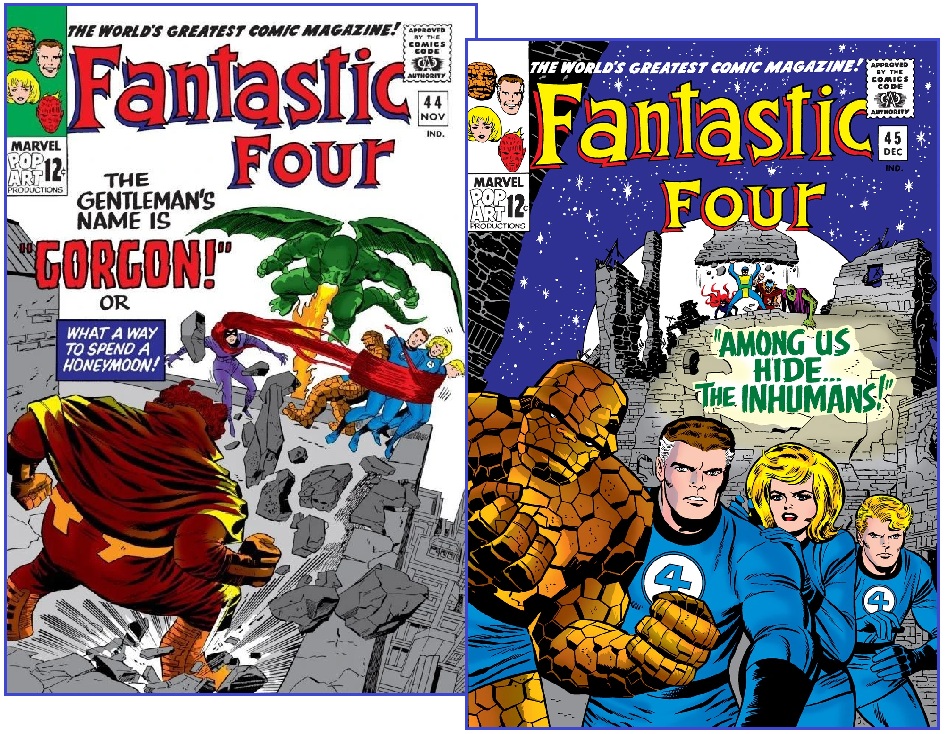
This episode adapts Fantastic Four #44-45.
Clyde Kusatu takes over the role of the Wizard for his brief appearance in this episode, replacing Ron Perlman. He also voices the inhuman Karnak. NCIS stalwart Rocky Carroll voices Triton, whilst Michael Dorn, of Worf fame, voices the impressive Gorgon. Kathy Ireland, the voice of Crystal, would later voice Ogress in The Incredible Hulk cartoon in the same continuity.
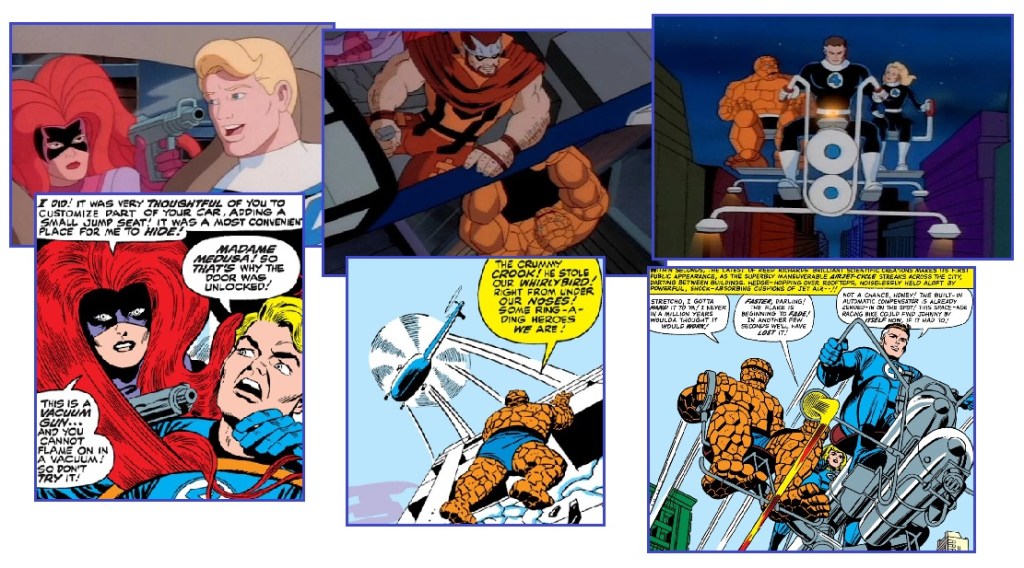
The Fantastic Four’s Jet Cycle first appears in this episode. It first appeared in comics in Fantastic Four #45.

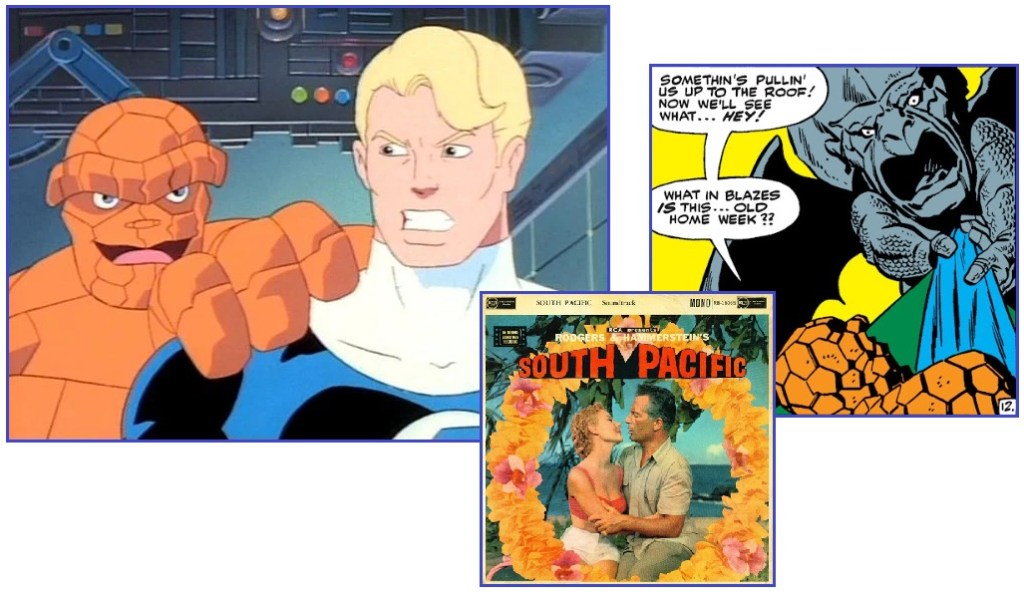
Ben’s best line this week: as he’s falling from a building, he grabs hold of a gargoyle on the way down – and promptly asks it what it’s looking at! He also sings “He’s gonna burn that red head out of his hair” to the tune of South Pacific’s ‘I’m Gonna Wash That Man Right Outa My Hair’ in regards to Johnny and Medusa.
CRYSTAL: ELEMENTAL HEART
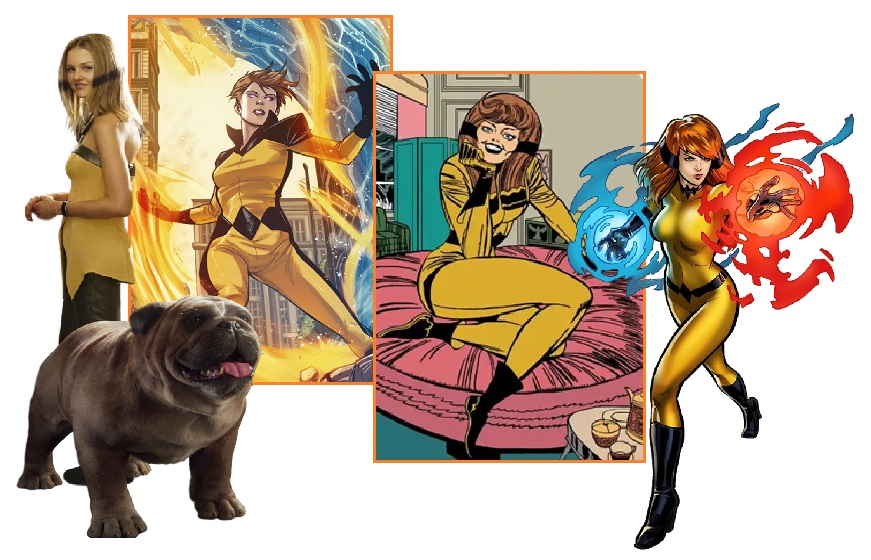
Crystal of the Inhumans first appeared in Fantastic Four #45 (1965), created by Stan Lee and Jack Kirby as part of the sweeping introduction of the Inhuman royal family. With her elemental powers – able to manipulate fire, water, earth, and air – Crystal quickly became a standout among her people. Unlike her more reserved sister Medusa or the silent king Black Bolt, Crystal was emotionally open, curious about the human world, and willing to cross boundaries others feared. She wasn’t just a princess – she was a bridge.
Her most iconic relationship began with Johnny Storm. Their romance was impulsive, fiery, and deeply felt – two young heroes from different worlds trying to make it work. For a time, Crystal even joined the Fantastic Four, filling in for Sue Richards during her maternity leave. But the pressures of politics, family, and identity eventually pulled her back to Attilan. Their breakup wasn’t explosive – it was bittersweet. Crystal loved Johnny, but she couldn’t deny who she was or where she belonged.
Crystal’s arc didn’t end there. She later married Quicksilver, Pietro Maximoff, in one of Marvel’s most politically charged unions – an Inhuman and a mutant, bound by love and strained by legacy. Their daughter, Luna, became a symbol of hope and division. As a mother, Crystal showed resilience and compassion, even as her marriage fractured. She joined the Avengers, proving herself as a capable leader and tactician, and later served as a diplomat for the Inhumans, often mediating between her people and the wider Marvel Universe.
Over the years, Crystal has evolved from a lovestruck teen to a seasoned warrior, mother, and ambassador. She’s fought alongside the X-Men, the Avengers, and her own royal family. Her powers remain formidable, but it’s her emotional intelligence and loyalty that define her. She’s one of Marvel’s most quietly enduring characters – never the loudest voice in the room, but often the one holding it together.
Crystal made her live-action debut in Marvel’s Inhumans (2017), portrayed by Isabelle Cornish. While the series struggled to find its footing, Crystal’s portrayal retained the character’s core traits: empathy, strength, and a deep bond with her teleporting dog, Lockjaw. Though the show didn’t explore her full potential, it marked her presence in the MCU-adjacent landscape. And for long-time fans, it was a reminder that Crystal’s story is far from over – she’s still the elemental heart of the Inhumans.
The Inhumans Saga (Part 1): And the Wind Cries Medusa | The Inhumans Saga (Part 3): Beware the Hidden Land




 X-Cess Minutiae
Leave a comment