


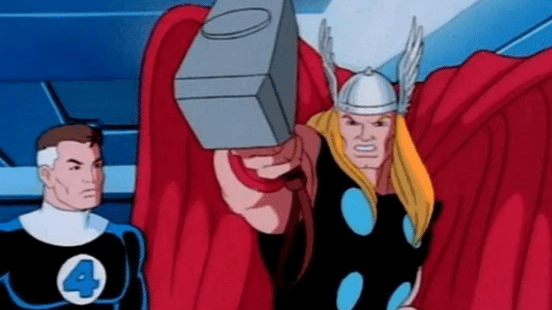
One of Marvel Comics’ greatest strengths has always been its shared universe – heroes crossing paths, stories bleeding into each other, and cameos that carry weight. It’s not just fan service – it’s worldbuilding. And in this episode, that tradition is alive and well. The Avengers make a brief but meaningful appearance, grounding the Fantastic Four’s cosmic crisis in a wider Marvel context. It’s a reminder that when the stakes rise, the whole universe feels it.
To Battle the Living Planet is widely considered one of the strongest episodes of the series. It’s stylish, well-paced, and epic in scope. The tension builds slowly, with global disasters and cryptic warnings, until the reveal of Ego – the sentient planet with a god complex. The payoff is earned, and the emotional beats land. Reed’s desperation, Sue’s concern, Johnny’s recklessness, and Ben’s loyalty all play out against a backdrop of planetary annihilation. It’s Marvel storytelling at its most operatic.
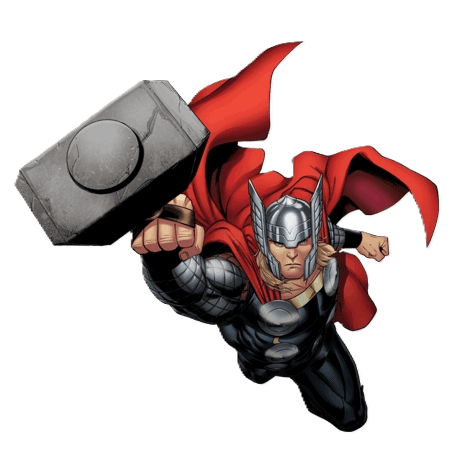
And then there’s Thor. Not just a cameo, but a presence. Wounded, noble, and still formidable, he brings mythic weight to the episode. Voiced by John Rhys-Davies – best known for Indiana Jones and The Lord of the Rings – Thor is given gravitas and warmth. Rhys-Davies delivers the dialogue with Shakespearean flair, elevating the character beyond the usual animated fare. It’s casting that understands the role: Thor isn’t just a warrior – he’s a god with a heart.
This episode doesn’t just battle a living planet. It battles scale, emotion, and legacy. And it wins.
At Four Freedoms Plaza, the team’s celebration is interrupted by global disasters – earthquakes, floods, and volcanic eruptions. When Thor’s hammer crashes through the building, Reed deduces it’s a summons. The Fantastic Four launch into space, tracking Mjolnir to a wounded Thor and a new threat: Ego, the Living Planet.
Ego’s surface is hostile, sentient, and moving toward Earth. The team lands and discovers massive thruster engines powering Ego’s trajectory. But their attacks fail – only Galactus, the being who exiled Ego, can destroy them. Reed and Thor travel to Galactus’s domain, where Reed bargains for help: Ego’s destruction in exchange for lifting Galactus’s vow to spare Earth.
Meanwhile, Sue, Johnny, and Ben infiltrate Ego’s core with a volatile power pack. As Galactus and Ego clash in space, Thing reaches the planet’s brain and detonates the device. Thor rescues him moments before Ego explodes.
Back aboard their ship, the team reunites. Galactus appears, reminding Reed of their deal. He’s not hungry now – but one day, he will be. The Fantastic Four watch him vanish into space, knowing the cost of survival may come due.
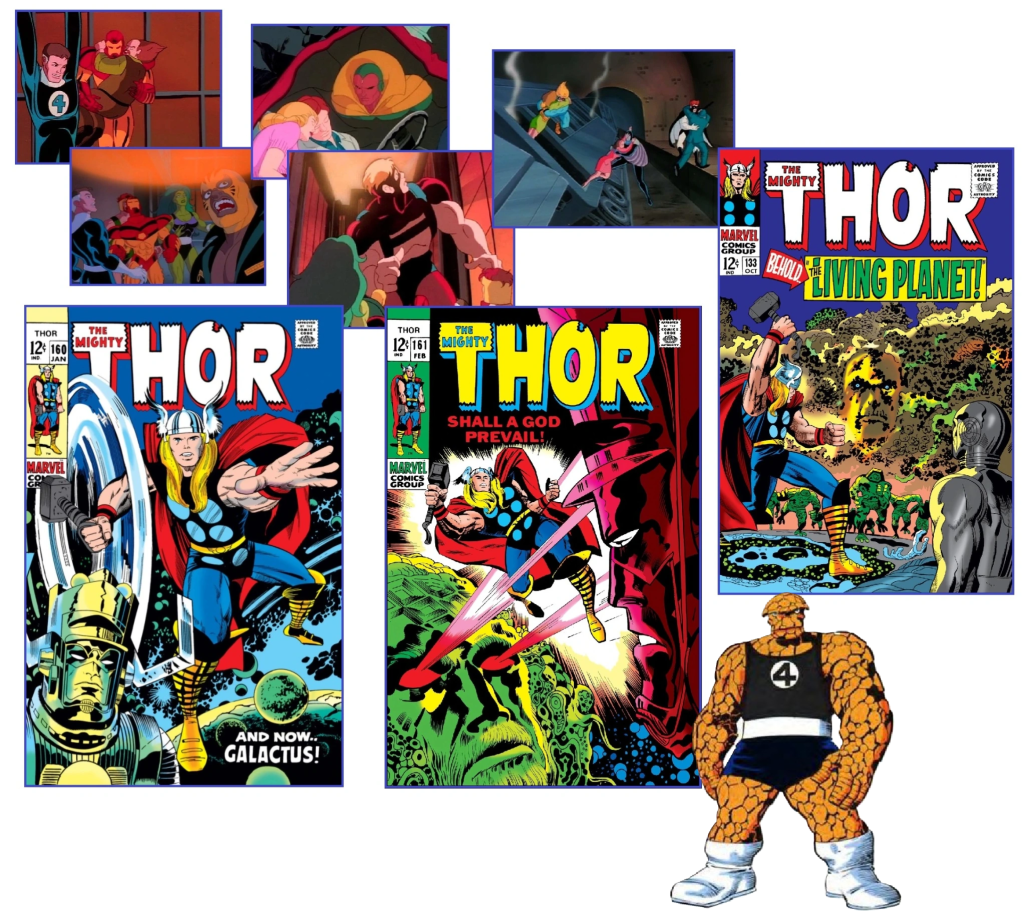
This episode is filled to the brim with Marvel cameos! The Avengers make their onscreen debut in this episode, although none of them speak. All will appear in later series set in this continuity: Iron Man, Captain America, the Wasp, Giant-Man, Vision and She-Hulk. Hercules and Rage are also on the roster.
We also see the New Warriors helping with civilians, specifically Speedball, Darkhawk and Justice.
This episode is an adaption of various different Marvel books: the bulk of the story comes from The Mighty Thor #160-161, but some of it also comes from Thor #133.
The Thing’s catchphrase from the comics – “What a Revoltin’ Development!” – can be heard for the first time in this episode. His line of the week: “‘I have an idea!’ – The scariest four words in the English language!” Also, he has the nerve to call Thor ‘The Fabio of the Fjords.” He’s also wearing his 80-90’s vest uniform for the first time.
COSMIC CONSCIOUSNESS: EGO, THE LIVING PLANET
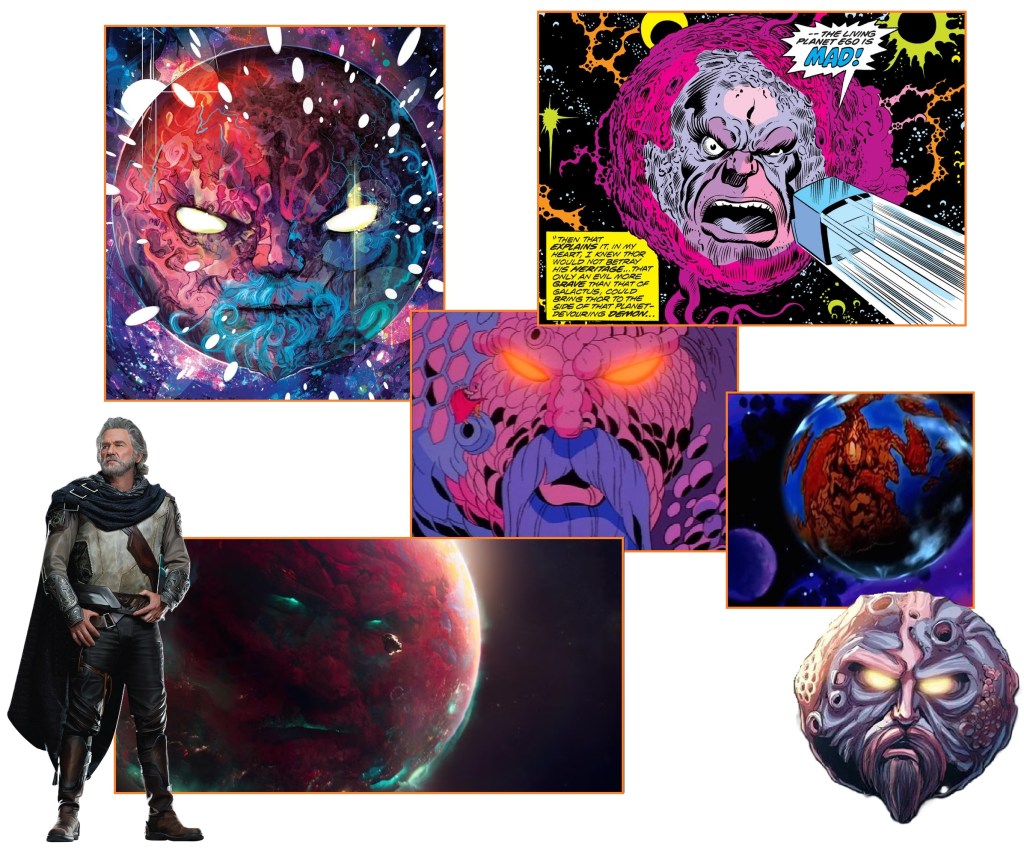
Ego first appeared in Thor #132 (1966), the brainchild of Stan Lee and Jack Kirby during Marvel’s golden age of cosmic invention. A sentient planet with a face and a will, Ego wasn’t just a villain – he was a concept. Kirby envisioned him as part of Marvel’s “space age mythology,” following Galactus and the Kree, expanding the idea that the universe itself could be alive, angry, and deeply personal. Ego wasn’t born – he was made, the result of a scientist merging with a planet during a supernova. And from that moment, he became a force of nature with a god complex.
In the comics, Ego has clashed with Thor, the Fantastic Four, Silver Surfer, and Nova. He’s absorbed starships, tried to conquer galaxies, and even attempted to become a god. His motivations shift – from survival to domination to existential dread – but his presence is always overwhelming. He’s not just a threat to Earth – he’s a threat to scale. When Ego moves, planets tremble. When he speaks, reality bends. And when he loses, it’s never permanent. He always finds a way back.
Ego’s most high-profile appearance came in Guardians of the Galaxy Vol. 2 (2017), where he was reimagined as a Celestial and the father of Peter Quill. Played by Kurt Russell, this version of Ego was charming, manipulative, and terrifying – a living planet with a human avatar and a plan to overwrite all life with himself. The film leaned into the emotional horror of Ego’s narcissism, making him less a cosmic threat and more a toxic parent writ large. He’s also appeared in What If…?, voiced again by Russell, and in various animated series and video games, always as a looming, planetary presence.
Ego isn’t just a villain. He’s a mirror. A reflection of unchecked ambition, cosmic loneliness, and the fear that intelligence without empathy becomes tyranny. He’s not evil because he’s big – he’s evil because he’s alone. And in the Marvel Universe, that makes him one of its most haunting creations.




 X-Cess Minutiae
Leave a comment