


Power is the thread running through this episode – who has it, who fears it, and who dares to claim it. Terrax wants it back. Galactus needs it to survive. The Fantastic Four fight to contain it. But it’s Frankie Raye who reframes the question. At the start, newly awakened to her flame powers, she tries to leave Earth behind – literally. She rockets toward the stars, desperate to escape the life she’s never felt part of. But her flames sputter out in the upper atmosphere, leaving her naked, falling, and alone. Johnny catches her before she hits the ground.
By the end, the roles reverse. Frankie has become Galactus’s new herald, imbued with the Power Cosmic. She ascends effortlessly, leaving Earth behind – not as a runaway, but as a chosen emissary. Johnny follows, but this time it’s his flames that fail. He watches her rise, powerless to follow, as she crosses the threshold he couldn’t reach.
This episode doesn’t just explore power – it interrogates its purpose. Terrax sees it as a weapon. Galactus sees it as sustenance. Frankie sees it as freedom. Her choice to save Galactus isn’t framed as sacrifice – it’s clarity. She doesn’t want to be rescued. She wants to matter. And in the vast silence of space, she finally does.
When Calls Galactus is one of the show’s most operatic entries – cosmic in scale, intimate in emotion, and mythic in consequence. It’s not just about saving the world. It’s about choosing your place in it.
And for Frankie Raye, that place is among the stars.
Still grieving his separation from Crystal, Johnny Storm meets Frankie Raye – a fiery redhead with powers eerily similar to his own. As a child, she was inadvertently doused in a chemical compound while snooping in her stepfather’s lab, unlocking latent abilities she’s long kept hidden.
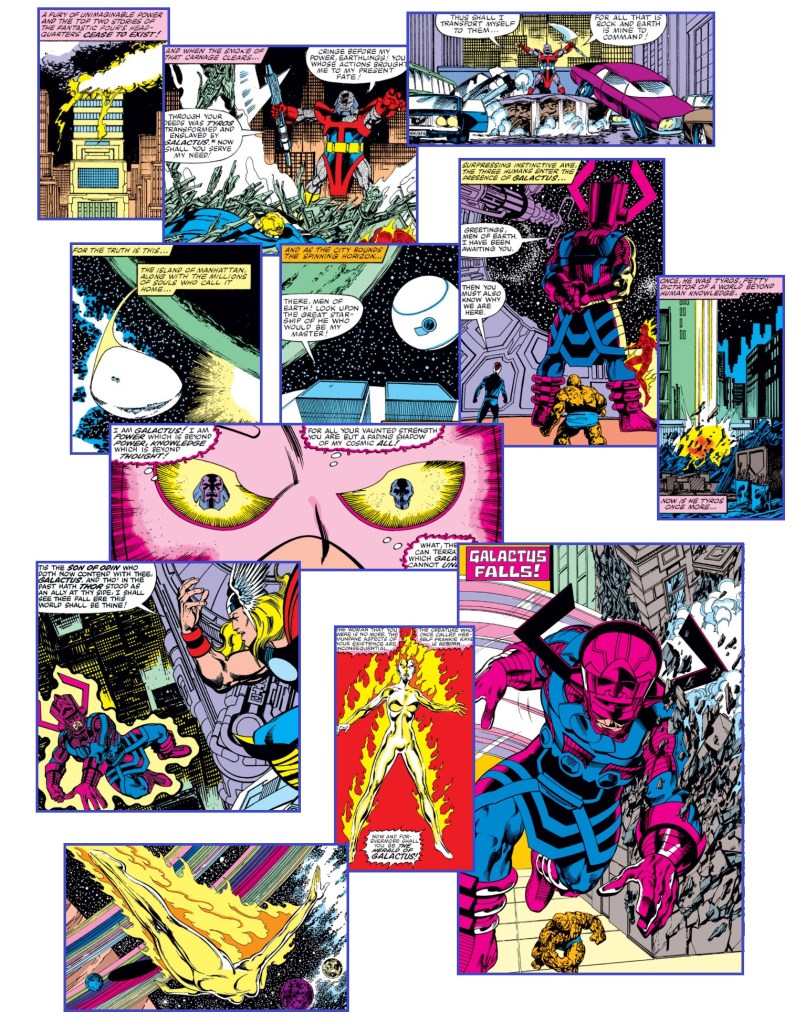
As the two connect, Manhattan is rocked by the arrival of Terrax, former herald of Galactus, who demands the Fantastic Four confront his old master. Reed learns Terrax has poisoned Galactus and now seeks protection from the only team to ever defeat him. Terrax rips the roof off Four Freedoms Plaza and, using his cosmic command of rock and minerals, lifts the entire island of Manhattan into the upper atmosphere. It’s only Sue Richards’ quick thinking that preserves the oxygen and saves the civilians.
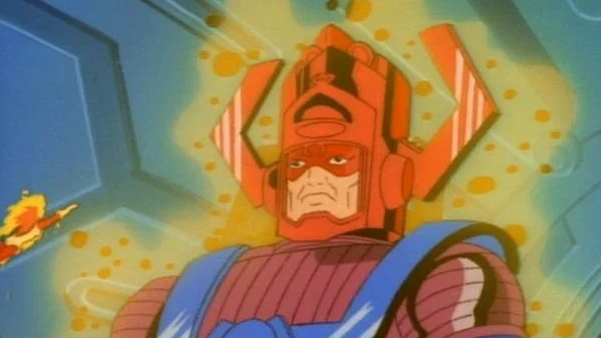
Galactus arrives, drawn by Terrax’s challenge. Still poisoned and ravenous, he strips Terrax of his power and casts him down to Earth. But weakened and desperate, Galactus declares that Earth must be consumed to restore his strength. The team resists, but Galactus is unstoppable – until Thor and Ghost Rider intervene. Thor wields Mjolnir, Ghost Rider unleashes the Penance Stare, and together they drive Galactus back. The World Devourer collapses in the streets of New York, dying.
Reed proposes restoring Galactus’s energy to spare the planet, but Frankie – moved by his suffering and drawn to the cosmic scale of his existence – volunteers to become his new herald. She says goodbye to Johnny, choosing the stars over Earth. Galactus accepts, sparing the planet and departing with Frankie at his side.
Before leaving, Galactus tells the Four that for saving his life, he will once again agree to spare Earth. And perhaps, for the first time, he has found the only creatures in the cosmos he might call friends.
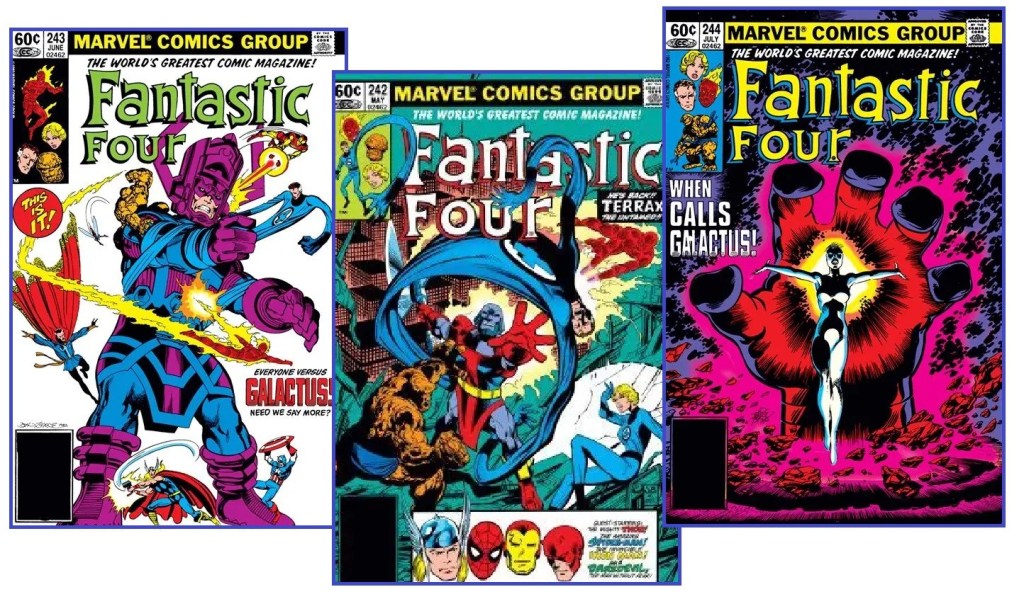
The story is based on Fantastic Four #242-244.
Although Frankie’s step-father is not mentioned by name, he is Dr. Phineas Horton – the creator of the original Human Torch in 1939’s Marvel Comics #1.
Ben needs reminding who Terrax is, after first meeting him in The Silver Surfer and the Coming of Galactus. Line of the week: when faced with Terrax and Galactus, as well as Thor and Ghost Rider, Ben compares the event to a superhero convention and tells the others “Nuts – And I wanted the weekend off!”
Frankie’s flammable clothing, given to her by Johnny, is the same uniform she wore after she joined the Fantastic Four, temporarily, in Fantastic Four #239.

This version of Frankie Raye believes she is destined for something more. Her counterpart in the Silver Surfer animated series shares this, and it’s even implied this is her mutant ability. The two series are difficult to reconcile continuity-wise, mainly due to Frankie’s double origin as Nova.
Tony Jay makes his final appearance as Galactus in the series. John Rhys-Davies makes a delightful cameo as Thor, in a direct sequel to his last appearance in To Battle the Living Planet.
A man can be seen, watching when Terrax attacks Four Freedoms Plaza. He’ll turn up again, two episodes later in Behold, A Distant Star.
Ghost Rider appears here, very briefly, showing off his powers, and then disappearing just as fast. Ben even makes a joke about it. Richard Greico voices him in this episode, and will again in The Incredible Hulk episode Innocent Blood, which serves as a backdoor pilot for the character.
TERRAX THE TAMER: HERALD OF HATE, BREAKER OF WORLDS
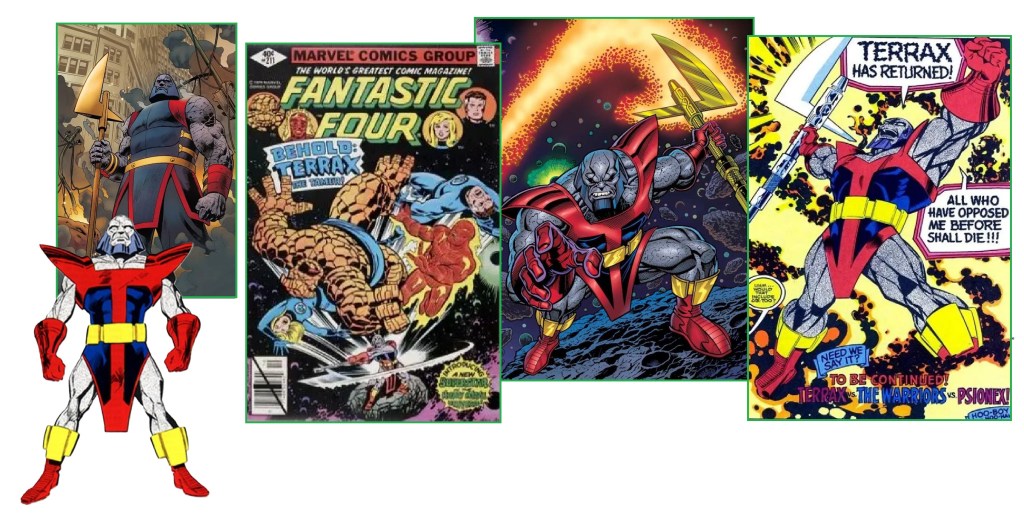
Terrax first appeared in Fantastic Four #211 (1979), born Tyros the Terrible, a dictator ruling the city-state of Lanlak on the planet Birj. He wielded limited control over stone and earth, using it to enforce his brutal reign. But it was his appetite for domination that caught the eye of Galactus. The Devourer of Worlds didn’t want another noble herald – he wanted someone ruthless. When the Fantastic Four subdued Tyros at Galactus’s request, the cosmic entity transformed him into Terrax the Tamer, amplifying his powers to planetary scale.
Unlike Silver Surfer or Firelord, Terrax didn’t struggle with morality. He embraced the role. He tore through galaxies, raised continents, and threatened entire civilizations. His control over rock and terrain made him a force of nature, and his cosmic axe became a symbol of brute power. But Terrax’s arrogance was his undoing. He defied Galactus, tried to hold Earth hostage, and even lifted Manhattan into orbit in Fantastic Four #242. Galactus responded by stripping him of his power and casting him down.
Terrax survived – barely. He was later revived by Doctor Doom, who used him as a pawn in his own schemes. But without the Power Cosmic, Tyros was unstable, violent, and self-destructive. He clashed with the Fantastic Four again in Fantastic Four #260, this time in a Queens supermarket, where he was ultimately consumed by the very power he once wielded. It was a fall from cosmic grace – brutal, messy, and strangely human.
Over the years, Terrax has returned in various forms – sometimes re-empowered, sometimes broken. He’s fought the Silver Surfer, tangled with the Annihilators, and even appeared in Dazzler, where he was hunted down for going rogue. He’s not a tragic figure. He’s a cautionary one. A herald who mistook power for purpose, and conquest for legacy.
Terrax endures because he represents the darker side of cosmic Marvel – the part that doesn’t seek redemption, only dominance. He’s not subtle. He’s not conflicted. He’s the sound of planets cracking and cities falling. And in a universe full of gods and monsters, sometimes the loudest voice is the one that refuses to kneel.




 X-Cess Minutiae
Leave a comment