


This is the episode where everything starts to settle – just long enough to be shattered. The Sentry Sinister plays like the last issue before a double-sized finale: threads are tied, couples reunite, cities fall, and the cast is reshuffled for what’s coming next. It’s not just a battle with a rogue Kree war machine – it’s the quiet reckoning of a season’s worth of emotional fallout.
Sue insists on a vacation, hoping to restore the team’s emotional balance after weeks of loss and upheaval. Reed, Ben, and Johnny are fractured, each carrying the fallout of Franklin Storm’s death and the moral reckoning that followed. But even paradise isn’t safe. Beneath the island lies Sentry 459, a Kree war machine built to protect the Inhumans and eliminate threats without question. It doesn’t evolve. It doesn’t forgive. It executes.
Meanwhile, deep beneath the sealed dome of Attilan, Black Bolt searches for a way to free his people from the barrier Maximus erected during his hostile takeover. The solution may lie in destabilizing the force field – but doing so could risk the lives of every Inhuman inside. The episode interweaves two threads: the Four battling a relentless machine with no off-switch, and Black Bolt weighing the cost of liberation against survival.
The Sentry proves nearly unstoppable, shrugging off attacks and adapting to every tactic. Reed’s intellect, Sue’s precision, and Ben’s brute force are pushed to their limits. The battle is less about defeating the Sentry and more about understanding it – decoding its programming, its purpose, and the ancient war it was built to fight. It’s a fight against history, not just hardware.
The Sentry Sinister is a direct adaptation of Fantastic Four #64, and a thematic companion to Hopelessly Impossible, which shows Johnny’s solo adventure while the others are away. Together, the episodes explore isolation, legacy, and the cost of forgotten wars. The Kree Sentry isn’t evil – it’s obsolete. And in the Marvel Universe, that’s often the most dangerous kind of enemy.
At Sue’s insistence, the Fantastic Four take a much-needed vacation to recharge before their next mission. Reed and Ben agree, but Johnny opts to stay behind at Four Freedoms Plaza, keeping watch over home base. The trio heads to remote Tivua Island, hoping for rest – but paradise quickly turns perilous. Beneath the surface lies a dormant Kree Sentry, an ancient war machine programmed to protect the Inhumans and eliminate all perceived threats.
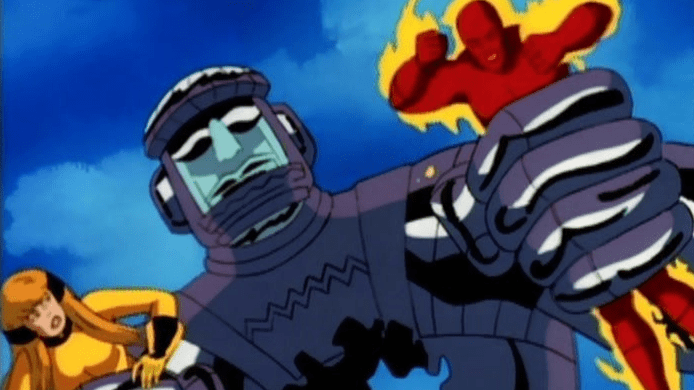
The Sentry awakens and attacks, misreading the Fantastic Four’s presence as hostile. Reed’s attempts to reason with it fail. The machine adapts to their powers, forcing the team into a desperate battle. Ben is injured. Sue’s shields strain. Reed scrambles to decode the Sentry’s programming before it wipes out everything in its path. Eventually, Ben defeats the robot, leaving it in pieces – or so he believes.
Meanwhile, deep within the sealed dome of Attilan, Black Bolt discovers a potential method to dismantle the force field Maximus erected during his hostile takeover. But the solution carries risk. The energy required could destabilize the city and endanger every Inhuman inside. Black Bolt must choose: liberation or survival. After gathering his people in shelters – and despite Maximus’s pleas – Black Bolt speaks. His voice shatters the barrier with an earth-shaking boom, freeing Attilan but destroying it in the process. As the Inhumans vow to rebuild and re-enter the world, Black Bolt silently gives Crystal permission to find Johnny Storm.
Johnny is stunned when Crystal and Lockjaw appear at Four Freedoms Plaza, and the lovers reunite. They leave for an impromptu date, but Lockjaw remains behind.
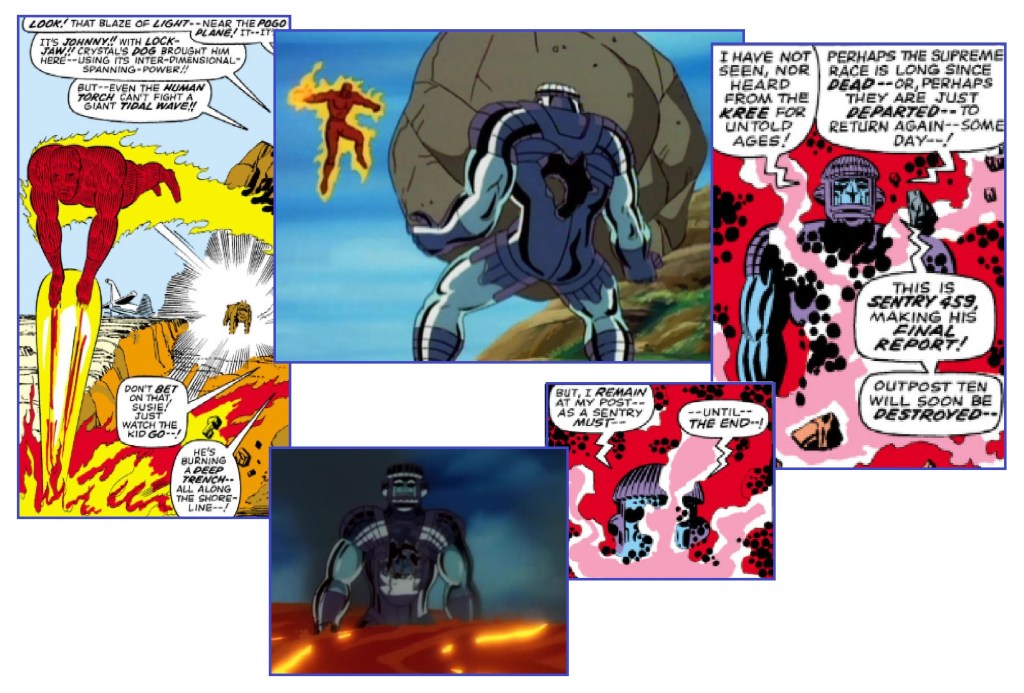
On the island, the Sentry reactivates and again targets the team. Before they’re overwhelmed, Sue sends a distress signal – seen only by Lockjaw. He interrupts the lovers’ date and teleports Johnny and Crystal to the island, where together, the five defeat the robot in molten lava.
The Sentry knowingly remains at his post, sinking beneath the volcanic eruption – performing his duty until the end. As the Four arrive home, Ben realises that walking Lockjaw – through numerous dimensions – won’t be as easy…
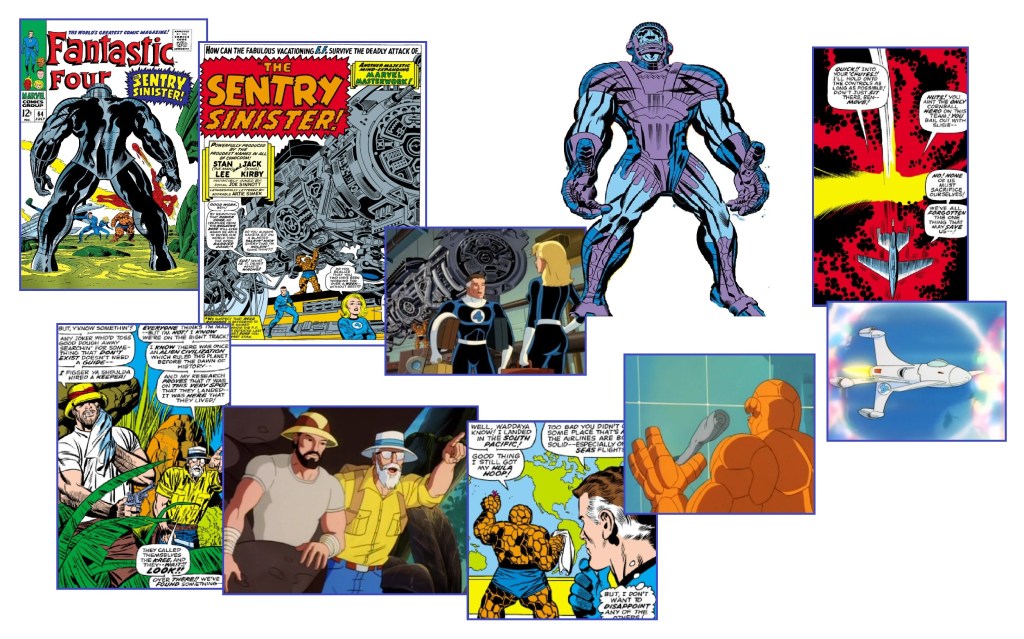

As noted above, the majority of the story for this episode comes from Fantastic Four #64, but the Inhuman plot line is from Fantastic Four #59.
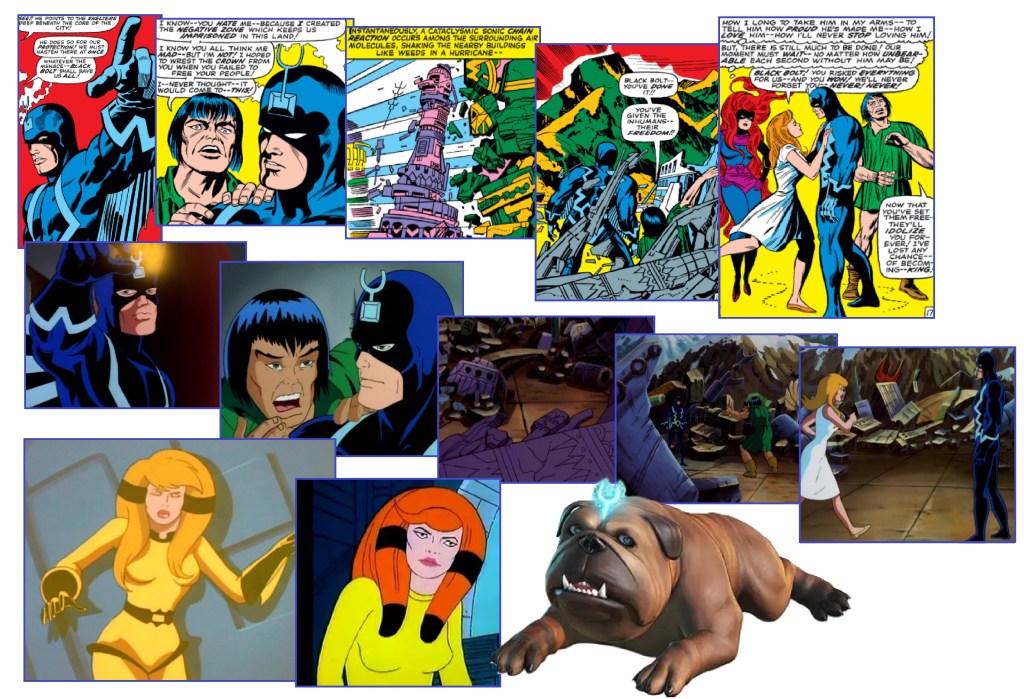
This is the first episode to feature Crystal in her yellow and black uniform that would remain synonymous with the character’s look for decades.
SENTRY 459: GUARDIAN OF KREE SECRETS
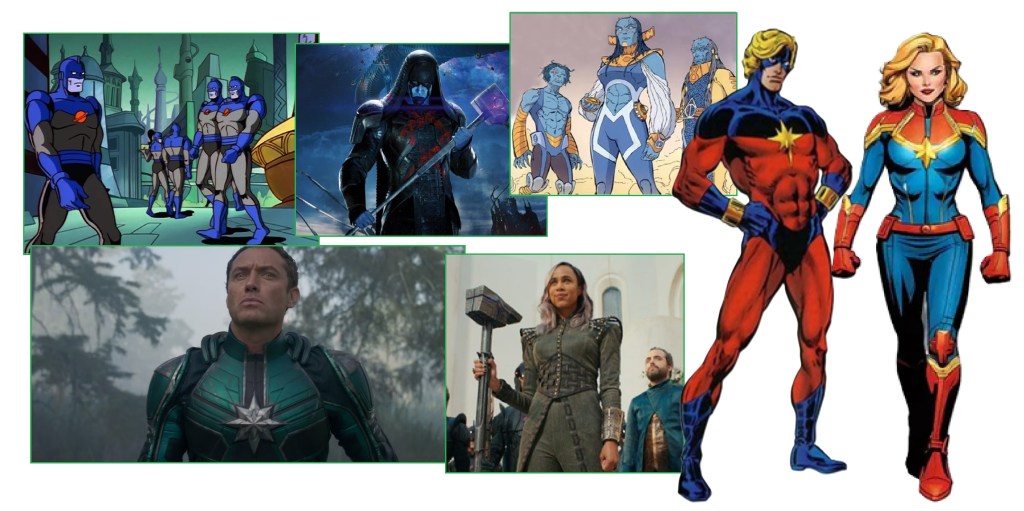
The Kree Empire doesn’t dabble – it dominates. A militaristic, expansionist race introduced in Fantastic Four #64 (1967), the Kree arrived on Earth not to conquer, but to experiment. They saw potential in early humans – genetic instability ripe for manipulation – and created the Inhumans as a living weapon. To monitor their progress, the Kree deployed a series of robotic sentries across the galaxy. The most infamous of these was Sentry 459, stationed on a remote Pacific island and programmed to observe, report, and, if necessary, eliminate.
Sentry 459 isn’t just a robot – it’s a relic of empire. Built with hurricane-force air jets, energy blasts, and self-repairing tech, it’s designed to survive millennia. It first activated when archaeologist Daniel Damian stumbled into its subterranean base, triggering a confrontation with the Fantastic Four. The battle was brutal, but the Four escaped, prompting the Sentry to send a distress signal to the Kree. That signal would echo across Marvel continuity, summoning Ronan the Accuser and setting off a chain of cosmic escalation.
Over the years, Sentry 459 has been reactivated, repurposed, and repelled. Colonel Yon-Rogg used it to try and kill Mar-Vell, the Kree’s own renegade champion. Ronan later deployed it in a scheme to reverse Earth’s evolutionary progress. It’s fought the Avengers, joined the villainous robot team Heavy Metal, and even been recruited by Ultron. Each time, it returns to its core directive: protect Kree interests, no matter the cost. It’s not evil – it’s loyal. And that makes it dangerous.
The Sentry’s presence always signals something larger. It’s a harbinger of Kree interference, a reminder that Earth is not alone, and not safe. Its battles with the Fantastic Four are never just skirmishes – they’re warnings. The Kree don’t forget. And when their sentries wake, it means the Empire is watching again.
Sentry 459 endures because it represents the cold logic of empire. It doesn’t evolve. It doesn’t forgive. It executes. And in a universe full of valiant heroes, sometimes the most terrifying enemy is the one that never stops doing its job.




 X-Cess Minutiae
Leave a comment