


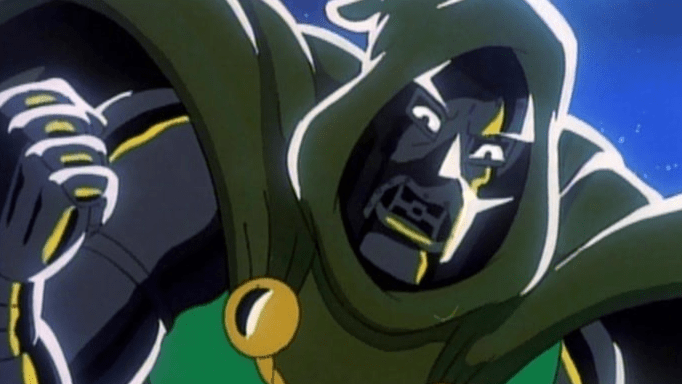
This is it. The last chapter. The culmination of a season steeped in grief, betrayal, and escalating cosmic threats. Doomsday doesn’t just close the book – it slams it shut with operatic force. Doctor Doom returns, not as a schemer in shadows, but as a god in daylight. He steals the Power Cosmic from the Silver Surfer once again, and this time, he doesn’t posture. He declares dominion over Earth, rewrites reality, and gives the planet one week to surrender. It’s not a bluff. It’s Doom unbound.
“Imagine,” he says, “I now possess the power to end hunger, to abolish disease, to eliminate crime… all under the benevolence of my iron will.” It’s the same strand we’ve seen before – Doom as saviour – but this time, it lands differently. This time, he plans to win. He separates the Four. He unleashes terror. The Avengers falter. The X-Men fall. And when the dust settles, it’s the Fantastic Four who remain. Their final battle is a masterclass in ensemble storytelling: every lesson learned, every loss endured, every bond tested comes roaring back in perfect sync. It’s not just a fight – it’s a reckoning.
And they don’t beat him with brute force. They beat him with irony. They make him angry. They make him change. From the architect of order to the tyrant of madness. From proclamations of peace to threats of universal enslavement. Doom loses not because he’s weak, but because he can’t stop proving he’s strong. And when he falls, it’s spectacular. The Silver Surfer watches, silent, and we’re left with the same truth he sees: power reveals character. And character, in the end, is what saves the world.
That Marvel can thread all this – cosmic scale, emotional fallout, philosophical weight – through four characters who still feel like a family? Seamlessly, with integrity and ease?
Well… that’s just fantastic, isn’t it?
As the Silver Surfer travels the Earth, he ponders existence. While drifting across Europe, he spots a woman in peril – beset by familiar-looking robots. Descending from the sky, he rescues Marta, who leads him to her remote cabin. But inside, the Surfer is greeted not with gratitude, but betrayal: Doctor Doom reveals himself. Marta attaches siphoning devices to the Surfer, and he collapses – his power once again under Doom’s command. The would-be saviour of Earth has unfinished business with the Fantastic Four.
In New York, Johnny and Crystal are out for the evening. Reed and Sue have retreated to a log cabin upstate. Ben Grimm remains behind, jumping at shadows. At first, he blames his scary zombie novel – until the walls come crashing in. A cosmically powered Doom confronts him, declaring Galactus far enough away to act. He immobilizes the Thing, leaving him a living statue in Central Park. Johnny and Crystal return to find the wreckage.
At the cabin, Sue urges Reed to leave work behind, but their moment is shattered by Doom’s arrival. He battles Mr. Fantastic and the Invisible Woman, while Johnny and Crystal locate and free Ben. With Lockjaw’s help, they teleport to Reed and Sue just in time to slow Doom down. But Reed shocks the team: there’s nothing they can do. He surrenders to Victor, who vows to keep them alive – to witness him save the world.
Doom gives Earth’s governments one week to capitulate. He defeats the Avengers and the X-Men with ease, while the Fantastic Four sit out the fight under Reed’s orders. Finally, Reed unveils a device and tests it on Ben. It slows him down and makes him furious – exactly what Reed hoped for. But Crystal warns: Johnny has lost patience and gone after Doom alone.
Doom dispatches the Human Torch easily. But the rest of the Fantastic Four arrive in Latveria to challenge the monarch. He battles them to a standstill, unfazed by Reed’s larger prototype device. When its energy blast appears useless, Doom cackles – until Reed calmly tells him: he can’t be sure.
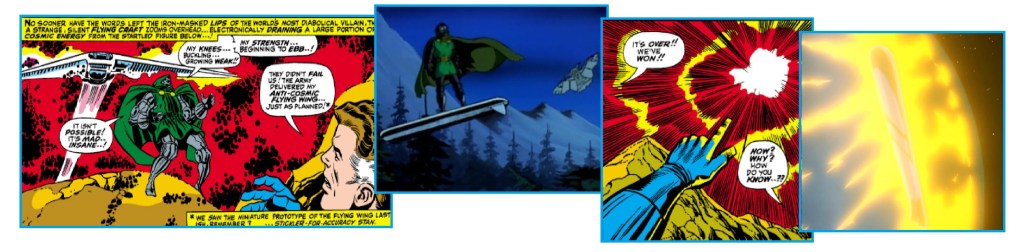
Victor, determined to prove his supremacy, chases the device into orbit. He follows it beyond Earth, into the depths of space – then screams in agony. A blinding flash signals his defeat. Reed reveals the truth: Doom’s stolen power couldn’t pass the barrier Galactus placed to contain the Surfer.
With his power restored, the Silver Surfer thanks the team and once again marvels at this strange, wondrous world he’s come to call home… and the fantastic family of friends who inhabit it.

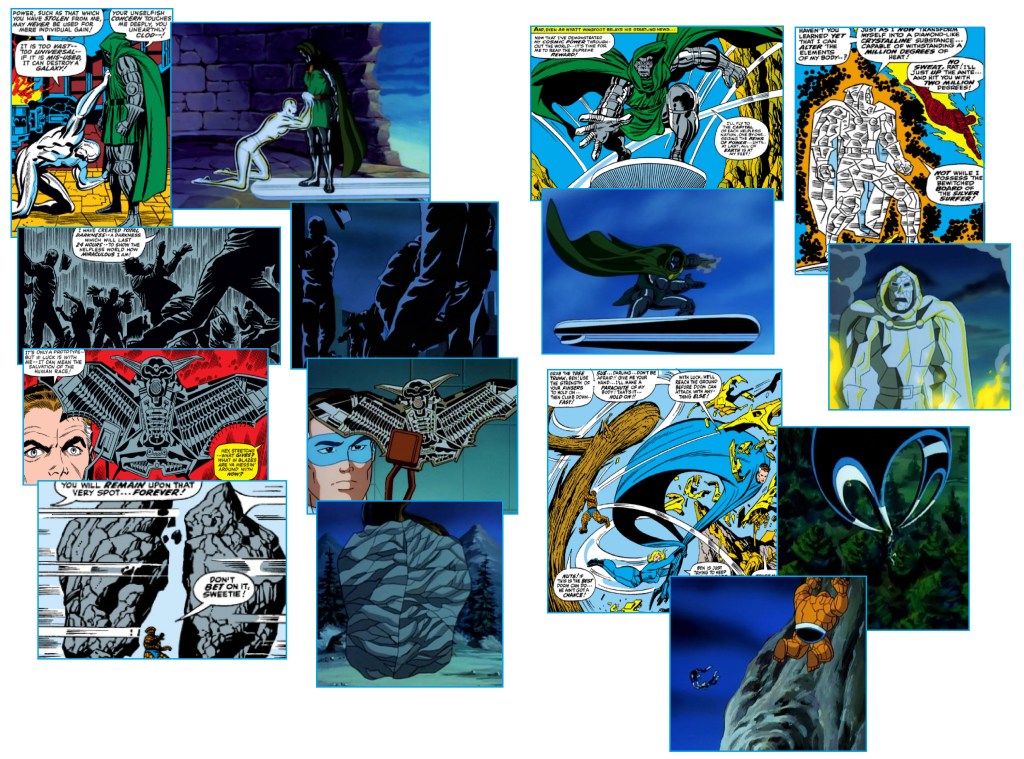
Once again, as with the first season finale The Silver Surfer and the Return of Galactus, the majority of the story is based on Fantastic Four #57-60, although this episode is far more in line with the comic book story. Indeed, Ben even mentions that Doom has stolen the Surfer’s power before.
Doom mentions the Thing crushing his hands from And a Blind Man Shall Lead Them. Although this episode implies he’s gone for good, he turns up again in The Incredible Hulk. Doctor Doom truly has all of the best dialogue this episode: when he leaves Ben as a statue in Central Park, he callously tells him “Do keep an eye out for pigeons.”
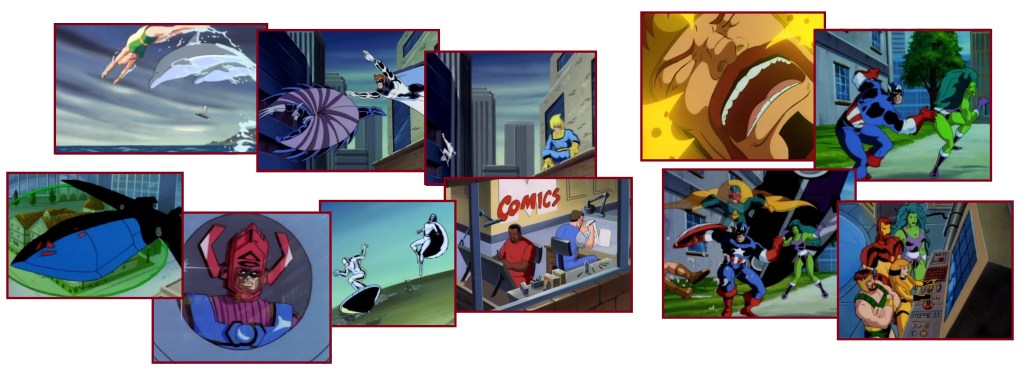
There’s cameos aplenty in this episode: Namorita, Darkhawk, Justice and Speedball, all of the New Warriors, can be seen racing around Manhattan; mutant X-Men ally Sabra can be seen in the sky; Doom attacks not only the Avengers, but also the X-Men’s Blackbird, which uses the same design as their own show. The Surfer also passes Marvel Comics – with what looks like Larry Houston, series producer, at the story board.
FANTASTIC FOUR-EVER!
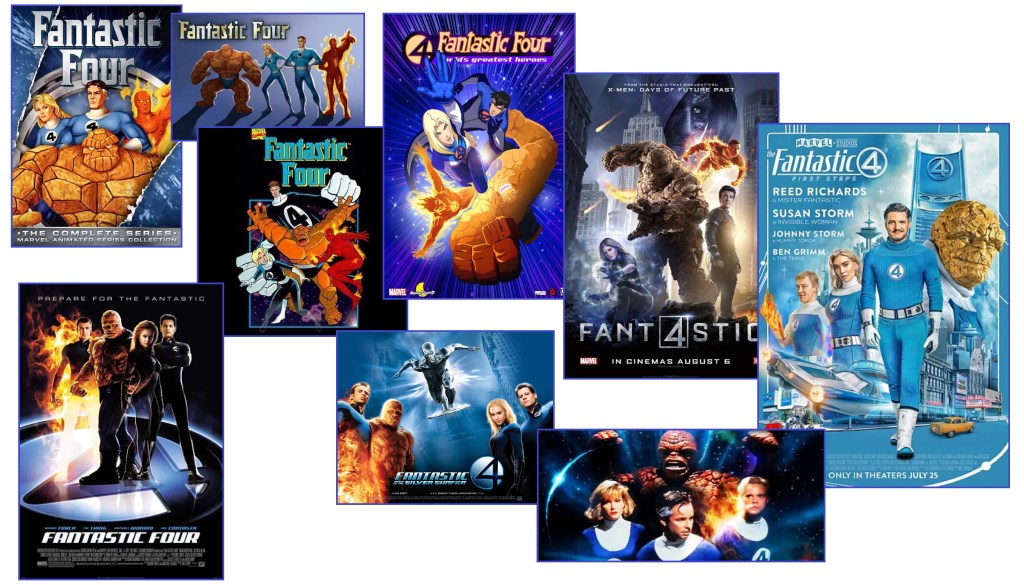
The Fantastic Four animated series was never just Saturday morning filler – it was a time capsule of Marvel’s mythic heart, refracted through the lens of mid-90s television constraints. It began unevenly, with clunky scripts and a theme tune that felt like it was written by a committee of saxophones. But by Season Two, the show found its rhythm: adapting Lee and Kirby’s cosmic sagas with surprising fidelity, threading ensemble dynamics, and leaning into the emotional fault lines that made the Four more than just a team – they were a family. And like all families, they bickered, broke, and rebuilt.
The stories chosen weren’t arbitrary. They were foundational texts: Galactus, the Inhumans, Doom’s ascension, the Surfer’s exile. These arcs defined the Fantastic Four’s place in the Marvel cosmology – explorers of the unknown, custodians of Earth’s weirdest frontiers, and emotional anchors in a universe that often forgets to feel. The show didn’t always have the budget to match its ambition, but it had heart – and a surprising commitment to continuity, even when the animation couldn’t quite keep up.
And there were plans for more. Had Season Three gone forward, supervising producer Tom Tataranowicz envisioned a bold pivot: Susan Storm pregnant with Franklin Richards, with the Sub-Mariner returning to complicate loyalties and deepen emotional stakes. Medusa and She-Hulk were slated to join as interim members, reshaping the ensemble and echoing the comic’s own evolutionary arcs. It would’ve been a season of transition – of legacy, lineage, and the mythic weight of parenthood in a world perpetually on fire.
Its legacy is quieter than some. It didn’t spawn a cinematic universe or dominate merch aisles. But it laid groundwork. The 2005 and 2007 Fantastic Four films lifted scenes and dynamics directly from it. And in the age of streaming retrospectives, the 1994 series has become a cult artifact: flawed, yes, but earnest. A love letter to the source material, written in the language of cel animation and Saturday morning optimism.
So we close the book not with a bang, but with a stretch, a flame, a force field, and a rocky fist. The Fantastic Four animated series didn’t redefine the genre – but it reminded us why these stories mattered. Why they endure. Why, even now, we still look to the stars and hope someone’s out there, saving the world not with power, but with love, loyalty, and a little bit of cosmic absurdity.




 X-Cess Minutiae
Leave a comment