


Apart from its quirky, almost biblical title, this one’s a strange beast. As Saturday morning fare, it’s loud, colourful, and kinetic – designed to sell toys and dazzle eyeballs. But like any long-running comic, there are arcs you treasure and arcs you endure. This feels like one of those early runs you sit through, hoping the creative team finds its footing somewhere down the line.
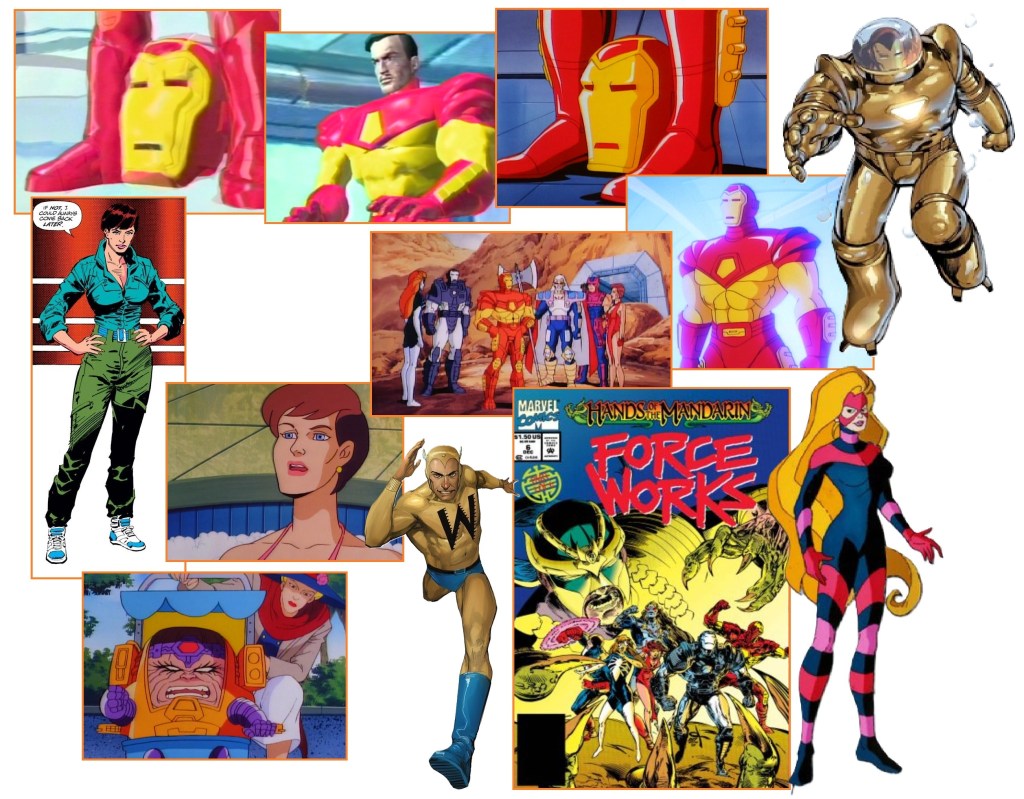
There’s ambition here, no doubt. The episode tries to bring Tony Stark’s world to life – with clunky CGI armouring-up sequences and a barrage of villains who feel like they’ve wandered in from three different books. But as a season opener, it’s overstuffed and undercooked. Seventeen characters are introduced, three of them (Spider-Woman, Scarlet Witch, and Hawkeye) without so much as a name drop. Heavy-hitters like Fin Fang Foom and Titanium Man show up, flex, and vanish. Titanium Man, in particular, gets the short straw – wrapped in asphalt and launched into orbit like a Soviet firework.
MODOK, meanwhile, appears mid-episode being pushed by Hypnotia in a pushchair, undermining any menace he might’ve had. The villains bicker, the heroes scramble, and the plot lurches forward like it’s trying to outrun its own exposition. There’s a sense that the writers wanted to build a world – but instead of laying foundations, they dumped the whole toolbox on screen and hoped something would stick.
And that’s the shame. The intention is there. The world is there. But it’s all crammed into twenty minutes of chaos, and the pacing never lets the characters breathe. Season One, especially in its early episodes, struggles to balance spectacle with story. It’s a series that wants to be mythic but keeps tripping over its own cape.
Still, for all its flaws, there’s something charming about the mess. It’s earnest. It’s trying. And if you squint past the noise, you can see the shape of something better waiting in the wings.
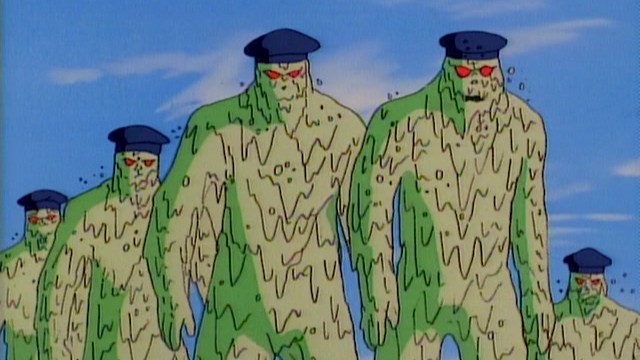
A year in the making, Mandarin’s masterstroke begins with a whisper beneath the waves. A Russian nuclear submarine vanishes off the coast of Norway, its crew hypnotised and transformed into radioactive zombies by Hypnotia’s eerie device. The Prometheus sinks, forgotten – until now. Mandarin, MODOK, and their rogue’s gallery of armoured misfits have waited twelve months to activate their undead army and unleash it on the world.
Tony Stark, mid-therapy and mid-flirt, is jolted from spa-side banter into full crisis mode. Whirlwind and Dreadknight raid Stark’s armoury in broad daylight, a distraction masking a deeper play. As Force Works scrambles, Tony suits up – red and gold, repulsors charged – and dives into the depths to investigate the Prometheus. But Mandarin’s forces are waiting. Blacklash, Grey Gargoyle, and Blizzard ambush Iron Man beneath the sea, while Fin Fang Foom, summoned like a Lovecraftian dragon, scorches the ocean floor.
War Machine and the rest of Force Works arrive just in time to mount a counteroffensive. Century bends time and space, teleporting the team into the abyss. The battle is chaotic, kinetic, and laced with techno-magic. MODOK’s plan unfolds: the zombie sailors breach the underwater tunnel linking Britain and Belgium, threatening to contaminate millions. Iron Man, battered and nearly brain-fried, rallies the team to collapse the tunnel and contain the outbreak.
But Mandarin has one last card to play: Titanium Man. The cybernetic juggernaut descends from orbit, a Soviet ghost in green armour, and pummels Iron Man and War Machine into the rocks. Together, they flip him, gift-wrap him in asphalt, and launch him into space – where he explodes in a fireball worthy of a Cold War finale.
In the end, redemption wins. Century restores the zombified sailors to their human selves, their lives reclaimed from Mandarin’s twisted experiment. Iron Man rockets skyward, victorious but wary. Mandarin, fists clenched and ego bruised, vows to return.
The title comes from the Christian Bible, specifically the book of Revelation, chapter 20, verse 14: “The sea gave up the dead that were in it, and death and Hades gave up the dead that were in them, and each person was judged according to what they had done.”
In season one, the same computer-generated scene was repeatedly used to show Tony Stark suiting up and Iron Man taking off. This often caused continuity issues since he would frequently be wearing different clothes or suiting up in a different environment.
Recurring character Veronica Benning is a physiotherapist who first appeared in Iron Man #292. She’s voiced by Jeanine Elias.
Robert Hays would later reprise Iron Man in both Spider-Man and The Incredible Hulk. James Avery, aka War Machine, is remembered by generations of fans, both as the voice of the Shredder in the original Teenage Mutant Ninja Turtles cartoon, as well as Uncle Phil in The Fresh Prince of Bel-Air. Voice of the Mandarin, Ed Gilbert, was Dormammu in Spider-Man, General Hawk in GI Joe and Baloo in Talespin. Jim Cummings (MODOK) is the voice of Winnie the Pooh and Tigger.
Hypnotia was created specifically for this animated series and has never appeared in any other medium.
Despite appearing in costume and seen using their powers and abilities, Hawkeye, Spider-Woman and the Scarlet Witch aren’t named in the episode, instead only being credited on the end titles. Wanda is listed as ‘Wanda Frank’ – a name she went by when she believed her father was Robert Frank, aka the Whizzer.
This episode takes place over the course of a whole year. Iron Man hints that the team has faced the Mandarin before. The team isn’t called Force Works anywhere in the first season.
Armour Watch: First episode out and Tony’s rocking the underwater armour as he investigates the Russian submarine.
UNMASKING THE MANDARIN
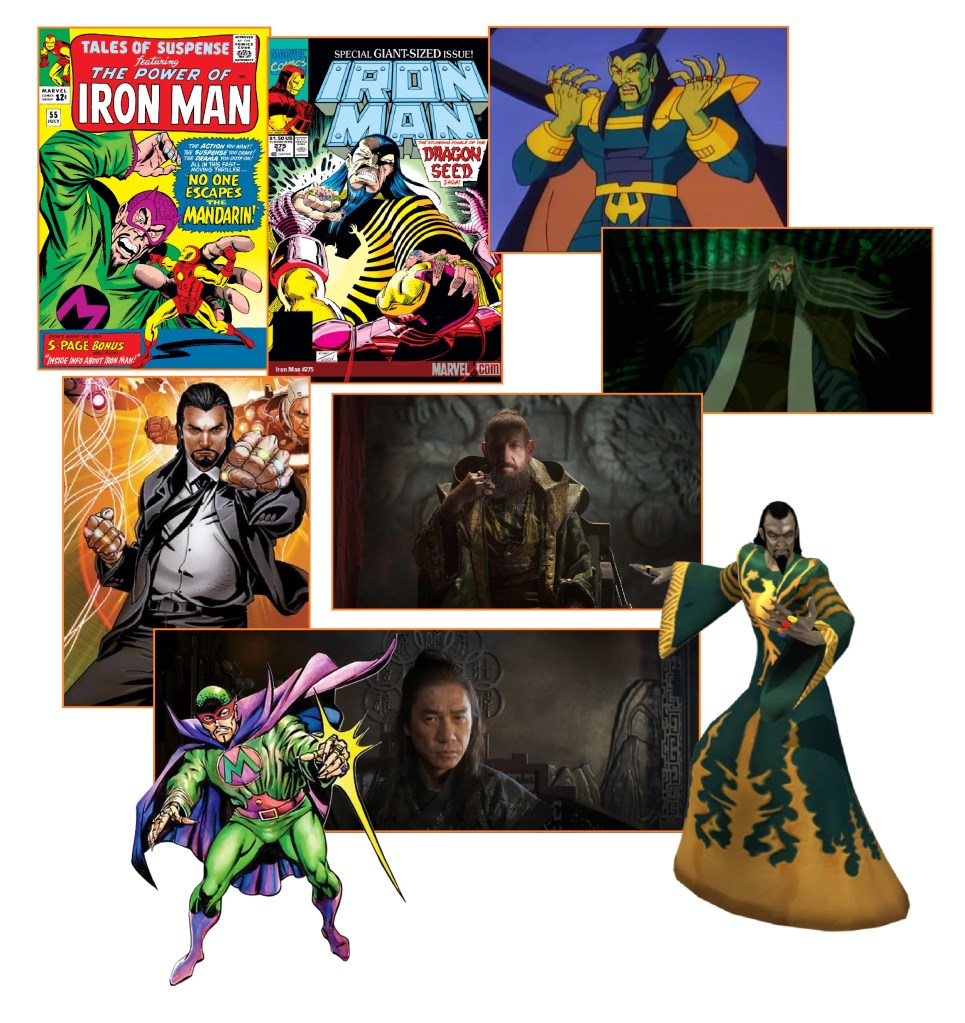
The Mandarin has always been a figure of contradiction – part warlord, part wizard, part technocrat. First introduced in Tales of Suspense #50 (1964), he was crafted as Iron Man’s ideological opposite: a villain who fused alien technology with ancient mysticism, and who challenged Tony Stark’s sleek futurism with something older, darker, and more theatrical. But beneath the rings and rhetoric, the character was born from Cold War paranoia and orientalist tropes – an amalgam of Western fears about the East, wrapped in pulp villainy and exoticism.
Over time, the Mandarin evolved. Writers reimagined him as a tragic figure, a self-made myth, a man chasing power to rewrite his own history. His ten rings – each with distinct alien abilities – became symbols of control, obsession, and cosmic reach. But the visual language never quite escaped its roots. In animation, especially Iron Man, the Mandarin was rendered with unmistakably green skin. Not because he was alien, but because green had become a shorthand – a way to signal “foreign,” “other,” and “dangerous” without naming race outright.
The truth is uncomfortable: the green was a racial proxy. In the absence of nuance, colour became code. Green skin allowed animators to sidestep direct caricature while still evoking the “Yellow Peril” imagery baked into the character’s origin. It was a design choice meant to soften the blow, but it didn’t erase the undertones. The Mandarin’s robes, accent, and mysticism still leaned heavily on pan-Asian aesthetics, often without cultural specificity or respect. He was a villain built from Western anxieties, not Eastern authenticity.
Live action has tried to course-correct. Iron Man 3 gave us Trevor Slattery – a decoy Mandarin, a commentary on fear as performance. Shang-Chi and the Legend of the Ten Rings introduced Xu Wenwu, a character who carried the Mandarin’s legacy but redefined it with emotional depth, cultural grounding, and narrative dignity. These versions didn’t just update the character – they interrogated him. They asked what it means to inherit a name built on stereotype, and whether mythic power can be reclaimed without perpetuating harm.
So yes, the Mandarin was green. Not because of magic, but because of metaphor. And in reckoning with that, we see the evolution of comic storytelling itself – from pulp to prestige, from caricature to complexity. The Mandarin remains a mirror: of Iron Man, of the era that birthed him, and of the audience still learning to see past the colour and into the character.




 X-Cess Minutiae
Leave a comment