


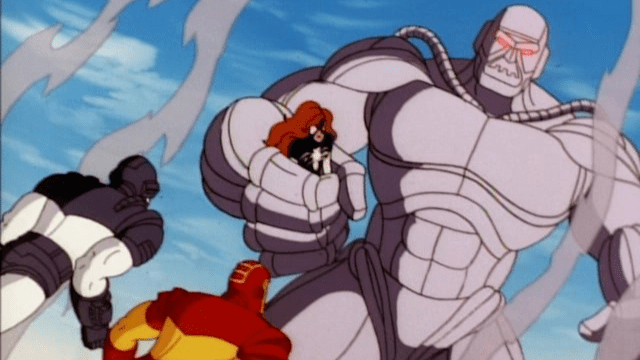
This one’s about power. Not the kind you earn, or even the kind you steal – but the kind that predates you. Alien power. Forgotten power. Power that doesn’t care who’s holding the remote. Mandarin, ever the egotist, believes he can command it. MODOK, ever the technician, believes he can quantify it. But Ultimo isn’t a weapon. It’s a presence. A machine with no mission statement. A deliverer with no clear delivery.
There’s something unsettling about that. In a world of supervillains with monologues and heroes with trauma, Ultimo is blank. It doesn’t speak in ideology or vengeance – it just is. It wakes, it walks, it burns. And Mandarin, who thrives on control, finds himself outmatched not by strength, but by silence. He wants to bend Ultimo to his will, but Ultimo doesn’t bend. It barely acknowledges him.
The episode dances around this discomfort. Alien technology is usually a shortcut to power in this universe – rings, suits, portals. But here, it’s a reminder that not all power is meant to be understood. Ultimo’s origin is vague, its purpose unclear. It’s not here to conquer, or liberate, or avenge. It’s here to deliver. But what? And to whom? The episode never tells us. And that ambiguity lingers like radiation.
Iron Man, for all his brilliance, doesn’t solve Ultimo – he survives it. Force Works doesn’t defeat it – they delay it. And Mandarin, who summoned it with fanfare and prophecy, ends the episode retreating, humiliated. The lesson isn’t just that power corrupts – it’s that power, when alien and ancient, doesn’t care about your plans. It moves through the world like weather.
So rejoice, says Ultimo. But there’s no joy in its wake. Just scorched earth, broken egos, and a lingering question: what were we being delivered from?
It begins with thunder. Mandarin, ever the theatrical tyrant, awakens a sleeping giant from the ruins of a forgotten volcano – an alien automaton wrapped in bandages and mystery. Ultimo. A weapon of ancient design, its purpose lost to time, its power untouched by even Mandarin’s rings. MODOK and Justin Hammer protest, but Mandarin insists: this is his deliverer. And when Ultimo finally stirs, vaporizing its handlers and declaring itself reborn, the storm truly begins.
Ultimo marches across continents, flattening docks, villages, and bunkers with the casual indifference of a god. Mandarin tries to claim it, fails, and tries again – attaching a control template to its skull and bending it, briefly, to his will. Iron Man, mid-party on the Iron Maiden, is pulled from champagne and small talk into a crisis that defies science. He suits up, dives in, and is promptly crushed. Captured. Tortured. Mandarin wants answers – who wears the armour, what secrets lie beneath. MODOK wants barbecue.
Force Works scrambles. War Machine, Hawkeye, Scarlet Witch, Spider-Woman, and Century all mobilize, each bringing their own chaos to the desert. But Ultimo is relentless. It drains the planet’s core, triggers earthquakes, and nearly crushes Julia in its grip. Century’s mystic axe barely slows it. Scarlet Witch’s hexes reveal its interdimensional control code. Iron Man, barely alive, returns with a plan: one shot, one arrow, one chance. Hawkeye delivers. The cosmic window opens. The arrow lands. Ultimo falls.
Mandarin retreats, vowing to reclaim the fallen titan. MODOK converts their saucer into a subterranean borer and vanishes into the earth. Ultimo is recovered, restrained, and placed under Stark surveillance. But its eyes glow red in the dark. The deliverer sleeps – but it dreams.
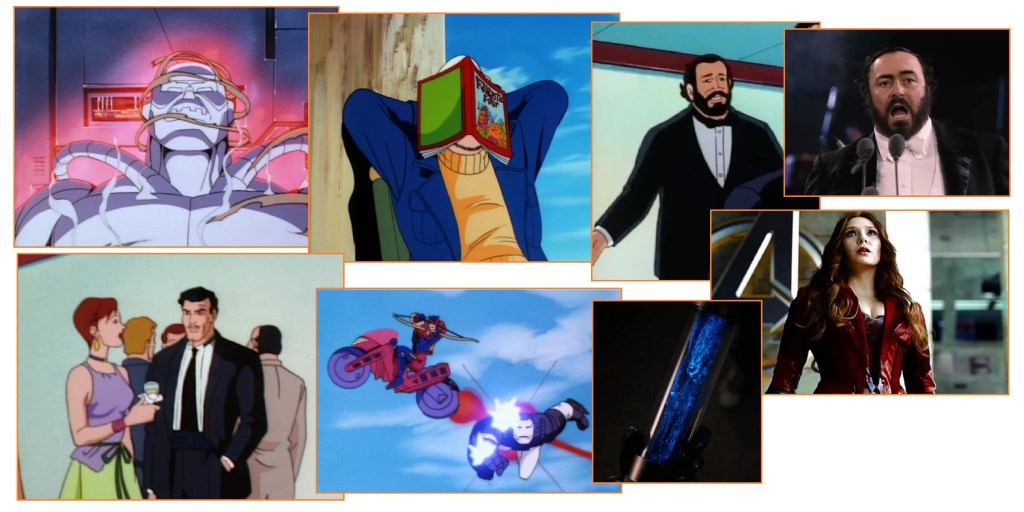
When Ultimo reaches the Italian coastline, the spectator who first spots him is reading a copy of Fantastic Four #1.
Veronica Benning is also attending the party on the yacht, as well as Luciano Pavarotti, the late opera star. There’s also a mention of George Lucas and his sci-fi movie history.
Hawkeye uses his motorbike as a sky-cycle, as he has in the comics.
Wanda has a European accent, whilst in X-Men she doesn’t. The Marvel Cinematic Universe’s Scarlet Witch lost hers overtime. She also has it in Avengers: United They Stand.
Vibranium is mentioned: despite Reed Richards not learning of it until Prey of the Black Panther.
FORCE WORKS: FROM COASTLINE TO COMBAT
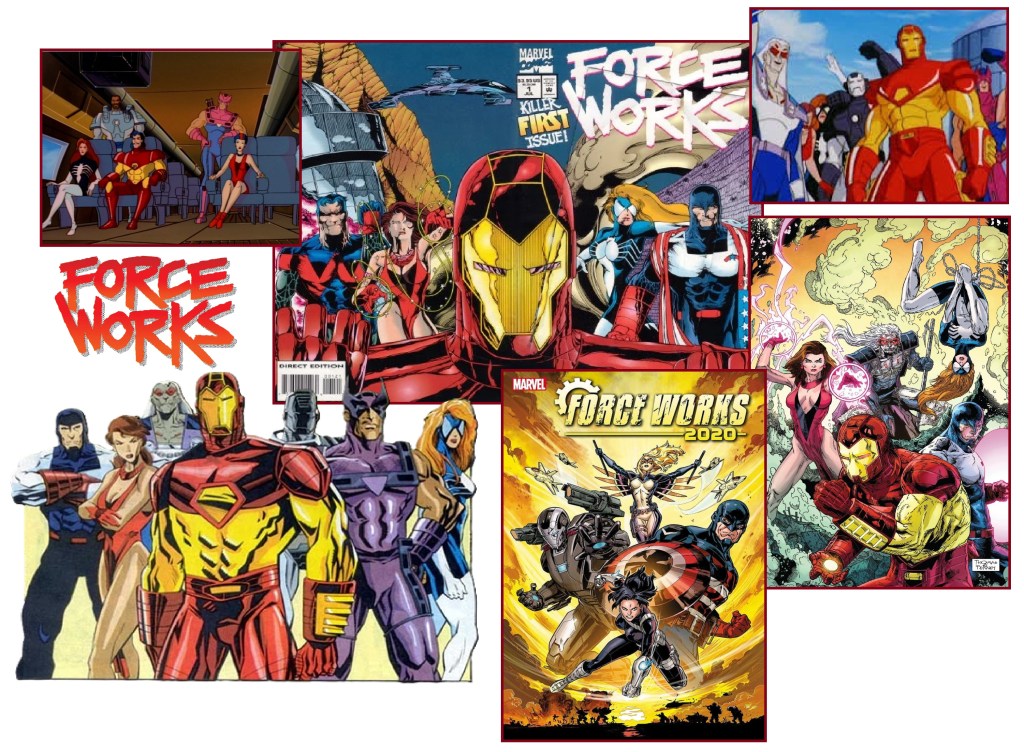
Force Works wasn’t born – it was repurposed. A phoenix rising from the ashes of the West Coast Avengers, the team emerged not from triumph, but from fracture. When the West Coast branch was deemed obsolete, Iron Man cast the deciding vote to disband it – then promptly led the walkout. What followed was a pivot: away from reactive heroics and toward proactive intervention. Force Works wasn’t about saving the day – it was about preventing the disaster before it happened. A militarised unit with predictive tech, mystic algorithms, and a mandate to act first and ask later.
In the comics, the line-up made sense. Iron Man, Scarlet Witch, Spider-Woman (Julia Carpenter), U.S. Agent, and Wonder Man – each a veteran, each carrying baggage. They weren’t idealists; they were bruised pragmatists. After Wonder Man’s apparent death, the alien warrior Century joined, bringing interdimensional gravitas and a touch of cosmic dread. Their base, The Works, was a Stark-funded fortress run by the AI P.L.A.T.O., complete with nanotech repairs and hard-light holograms. It was less a clubhouse and more a command centre – part Avengers, part black ops.
The animated series kept the bones but reshuffled the limbs. U.S. Agent was swapped for Hawkeye, adding a bit of snark and street-level grit. Scarlet Witch remained the emotional spine, her hex powers predicting global threats. War Machine brought the firepower, Spider-Woman the espionage, and Century the mystic wildcard. Together, they formed the supporting cast of Iron Man – a team that felt less like backup and more like a battalion. Their role wasn’t just to assist Tony Stark – it was to challenge him, ground him, and occasionally save him from himself.
In-universe, Force Works was a response to escalation. Supervillains weren’t robbing banks anymore – they were summoning dragons, launching orbital strikes, and rewriting reality. The Avengers were too slow, too scattered. Force Works was designed to be fast, focused, and unflinching. But that came at a cost. The team’s predictive tech was fallible. Their missions often spiralled into chaos. And their internal dynamics – especially Stark’s tendency to override leadership – fractured trust. They were a unit built for war, but not always for each other.
Still, Force Works mattered. It was a transitional team, a bridge between classic heroics and modern complexity. In the animated series, they gave Iron Man a world to protect and a family to disappoint. They weren’t perfect, but they were present. And in a universe where threats come from every dimension, sometimes presence is the first line of defense.




 X-Cess Minutiae
Leave a comment