


This episode is all about trust. Not just in systems, satellites, or predictive tech – but in people. In friendships forged under fire. In the kind of bond that survives betrayal, possession, and the occasional psychic parasite. At its core, Data In, Chaos Out isn’t just a techno-thriller – it’s a stress test for the friendship between Tony Stark and James Rhodes. And it nearly breaks.
The legal scaffolding is there – Stark Industries under investigation, Tony arrested, the world’s infrastructure collapsing under corrupted code. But the real tension isn’t in the courtroom. It’s in Rhodey’s eyes, when he turns on Tony. It’s in the moment Iron Man pleads with War Machine to remember who he is. The parasite is the plot device, sure – but the emotional fallout is real. Because when your best friend believes you’re the villain, the armour doesn’t help.
This dynamic has always been central to their story. In the comics, Rhodey was the conscience to Tony’s chaos, the soldier to his showman. In the MCU, it’s the same rhythm – Don Cheadle’s War Machine grounding Robert Downey Jr.’s Iron Man with dry wit and quiet loyalty. Even when they clash, there’s history in the room. And this episode taps into that: the pain of mistrust, the relief of reconciliation, and the cost of being right too late.
There’s also a deeper unease here – about technology that outpaces morality. MODOK and Mandarin weaponize data, twist systems, and nearly collapse civilization with a few keystrokes. It’s a reminder that power without purpose is just chaos waiting for a signal. And that even the smartest man in the room can be outmanoeuvred if he forgets the human cost.
But in the end, it’s not the override code or the satellite uplink that saves the day. It’s friendship. It’s Rhodey snapping out of it. It’s Tony refusing to give up. And it’s Force Works, fractured but functional, holding the line. Because in a world run by data, sometimes the only thing that makes sense… is the person who knows your worst and still shows up.
It starts with a glitch. Then a crash. Then a war. Stark satellites, designed to stabilise global defense and financial systems, begin to misfire. Jets launch without pilots. Tanks roll through deserts without orders. Stock markets implode. And somewhere in orbit, Mandarin and MODOK sit smugly in a stolen Stark satellite, rewriting the world’s code one corrupted byte at a time.
Tony Stark, mid-mining simulation, nearly burns up in re-entry. Xenebrium – volatile, rare, and essential – is the new obsession. But while Tony tests his armour’s limits, MODOK deploys E.L.F., a grotesque psychic parasite, to infect James Rhodes. The creature whispers lies, projects holograms, and convinces War Machine that Tony is the architect of global collapse. The betrayal is swift. The arrest is public. And Justin Hammer, ever the opportunist, steps into the spotlight with a patriotic grin and a corporate coup.
Force Works fractures. Scarlet Witch reads doom in her tarot. Hawkeye cracks wise but watches closely. Spider-Woman stands by Tony, but even she hesitates. Century senses something wrong in Rhodey’s aura. Meanwhile, Iron Man launches himself into orbit aboard a prototype satellite, hoping to override Mandarin’s sabotage before the world turns to ash.
The battle in space is brutal. MODOK’s flamethrower drones surround Iron Man. Mandarin’s rings strip away his defences. War Machine, possessed and furious, arrives to finish the job. But Iron Man holds the line, dodging blows, pleading with his friend, and finally exposing the parasite at the base of Rhodey’s skull. E.L.F. is expelled. Century obliterates it with a swirl of cosmic energy. And the team, reunited, fires the override satellite just as Mandarin triggers the ship’s self-destruct.
The villains escape. The heroes do not. Or so the Mandarin thinks. The heroes’ xenebrium-shielded shuttle survives the blast, and Century conjures an asteroid storm to delay the villains’ retreat. Back on Earth, the systems stabilise. The satellites reboot. And Tony Stark, bruised but vindicated, reminds us that in a world run by data, trust is the rarest currency of all.
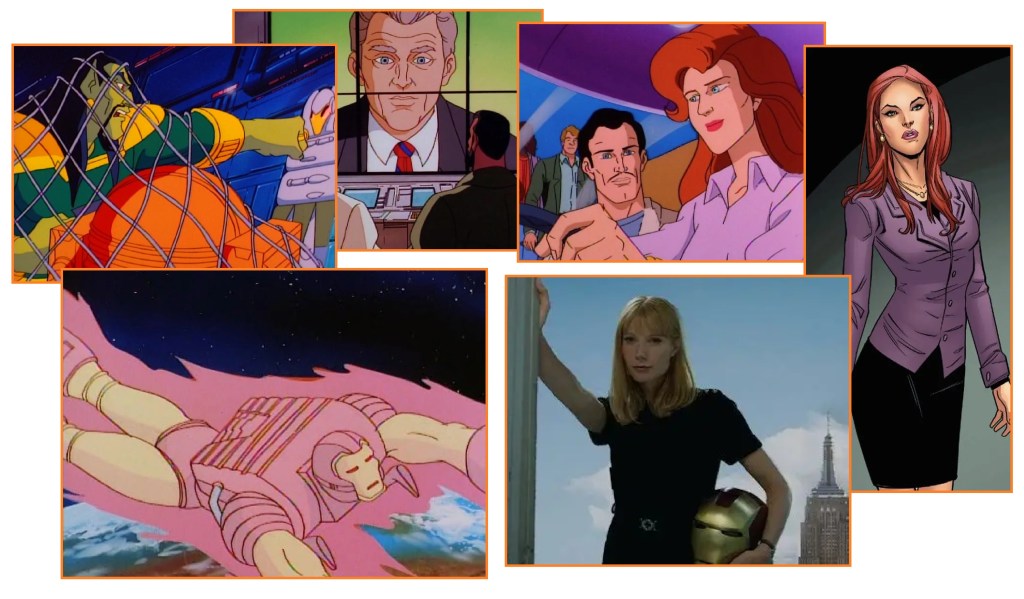
More real life cameos this episode as then-President Bill Clinton makes an appearance.
It is rapidly apparent that Julia Carpenter is fulfilling exactly the same position as Pepper Potts, Tony’s assistant and eventual wife in the MCU, played by Gwyneth Paltrow in seven movies thus far.
Hawkeye’s arrow fires a mesh made of the unbreakable adamantium at the Mandarin and MODOK. It’s the same metal that coats Wolverine’s bones and is indestructible. Unless you’re one of MODOK’s robots it seems, as they cut through it when the Mandarin can’t…
Armour Watch: Briefly in this episode, whilst in the simulator, Iron Man’s space armour can be seen.
CENTURY: A HUNDRED MINDS, ONE MISSION
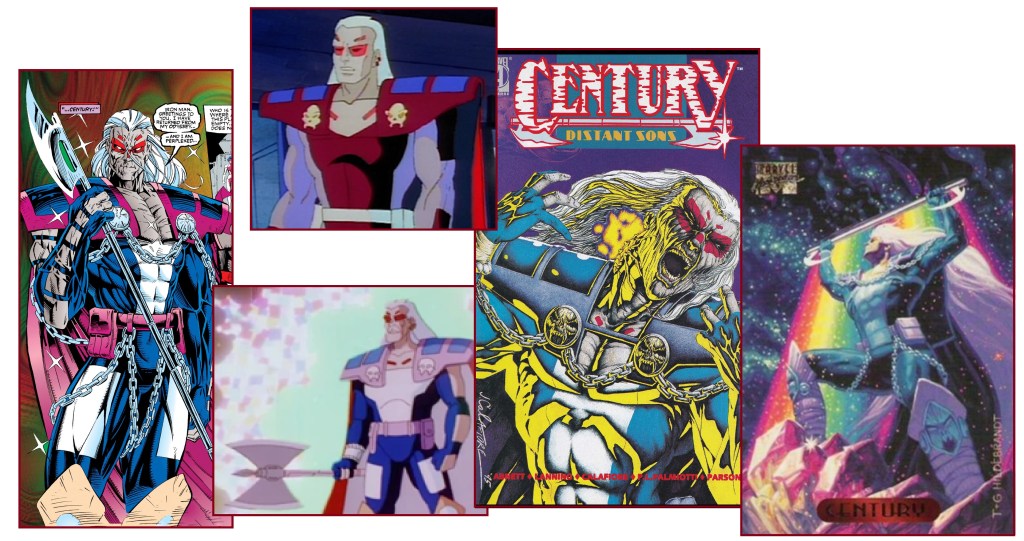
Century first appeared in Force Works #1 (1994), dropped into the Marvel Universe like a cosmic wildcard. He wasn’t a legacy character or a reworked villain – he was something stranger. A composite being forged from the minds of a hundred warriors from the planet Hodomur, created to hunt the interdimensional entity Lore. His weapon, Parallax, was both staff and compass, guiding him through time and space with eerie precision. Century wasn’t born – he was built. And he carried the weight of genocide, guilt, and fractured memory.
In the comics, Century joins Force Works after being summoned during a Kree skirmish, bringing with him the alien threat known as the Scatter. He’s quiet, solemn, and deeply alien – more observer than participant, until the fighting starts. His arc is one of penance: once enslaved as a tracker for the Scatter’s planetary conquests, he now fights to undo the damage he helped cause. He mourns Wonder Man, clashes with U.S. Agent, and bonds with Scarlet Witch – not romantically, but spiritually, as two beings shaped by chaos.
His inclusion in the Iron Man animated series is… unexpected. Century appears without backstory, dropped into the Force Works line-up as a mystic wildcard. No mention of Hodomur, Lore, or the Scatter. He’s treated as a teleporting alien with a cool axe and cryptic one-liners. In a show built around tech and armour, Century feels like a mythic ghost haunting the circuitry. His presence adds texture, but no context – he’s there, but never explained.
Still, Century lingers. He’s never had a solo series, never anchored a major arc, but he remains one of Marvel’s most quietly compelling figures. A memory of a hundred lives, stitched together to fight a war he didn’t choose. And in a universe full of heroes with origin stories, Century stands apart – less a man, more a mission. A myth in motion.
Rejoice! I Am Ultimo, Thy Deliverer | Silence My Companion, Death My Destination




 X-Cess Minutiae
Leave a comment