


On paper, it’s another sabotage story. Tanks, viruses, corporate rivalry. Hammer wants to win, Mandarin wants to destroy, and MODOK wants… something involving ravens. But beneath the techno-chaos, this episode is about vulnerability. Stark’s empire runs on innovation, but it’s constantly under siege – not just from outside forces, but from the very systems he built. His armour fails in space. His simulations are hacked. His tech is turned against him. And when Rachel is kidnapped, the stakes shift from industrial to personal.
This isn’t just about sabotage – it’s about exposure. Stark is exposed as a target, Julia as a mother, Rachel as leverage. The villains don’t just attack – they manipulate, infiltrate, and exploit. Hypnotia doesn’t fight Julia – she impersonates her daughter’s friend. MODOK doesn’t launch missiles – he steals data. Mandarin doesn’t duel Iron Man – he waits for the battery to die. It’s a war of attrition, and Stark’s greatest weapon – his armour – is only as strong as the sunlight it needs to survive.
And yet, the episode doesn’t end in despair. It ends in music. Rachel, trapped and terrified, powers Iron Man’s suit with piano chords. It’s absurd. It’s brilliant. It’s a reminder that vulnerability isn’t weakness – it’s what makes the rescue matter. Stark doesn’t win because he’s the smartest man in the room. He wins because someone believed in him enough to plug in a Walkman and hope.
So yes, the sabotage is familiar. But this time, it’s not about the tech – it’s about the cracks. And what slips through them.
James Rhodes, representing Stark Enterprises, and Justin Hammer, representing Hammer Industries, present their latest tank designs to General Amos Quirt. Quirt chooses Stark’s model – sleeker, smarter, more stable. Hammer, humiliated, makes a call. Mandarin answers. And the twist? Stark’s tanks are already infected. A virus, planted by Mandarin, waits to detonate.
Meanwhile, Tony Stark is testing his armour in deep-space simulation, battling a digital Dreadknight while his solar battery flickers. No sunlight, no power. Julia Carpenter aborts the test, but it’s too late – a robotic raven has already hacked the simulation data and flown off. MODOK receives the intel. Iron Man’s weakness is catalogued. And the trap begins.
That night, Stark, Julia, and Rachel Carpenter attend a piano recital. The raven flies again – this time to Hypnotia, who shape-shifts into Rachel’s friend and lures her to an arcade. There, Rachel is trapped in a rigged video game: play or be electrocuted. Stark and Julia spot her on a security feed. Hammer delivers the ultimatum – hand over the tank specs or lose the girl. Mandarin, watching from the shadows, reveals the real plan: bait Iron Man, drain his power, and finish him.
Iron Man flies to Hammer Industries and walks straight into the trap. No sunlight. No charge. The armour begins to fail. But Rachel plugs her Walkman’s sound system into the suit – feeding it energy through music. It works. Iron Man rallies, fights off the villains, and rescues Rachel. Mandarin activates the tank virus, but Iron Man overrides it. The villains flee. The tanks remain. And somewhere in the chaos, a piano saved the day.
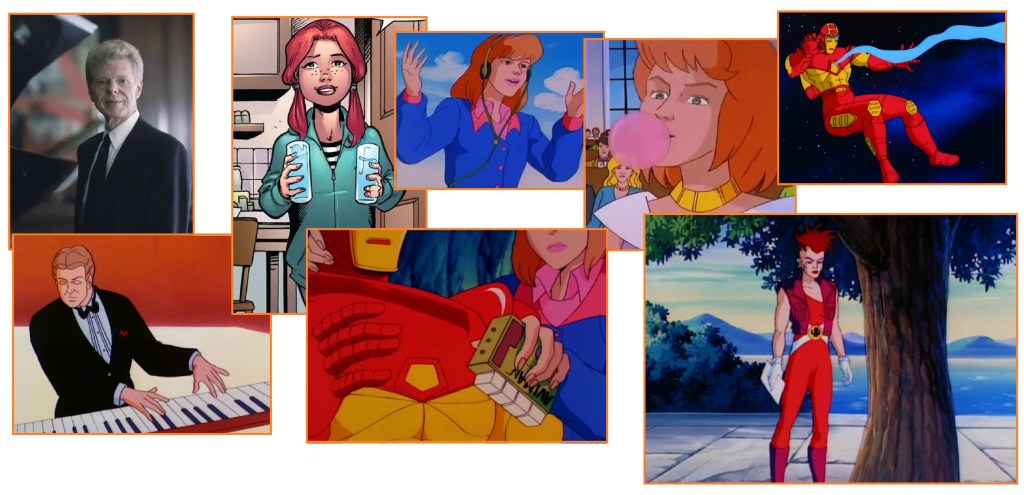
Van Cilburn is a real pianist. He passed in 2013. A selection of his music runs over the end titles instead of the usual theme.
Rachel Carpenter first appeared in Iron Man #214. Her walkman’s brand is ‘Aviman’ – presumably an homage to producer Avi Arad.
The villain who lures Rachel, disguised as her best friend Leslie, is named in the end credits as ‘Elastika’. This appears to have been an early form of Hypnotia before the character’s designs were settled on.
Armour Watch: Tony’s in his space armour in the simulation in this episode.
JULIA CARPENTER: BLACK THREADS AND BROKEN TIES
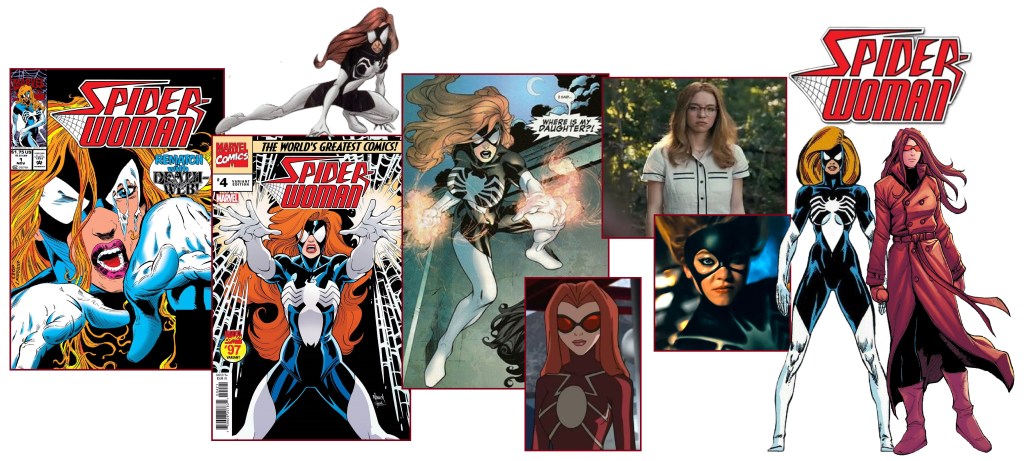
Julia Carpenter first appeared in Secret Wars #6 (1984), created by Jim Shooter and Mike Zeck as Marvel’s second Spider-Woman. Her origin was pure government subterfuge: injected with a mix of spider venom and exotic plant extracts under the guise of an athletic study, Julia was transformed into a superhuman weapon. Recruited by The Commission, she was thrown into the chaos of Battleworld before she even understood her powers – fighting alongside the Avengers, clashing with Doom, and earning her place in the mythic mess of Marvel’s crossover machine.
Back on Earth, Julia’s arc twisted through Freedom Force – a government-sponsored team of reformed villains – where she quickly learned that loyalty and legality don’t always align. She broke ranks to free the Avengers from wrongful imprisonment, became a fugitive, and eventually found her footing with the West Coast Avengers. When that team dissolved, she joined Force Works, bringing espionage skills, psychic webs, and a quiet resilience to a unit built for pre-emptive strikes. Her daughter, Rachel, lived with her at The Works, grounding Julia’s arc in something rare for superhero fiction: single motherhood.
In the Iron Man animated series, Julia appears as Spider-Woman – no origin, no exposition, just presence. She’s a core member of Force Works, balancing field missions with maternal instincts. Rachel’s inclusion isn’t just a plot device – it’s a tether. Julia’s dual role as hero and mother adds emotional weight to the techno-chaos around her. When Rachel is kidnapped or manipulated, Julia doesn’t just fight for justice – she fights for family. It’s a dynamic that sets her apart from the rest of the team, and from most animated heroines of the era.
Julia’s legacy continues. She’s appeared in Spider-Man: Across the Spider-Verse (2023) and featured in Madame Web (2024), portrayed by Sydney Sweeney under her maiden name, Julia Cornwall. In comics, she’s worn many mantles – Spider-Woman, Arachne, even Madame Web. She’s lost her powers, regained them, and walked away from heroics to raise her daughter. But she always returns. Because Julia Carpenter isn’t just a spider-themed vigilante – she’s a survivor. A mother. A memory stitched into the web of Marvel’s ensemble mythos.




 X-Cess Minutiae
Leave a comment