


Talk about an episode that catches you off guard!
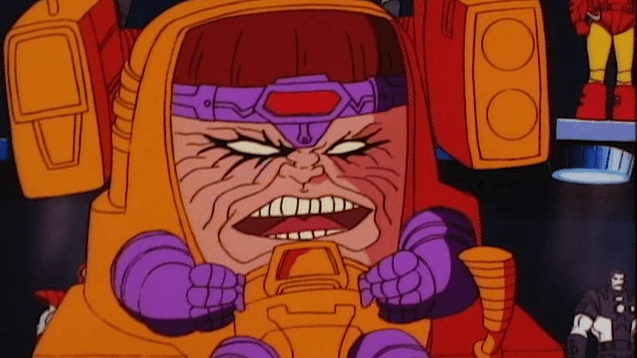
MODOK, the floating grotesque usually relegated to comic relief and villainous tech support, becomes the emotional core of the episode. For once, it’s not sabotage, conquest, or absurd weaponry – it’s heartbreak. And it takes twelve full minutes before anyone, including the audience, realises what’s really going on. The suspense simmers. The alarms blare. And everyone assumes MODOK’s up to his usual tricks. But this time, it’s personal. This time, it’s about his wife.
The reveal lands like a glitch in the narrative code. MODOK, the Mental Organism Designed Only for Killing, is married to Alana Ulanova – a supermodel, no less. Stark is stunned. Julia is speechless. Even Mandarin raises an eyebrow. The absurdity is played straight, and that’s what makes it work. Because beneath the hoverchair and the psychic blasts, MODOK is grieving. Betrayed. Mutated. And desperate to protect the one person who ever saw him as more than a weapon.
It’s the only time in the series we’re asked to sympathise with MODOK. And it works. His origin is rewritten – less corporate experiment, more romantic tragedy. Red Ghost, jealous and petty, twisted MODOK into his current form. And now, MODOK’s not trying to destroy Stark Industries – he’s trying to save his wife from the villains he works for! The villains don’t believe him. The heroes don’t trust him. But the truth cuts through the chaos: even monsters have hearts. Even floating heads can mourn.
Stark, ever the cynic, learns something too. That appearances deceive. That good people can be driven to bad choices by circumstances beyond their control. And that sometimes, the most absurd plot twist hides the most human truth. MODOK doesn’t win. He doesn’t get the girl. But for one episode, he’s not the punchline. He’s the point.
James Rhodes and Wanda Frank head to Emerald Cove, clearing enemy vehicles while testing Tony Stark‘s new Wave Strider super boat. But on the sand, Alana Ulanova – celebrity, icon, and model – is mid-pose when the Mandarin‘s army arrives and turns the beach into a hostage zone. MODOK, ever the bureaucratic monster, warns Mandarin not to kill high-profile targets. Mandarin, suspicious of MODOK’s sudden ethics, begins to watch his ally more closely.
Back at Stark Enterprises, alarms blare. Iron Man and Force Works respond, expecting sabotage. Instead, they get MODOK – hovering in, demanding a truce, and threatening to blow up the building if they don’t listen. His request? Save the captives at Emerald Cove. His reason? Alana Ulanova is his wife. The revelation lands like a punchline. MODOK explains that he and Red Ghost once competed for Alana’s affections. She chose MODOK. Red Ghost retaliated – mutating him into the floating grotesque he is now.
Force Works agrees to intervene. Alana briefly escapes the villains, only to be recaptured. Rhodes and Wanda arrive first, with James suiting up as War Machine and launching into battle. Wanda hexes the beach into chaos. The rest of Force Works arrives, and Alana escapes again – this time for good. The villains are routed, the beach reclaimed, and MODOK’s romantic tragedy remains unresolved.
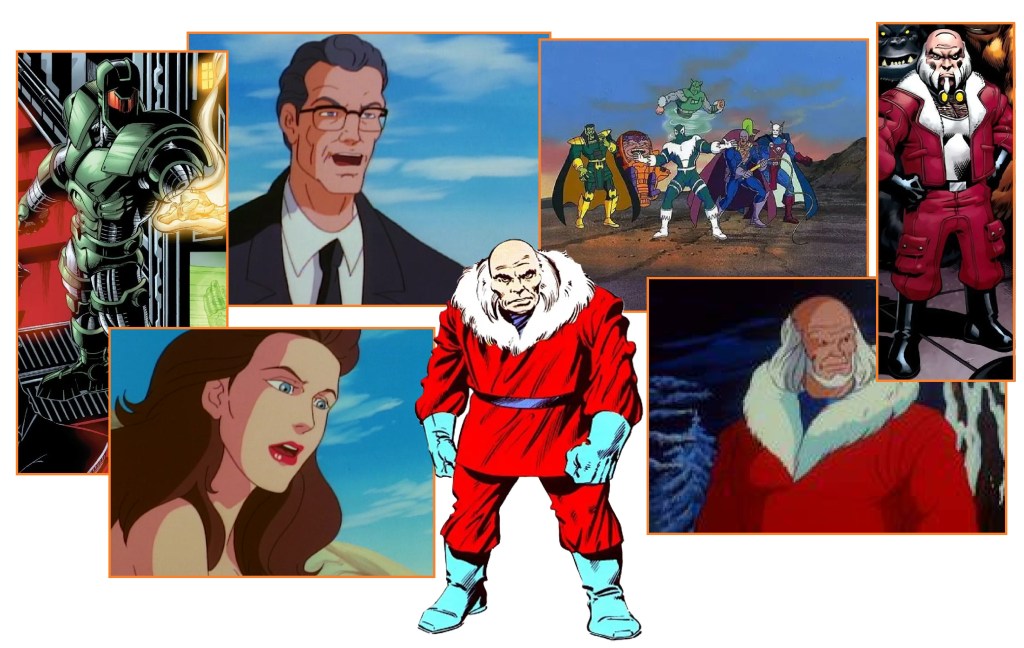
Sam Jaggers, the news journalist, reappears for the first time since the pilot episode.
Tony spends his opening scenes in this episode recapping the villain’s roll call, something usually done in a series’ pilot episode. One wonders whether episodes were swapped for airing.
The man responsible for MODOK’s transformation is Ivan Kragoff, also known as the Red Ghost, a Fantastic Four villain strangely absent from their animated series of the same time. He first appeared in Fantastic Four #13 and has nothing to do with MODOK in the comic books. He also has no connection to the Titanium Man, who he is said to have created here.
MODOK’s wife is unique to this series and doesn’t appear in the comics. His origin here is unlike his comic book counterpart as well; on panel George Tarleton was transformed by Advanced Idea Mechanics, a scientific terrorist organisation that MODOK is frequently seen leading.
MODOK: THE MONSTER WHO BECAME A MEME
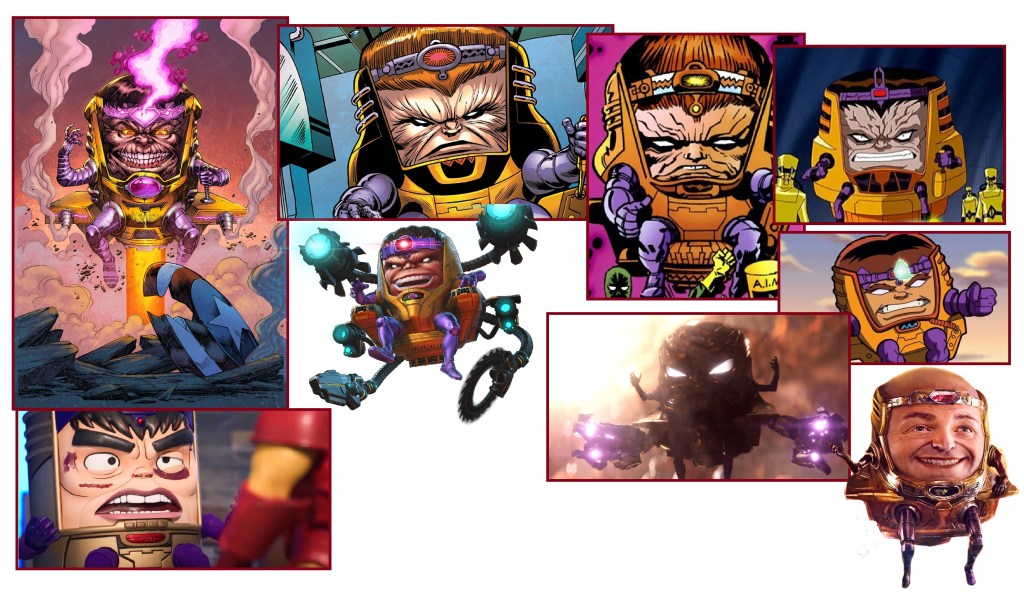
MODOK – Mental Organism Designed Only for Killing – was never meant to be funny. Created by Stan Lee and Jack Kirby in Tales of Suspense #93 (1967), he was a grotesque by-product of A.I.M.’s ambition: George Tarleton, mutated into a psychic supercomputer with a head too large for his body and a hoverchair to match. In the comics, MODOK was a serious threat. He assassinated his creators, seized control of A.I.M., and became a recurring villain for Captain America, Iron Man, and the Hulk. He wasn’t just smart – he was cruel, calculating, and deeply resentful of physical perfection. MODOK didn’t quip. He killed.
But somewhere along the way, the tone shifted. In Iron Man, MODOK was reimagined as a squabbling sidekick to Mandarin – hovering, whining, and occasionally threatening to blow up buildings for personal drama. The Superhero Squad Show doubled down, turning him into a literal punchline with a voice like a malfunctioning GPS. Then came Marvel’s MODOK on Disney+, where Patton Oswalt voiced a version of the character deep in midlife crisis – divorced, ousted from A.I.M., and juggling villainy with parenting. It was satire, yes, but also strangely poignant. MODOK became a mirror for burnout, ego, and the collapse of legacy.
Live action followed suit. In Ant-Man and the Wasp: Quantumania, MODOK was reimagined as Darren Cross – warped, tragic, and played for laughs. The grotesque design remained, but the menace was gone. MODOK, once a symbol of unchecked ambition, was now a floating meme with daddy issues. And yet, this tonal whiplash didn’t erase him – it mutated him. In comics like NEXTWAVE, MODOK returned as a parody of himself: a screaming, giggling lunatic who bred killer koalas and weaponized absurdity. The monster had become the joke. And the joke had teeth.
MODOK’s evolution is less a fall from grace and more a loop of reinvention. He began as a nightmare, became a meme, and now exists in a strange liminal space – half threat, half theatre. He’s still dangerous, still brilliant, but now he’s also ridiculous. In a strange sense, MODOK reminds us that even the most serious monsters can be rewritten: sometimes by satire, sometimes by sadness. And sometimes by killer koalas.
The Grim Reaper Wears a Teflon Coat | The Origin of the Mandarin




 X-Cess Minutiae
Leave a comment