


This isn’t just another tech theft. It’s a sleight-of-hand played across dimensions. The Grim Reaper jet – Stark’s latest marvel – isn’t stolen in the traditional sense. It’s displaced. Hidden in plain sight. The villains don’t break in – they step out of time. And while Stark dazzles the military with speed and specs, Mandarin’s crew rewrites the rules of reality behind the curtain. It’s not sabotage – it’s a performance. And Stark, for once, isn’t the one holding the spotlight.
But the real trick isn’t the jet – it’s the distraction. Hammer plays the bureaucratic saboteur, MODOK fumbles through absurd tech trials, and Mandarin orchestrates it all like a conductor with a grudge. Stark’s pulled into therapy, Scarlet Witch returns from leave, and Force Works is left chasing shadows. The Grim Reaper isn’t just a prototype – it’s a symbol of how easily control slips through your fingers when the enemy isn’t playing by the clock.
There’s a creeping unease in this episode. Stark’s tech is flawless, but his systems are vulnerable. His team is loyal, but scattered. His enemies aren’t just attacking – they’re manipulating. The theft isn’t about the jet – it’s about Stark’s perception. About making him doubt what he sees, what he knows, and what he’s built. And when the jet reappears in enemy hands, aimed at the Pentagon, the illusion becomes a threat. Reality bends. Trust fractures.
And yet, the resolution isn’t triumphant – it’s exhausted. Iron Man and War Machine stop the jet, but Mandarin escapes. The Reaper sinks into the ocean like a failed promise. The villains are still out there, rewriting reality one scheme at a time. And Stark, once again, learns that innovation without vigilance is just an invitation to chaos. The jet may be grounded, but the war is still airborne.
Tony Stark unveils his latest prototype jet – the Grim Reaper – to a room full of military brass, all eager to see what Stark tech can do at Mach speeds. Scarlet Witch, meanwhile, asks for time off, sensing the burnout creeping in. But before anyone can breathe, the villains infiltrate the hangar and steals the jet clean out from under them. Or so it seems. Security footage shows the jet still parked. Stark, Rhodes, and Julia Carpenter are baffled. The jet is gone – but it’s also not.
MODOK tries to pilot the Reaper, but the jet ejects him like bad code. Mandarin, watching from the shadows, instructs Justin Hammer to keep Stark distracted – therapy, press, anything to keep him off the scent. Scarlet Witch returns just in time to see Stark unravel the mystery: the villains didn’t steal the jet in space or time – they stepped outside of it. A temporal heist. The Reaper was never missing. It was misplaced in reality.
Force Works mobilises. They recover the jet and deliver it to the waiting officers – only to discover those officers are Mandarin’s agents. The jet is airborne again, this time with Mandarin at the helm, en route to bomb the Pentagon. Iron Man and War Machine give chase, dodging missiles and Mandarin’s ego. The battle is brutal, the jet is crippled, and the villain escapes. Stark and Rhodes drop the broken Reaper into the ocean, letting it sink beneath the waves like a failed promise.
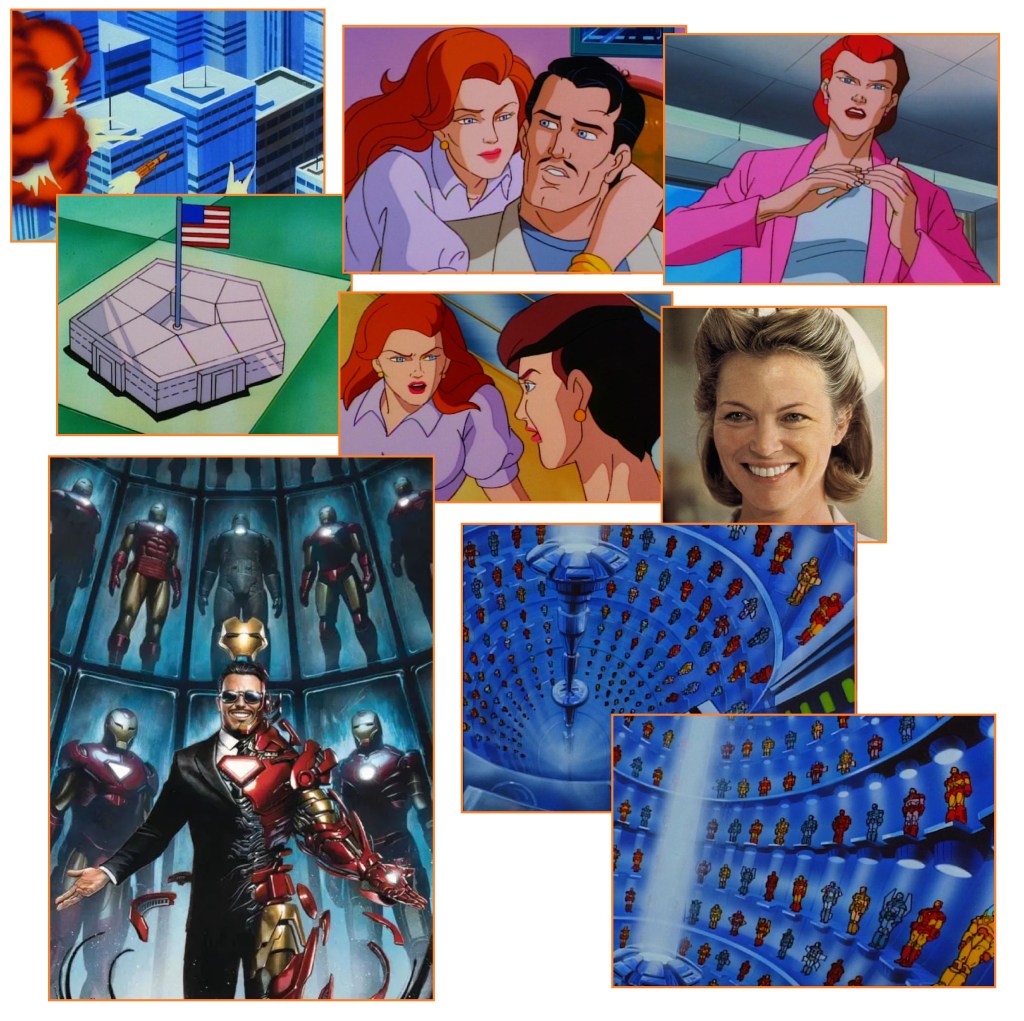
The opening scene of this episode is horribly prescient: it shows a warplane being aimed at and attacking New York City – and hitting the Twin Towers. Another simulation, this time run by the Mandarin later in the episode, also shows a plane hitting and destroying the Pentagon.
This episode has Wanda and Julia almost come to blows over Tony’s affection, a plot line that will follow the pair until the first season finale, The Wedding of Iron Man.
Julia Carpenter, meow! Annoyed with Veronica Benning for being in a physio pool with Tony, Julia calls her ‘Nurse Ratched’, after the vile nurse played by an award-winning Louise Fletcher in One Flew Over the Cuckoo’s Nest.
This is the first episode that explicitly states that Tony has a piece of shrapnel still embedded in his chest.
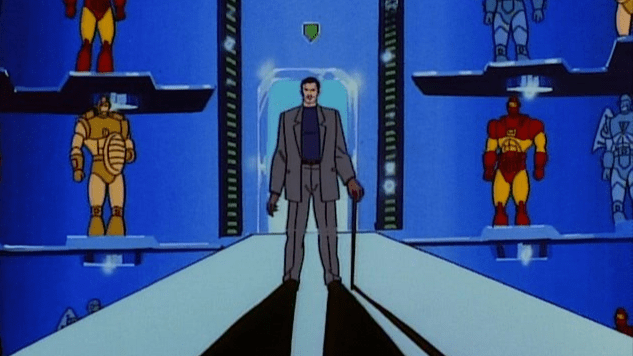
Armour Watch: How about our first glimpse at the Hall of Armour!
JUSTIN HAMMER: SABOTAGE AND SUBTERFUGE

Justin Hammer first appeared in Iron Man #120, created by David Michelinie, Bob Layton, and John Romita Jr. He wasn’t a mad scientist or armoured brute – he was something worse: a businessman with no conscience. Hammer Industries was Stark’s mirror image, a weapons empire built on sabotage and supervillain outsourcing. If Iron Man’s rogues gallery suddenly had upgraded tech, odds were Hammer paid for it. He didn’t just fund villains – he franchised them.
Hammer’s most infamous move came during the Demon in a Bottle arc, where he used a hypersonic transmitter to hijack Iron Man’s armour mid-flight, forcing Tony to kill a foreign diplomat in public. It was a masterstroke of corporate warfare – ruin the brand, win the bid. Hammer didn’t know Stark was Iron Man, but he knew how to break him. Over the years, he became the silent partner behind Blacklash, Beetle, and countless armoured mercenaries. He wasn’t flashy. He was efficient.
In animation, Hammer pops up in Iron Man as a recurring irritant – smarmy, opportunistic, and always one phone call away from Mandarin. He’s less a mastermind and more a middle manager of evil, but the essence remains: he’s the guy who weaponizes bureaucracy. In Avengers Assemble, he’s reimagined with a Rockwellian flair, echoing his live-action portrayal. And yes, Sam Rockwell brought him to life in Iron Man 2 (2010) – a twitchy, insecure tech bro who wanted to be Tony Stark but lacked the soul, the genius, and the restraint.
Hammer’s legacy lives on through his daughter Justine and granddaughter Sasha, both of whom carry the family’s flair for manipulation. But Justin himself remains a cautionary tale: what Tony Stark might’ve become if he’d never stopped selling weapons, never built the suit, never looked inward. He’s not Iron Man’s opposite – he’s his shadow. And sometimes the most dangerous enemy is the one who never puts on a helmet.
Silence My Companion, Death My Destination | Enemy Within, Enemy Without




 X-Cess Minutiae
Leave a comment