


There’s a mood to this episode – foggy flashbacks, buried alien tech, and a villain rewriting his own legend in real time. Mandarin’s origin unfolds like a pulp novella: Arnold Brock, Ilona Vermeer, and Yinsen on a doomed expedition, rebels in the jungle, and a temple full of jewels that whisper power. The visuals are rich, the tone leans mythic, and the whole thing feels just plausible enough to distract Force Works. Whether it’s true or not is never confirmed. That ambiguity becomes part of the tension.
Threaded through the spectacle is a clever bit of foreshadowing. Yinsen’s name drops early, long before the audience knows his significance. It’s a quiet setup for Iron Man’s own origin, tucked inside Mandarin’s melodrama. The backstory is compelling, but it’s also suspect – delivered via a black box that could just as easily be a trap. Mandarin’s voiceover sells it like scripture, but the team never gets proof. They’re chasing a story, not a fact.
Then comes the pivot. Mandarin seizes the base, finally gets his own armour, and launches into a transformation sequence that’s pure villain theatre. It’s dramatic, it’s overproduced, and it lasts just long enough for the suit to malfunction and smack him in the face. The grandeur collapses instantly. The villain who spent half the episode narrating his myth ends up retreating, bruised and baffled.
It’s a strange episode – tonally erratic, structurally bold, and completely entertaining. The origin might be fiction, the armour might be cursed, and the villain might be a little too fond of his own voice. But it all works, because the story never asks you to believe – it just dares you to follow.
Stark’s offshore rig is under siege. Mandarin, MODOK, Justin Hammer, and the villains launch a coordinated assault, and Force Works scrambles to intercept. The villains retreat, but not empty-handed – Spider-Woman recovers a black box from the wreckage. It’s not flight data. It’s Mandarin’s diary. And it’s about to rewrite everything.
While Iron Man, War Machine, and Hawkeye defend the remaining drills, the rest of Force Works listens to Mandarin’s origin story. Arnold Brock, a guide named Yinsen, and Brock’s fiancée Ilona Vermeer – an expedition gone wrong, a temple full of alien jewels, and a battle with Fin Fang Foom and the Kakarantharaians. Brock survives, transforms, and becomes the Mandarin. It’s mythic, tragic, and possibly staged. But the team listens. And that’s when the trap springs.
Hypnotia embedded a delayed hypnotic spell in the diary. Spider-Woman, Century, and Scarlet Witch fall under its influence, disabling Stark’s security systems. Mandarin enters, armoured and ready. But the plan backfires. The armour turns on him – unstable, aggressive, and unwilling to obey. Force Works regroups, subdues his army, and watches Mandarin retreat once again, betrayed by his own tech.
No one’s quite sure what was real. The diary, the origin, the rings – it could all be theatre. But the damage was real. And for Force Works, trust is now just another system waiting to be hacked.
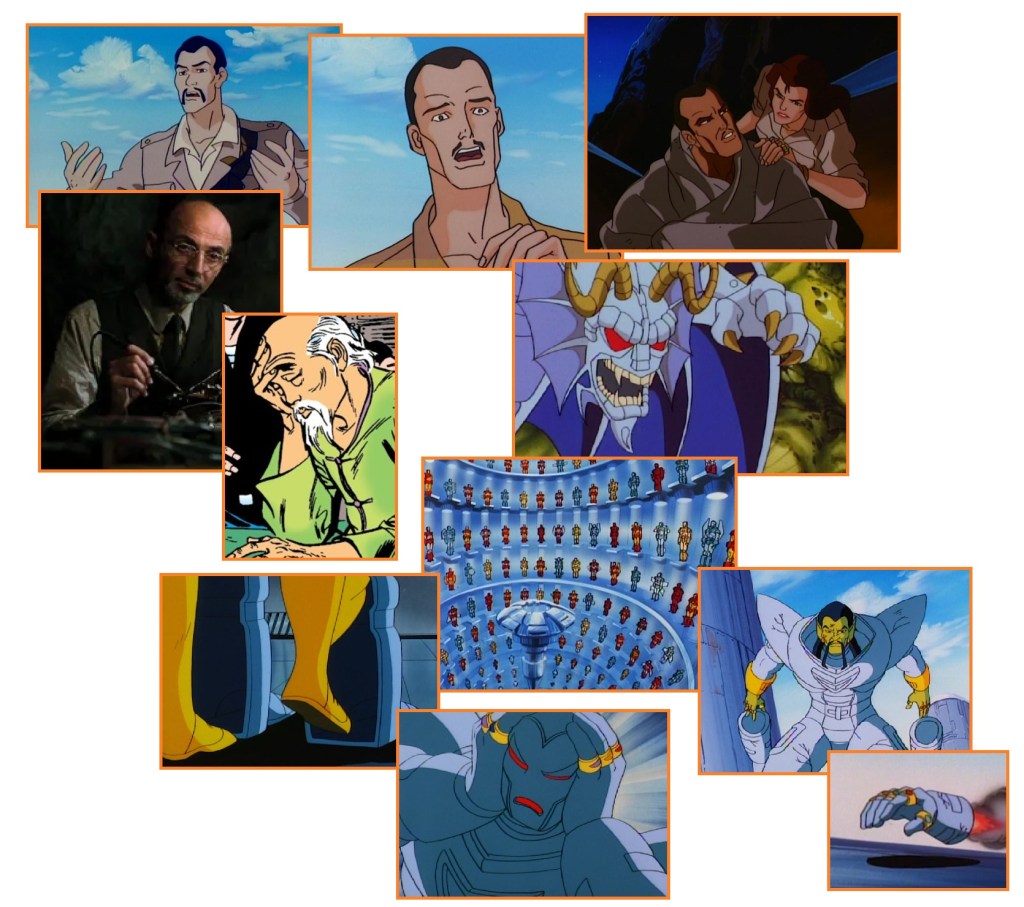
The Mandarin’s origin story is a mix-match. His comic book origin comes complete with crashed alien spacecraft, but his real name, llona Vermeer and his connection to Yinsen is all for this series. Fitting really, since it could very well all be fiction if it was used just to distract Force Works.
Yinsen is also the scientist that Tony Stark creates the Iron Man armour with in The Origin of Iron Man (Part 1), thereby making him pivotal to the origins of both hero and villain.
Fin Fang Foom is the dragon that attacks Arno Brock, but he’s miscoloured. He also turns up in the final shot when the Mandarin teleports the villains away – despite the fact he’s not there during the battle!
In the final battle, after the Mandarin loses his gauntlets with his rings, he has another complete set on his hands… Illusion?
Armour Watch: Mandarin seems particularly impressed by the Undersea Armour. His armour itself is an experimental nuclear powered suit, created out of adamantium.
‘HE WHOSE LIMBS SHATTERS MOUNTAINS‘
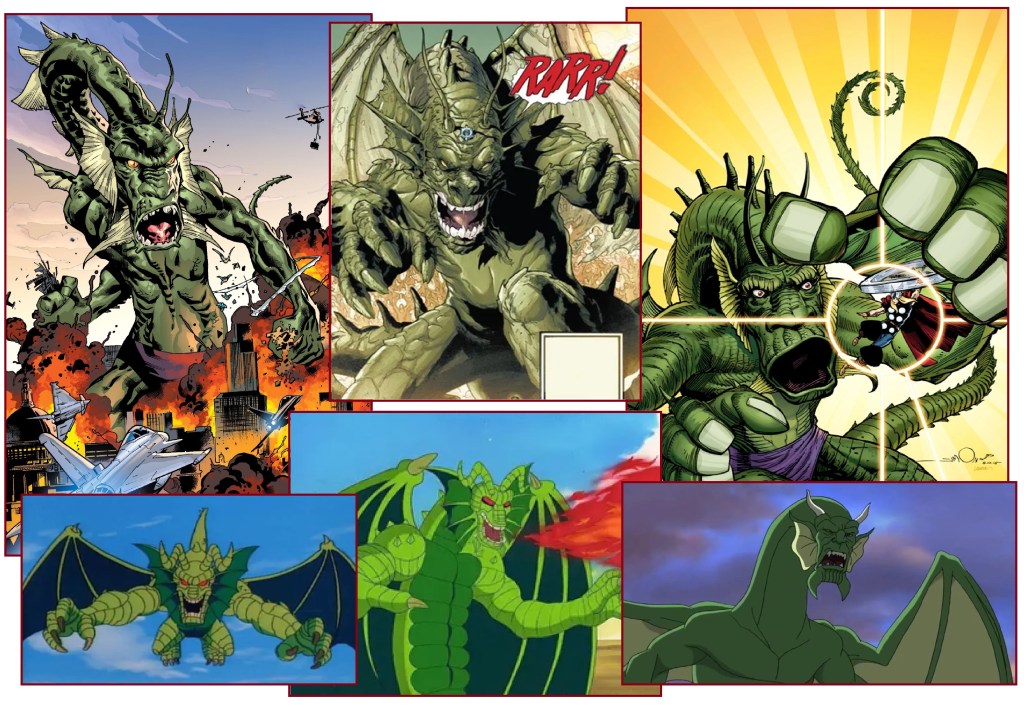
Fin Fang Foom first crash-landed into Marvel lore in Strange Tales #89 (1961), a pre-superhero era monster story by Stan Lee and Jack Kirby. He wasn’t a dragon – he was a Makluan, a shape-shifting alien from the planet Kakaranthara (Maklu IV), buried in China and awakened by a clever scholar to repel a Communist invasion. His name, inspired by a British musical (Chu Chin Chow), was pure pulp rhythm. But the creature himself? Towering, green-scaled, and furious. Foom wasn’t just a monster – he was a myth in motion, a Cold War metaphor wrapped in cosmic scales.
Over time, Foom was folded into Marvel continuity. He battled Iron Man in Iron Man #261–275, became part of the Mandarin’s arsenal, and occasionally clashed with Thor, Hulk, and even the X-Men. His backstory expanded: navigator of a Makluan starship, sleeper agent buried in legend, and eventual wielder of the infamous ten rings. Sometimes he was a conqueror. Sometimes a pawn. Sometimes a misunderstood exile. But always, he loomed – “He Whose Limbs Shatter Mountains and Whose Back Scrapes the Sun.” A dragon with a sci-fi twist and a temper to match.
Animation treated him with varying degrees of reverence and ridicule. In Iron Man, he’s summoned by Mandarin like a Saturday morning kaiju – roaring, rampaging, and vanishing just as quickly. The Super Hero Squad Show turned him into a joke with a chef’s hat and a taste for stir-fry. And Hulk and the Agents of S.M.A.S.H. gave him a more traditional monster arc, albeit with the usual tonal whiplash. Foom’s animated legacy is less about continuity and more about spectacle – he shows up, he stomps, he leaves. A dragon-shaped exclamation mark.
But in comics like NEXTWAVE, the pendulum swings hard into satire. Foom wears purple underpants, lusts after human women, and gets punched in the face by Monica Rambeau. It’s brilliant. It’s the full-circle evolution of a character who started as a metaphor, became a menace, and now exists somewhere between myth and meme. Fin Fang Foom endures not because he’s consistent – but because he’s unforgettable. A dragon, a joke, a legacy. And sometimes, all three at once.




 X-Cess Minutiae
Leave a comment