


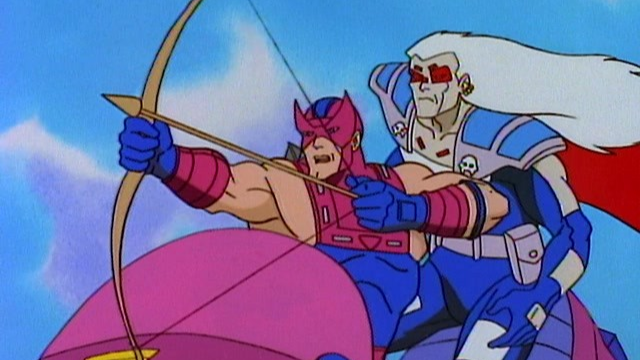

As you can guess from the episode’s title, paranoia runs hot between the heroes in this installment. Mandarin’s convinced Force Works has discovered his surveillance tech. They haven’t. But his assumption puts him exactly where he needs to be – dropping fake evidence, sowing distrust, and watching the team unravel from the inside. It’s sabotage by suggestion. And it works, almost.
The mole hunt zeroes in on Hawkeye. It shouldn’t. He’s been solid since episode one, and the team even checks the tapes. But the setup is convincing – photographs, absences, evasive answers. Mandarin’s framing is textbook. What he doesn’t expect is resistance. Force Works doesn’t turn on Hawkeye. They don’t interrogate him. They don’t even flinch. And Mandarin, watching from the sidelines, is visibly baffled. His plan was airtight. His logic sound. But the heroes choose trust over proof, and it breaks his rhythm.
There’s something off-kilter about the whole episode. The tone wobbles between genuine tension and accidental comedy. The Mandarin, usually composed, starts to look like a man losing control of his own narrative. Whether it’s intentional or not, the effect is clear: the villain’s certainty collapses, and the team’s loyalty holds.
It’s not about betrayal. It’s about belief. And in a series built on espionage and legal wrangling, that’s the rarest weapon of all.
A Stark Enterprises shipment of adamantium rolls out under heavy guard. Iron Man, Spider-Woman, Century, Scarlet Witch, and War Machine expect trouble – and they get it. Mandarin and his goons strike fast, but something’s off. Hawkeye’s missing, and his absence is felt. The battle turns, the villains retreat, and the shipment is revealed to be a decoy. War Machine starts connecting dots. The operation was too clean. Someone’s leaking intel. And when Hawkeye finally shows up, evasive and unaccounted for, suspicion lands hard.
Spider-Woman goes undercover, trailing Hawkeye to Hammer Hills. She loses him. Mandarin doesn’t. Meanwhile, a drowning woman turns out to be Hypnotia in disguise – another layer of misdirection. Force Works regroups for the real shipment, unaware that MODOK has already tagged the transporter. The second attack comes fast. Mandarin tries to claim the adamantium, but Iron Man shuts him down. The metal stays put. Hawkeye is interrogated after photographs of him with Justin Hammer arrive. Despite the fake evidence, the group decide that their teammate is not a mole but the Mandarin does have a way of getting inside information. Mandarin and his robots attack the building, hoping to obtain Iron Man’s armour. The team recalibrates. They swiftly repel the attack, much to Mandarin’s confusion.
Back at Stark Enterprises, the tension breaks. Hawkeye explains himself later: he’s not a traitor – just a grandson. Jackson Wiley, sick and fading, has been Hawkeye’s quiet priority.
Trust is now restored. But Mandarin’s access remains unexplained.
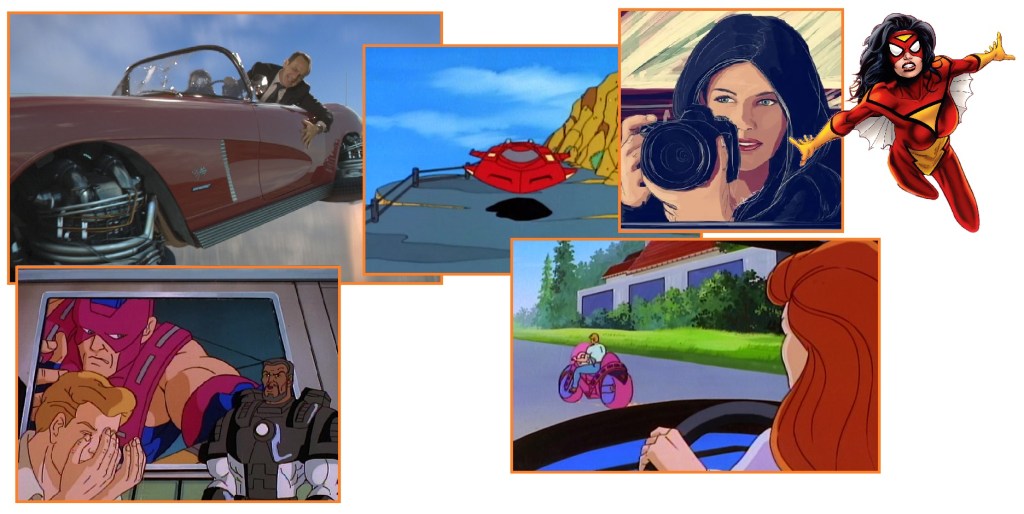
Adamantium is once again everyone’s favourite element this episode.
Tony’s car converts into an aircraft, just as some SHIELD models do, such as Coulson’s Lola in Marvel’s Agents of SHIELD.
Tony implies that Julia used to be a private investigator. In the comics, this job usually goes to the original Spider-Woman, Jessica Drew.
In two hilarious moments, the bad guys steal the show; when the Mandarin cannot understand the strange driving of Julia Carpenter, MODOK tells him to remember that he’s in California! Secondly, when he’s retreating at the episode’s conclusion he’s flabbergasted that the heroes aren’t too busy torturing Hawkeye to stop him!
There are flashbacks directly to And the Sea Shall Give Up Its Dead and Rejoice! I Am Ultimo, Thy Deliverer. Rhodey also mentions the time Mandarin built a duplicate Iron Man – which is actually the next episode. More proof that the episode order has clearly been shuffled along the production line.
DREADKNIGHT: DOOM’S CAST-OFF, FRANKENSTEIN’S HOUSEGUEST
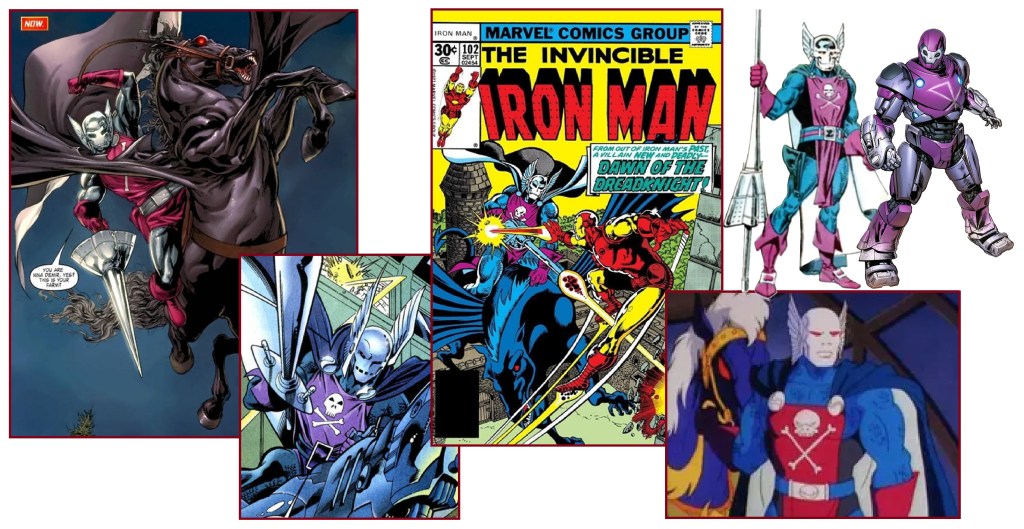
Dreadknight first galloped into Marvel continuity in Iron Man #101–102 (1977), a gothic detour penned by Bill Mantlo and drawn by George Tuska. Real name Bram Velsing, he was a Latverian scientist with delusions of grandeur and a grudge against Doctor Doom. When Doom discovered Velsing’s ambitions, he didn’t just fire him – he fused a skull-shaped helmet to his face using a Bio-Fusor, turning him into a literal monster. Humiliated and disfigured, Velsing fled to Castle Frankenstein, where Victoria Frankenstein patched him up and gave him access to mutated tech – including a bat-winged steed named Hellhorse.
From there, it gets delightfully unhinged. Dreadknight tries to steal Frankenstein’s notebooks, gets knocked out by Iron Man and Frankenstein’s Monster, and spends the next few years bouncing between comas, mystical revivals, and failed revenge plots. He’s fought Captain Britain, Spider-Man, and the Black Knight, often while still nursing his Doom fixation. His arsenal includes a power lance, nerve gas pistols, and electrified bolas – classic pulp villain gear, all delivered with theatrical flair. He’s joined the Frightful Four, the Masters of Evil, and even tried to seize Latveria during one of Doom’s absences. It didn’t go well.
In Iron Man, Dreadknight is reimagined as one of Mandarin’s rotating henchmen – less tragic, more disposable. His Hellhorse is renamed “Nightwing” due to censorship, and his gothic backstory is mostly ignored. He shows up, gets knocked down, and vanishes. Later animated appearances, like Armoured Adventures, rework him into a literal army of stone knights – stripped of identity, reduced to obstacle. The original Bram Velsing is nowhere to be found.
And yet, Dreadknight is remembered. He’s a villain built on resentment, theatricality, and second hand tech. A castoff of Doom, a failed Frankenstein, and a cautionary tale about ambition without vision. He’s never been a top-tier threat, but he’s unforgettable – a skull-faced rider with a lance, a grudge, and a horse that shouldn’t exist. Dreadknight remains defiantly medieval. And that’s his charm.
The Origin of the Mandarin | Iron Man to the Second Power (Part 1)




 X-Cess Minutiae
Leave a comment