


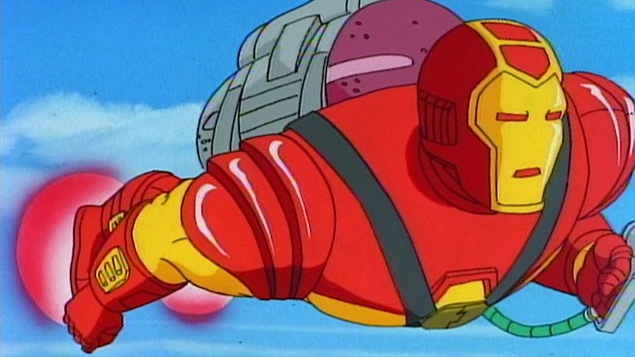
There’s a trope that never quite goes out of fashion: the villain-built double. A twisted reflection of the hero, forged not in admiration but in appropriation. It’s been done across genres – evil clones, corrupted copies, mechanical mimics – but when it’s Iron Man, it hits differently. Because Tony Stark isn’t just a man in a suit. He is the suit. So when MODOK and Mandarin build a duplicate, they’re not just copying tech – they’re trying to rewrite identity.
This episode leans into that tension. The imposter isn’t perfect – its shoulder’s mirrored wrong, its voice is off – but it’s close enough to fool the world. And that’s the danger. The duplicate doesn’t just attack cities – it hijacks satellites, issues ultimatums, and spreads biological terror. It’s not a brute force weapon. It’s a symbol. A message. That Iron Man can be replicated, corrupted, and turned against the very world he swore to protect.
Meanwhile, the real Tony is missing. Force Works scrambles. The villains tighten their grip. And the episode becomes a race – not just to stop the imposter, but to reclaim the narrative. Because when the world sees Iron Man threatening extinction, it doesn’t ask if it’s the real one. It just reacts.
The trope works here because it’s personal. It’s not just about tech – it’s about trust. About what happens when the symbol of protection becomes the face of destruction. And when Tony finally returns, it’s not just a victory – it’s a restoration. Of identity. Of ensemble. Of truth.
At the Citadel of Science, MODOK unveils a skeletal prototype – an artificial frame designed to mimic Iron Man’s armour. It’s functional, but flawed. The Mandarin, ever watchful, critiques the design and demands precision. To perfect the duplicate, MODOK initiates a trap at Stark Enterprises, activating a hidden bug in the assembly line. Iron Man responds, unaware he’s walking into a scan. Captured briefly, his armour is copied – but not completely. The right shoulder remains unrecorded, forcing MODOK to mirror the left.
With the prototype operational, Mandarin sets his plan in motion. The villains are dispatched to a Peruvian farming village, where they seize control and begin testing a biological agent known as Dark Water Fever. Crops are sprayed. Locals are taken. The duplicate Iron Man, indistinguishable to the untrained eye, infiltrates Hammer’s facility and steals a sample of the contagion.
The imposter then hijacks Stark’s orbital satellite, issuing a global ultimatum: surrender one million units of currency by midnight, or face extinction. To prove his intent, he releases Dark Water Fever over Los Angeles, triggering panic and confirming the threat. The real Iron Man is missing. The world watches. The countdown begins.
As the villains tighten their grip and the duplicate spreads chaos, the question looms: who will stop the imposter before the damage becomes irreversible? And where is the true Iron Man in the hour of crisis?
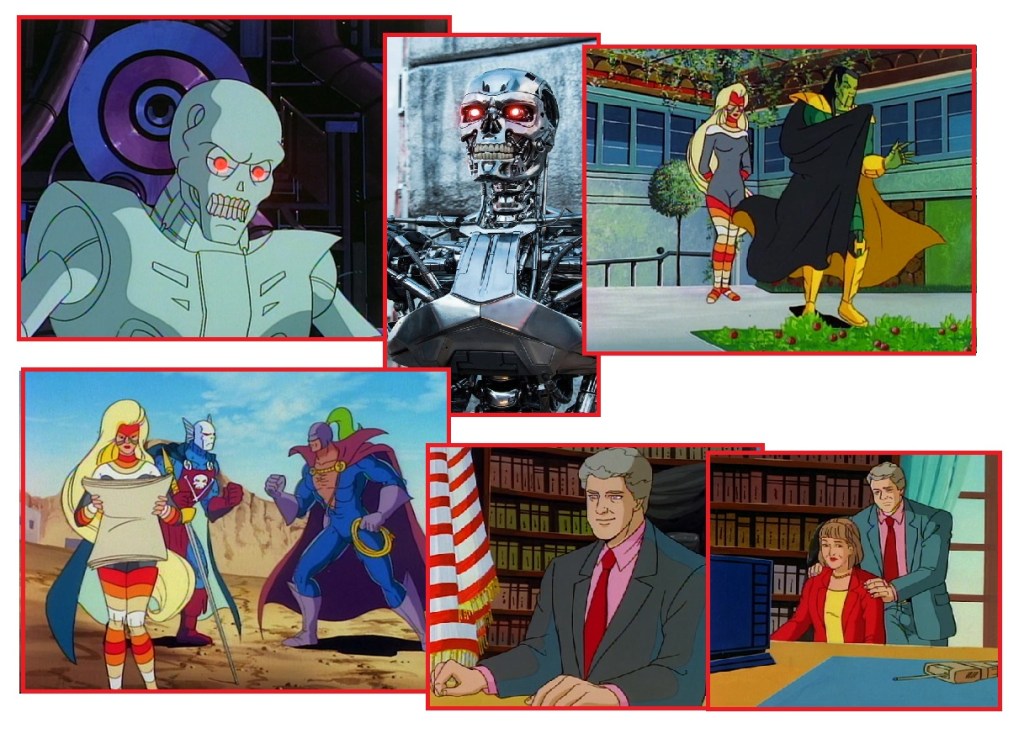
MODOK’s skeletal decoy, before it looks like Iron Man, looks suspiciously like the T-1000 from the Terminator franchise.
Mandarin is hilarious in this episode. He accuses MODOK of being melodramatic – and then immediately proceeds to flourish his cape! Hypnotia then wonders aloud where MODOK got it from.
This episode takes place before the events of the last episode. Presumably the order was shifted in production.
Dreadknight and Blacklash both end up chasing after the apparently uninterested Hypnotia, who seems to have eyes for Tony Stark!
President Clinton makes another cameo and, later in the episode, is joined by First Lady Hilary Clinton.
WHIPS AND WIRES: THE STORY OF BLACKLASH
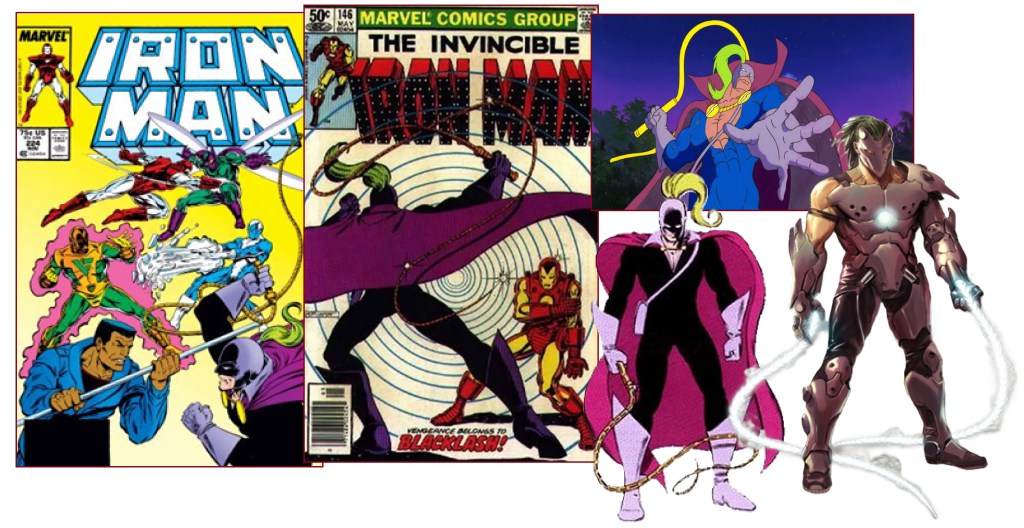
He’s gone by a few names – Whiplash, Blacklash, even Mark Scarlotti if you’re feeling formal – but one thing’s always been clear: this guy’s got a flair for the dramatic. First appearing in Tales of Suspense #97 (1968), Blacklash was a Stark Industries weapons designer who decided crime paid better than R&D. Armed with electrified whips and a taste for high-stakes sabotage, he quickly became one of Iron Man’s more flamboyant foes. Not the deepest villain in the drawer, but always good for a flashy entrance and a messy exit.
Over the years, Scarlotti’s bounced between mercenary gigs and villain teams – working with the Maggia, crossing paths with Spider-Man, and occasionally getting roped into larger schemes he’s not quite built for. He’s not a mastermind, but he’s persistent. And like many of Iron Man’s rogues, he’s a cautionary tale: brilliant mind, poor choices, and a tendency to lash out when things go wrong. His arcs often end with regret, not triumph.
Animation gave Blacklash a few turns at bat. He popped up in the Iron Man series as part of the Mandarin’s crew – complete with a ponytail, a sneer, and a voice that sounded like he’d just walked off a Bond set. He was more muscle than menace, but the whip tricks were solid. Later appearances in Armoured Adventures and Avengers Assemble retooled him slightly, but the core remained: stylish, dangerous, and always one bad decision away from a knockout.
The MCU gave us a version of him in Iron Man 2 (2010), though heavily reimagined. Mickey Rourke’s Ivan Vanko fused elements of Blacklash and Crimson Dynamo into a single character – gritty, vengeful, and armed with electrified whips that tore through F1 cars like butter. It wasn’t comic-accurate, but it worked. That version had pathos, pain, and just enough menace to make Tony sweat.
Blacklash isn’t top-tier, but he’s part of the texture. He’s the kind of villain who reminds us that Stark’s world is full of brilliant minds who took the wrong turn.
The Defection of Hawkeye | Iron Man to the Second Power (Part 2)




 X-Cess Minutiae
Leave a comment