


This one plays like a finale because it is a finale – regardless of where it landed in the broadcast order. The structure’s too tight, the call-backs too deliberate, and the payoff too clean to be anything else. Flashbacks reach all the way back to the pilot, threading through Mandarin’s suspicions, MODOK’s surveillance, and Stark’s layered misdirection. Someone plotted this through. And when the pieces click into place, they really click.
The suspense is razor-sharp. The audience is genuinely in the dark about who’s inside the armour, and the reveal – that Julia married a robot while the real Tony piloted the suit remotely – is classic misdirection. It’s not just clever. It’s character-driven. Stark weaponises his own myth, turning the mask into a decoy and the wedding into a trap. The ensemble gets their beats. The villains get their spectacle. And the rhythm never falters.
Then there’s Mandarin. When he finally confirms Stark’s identity, he doesn’t whisper it. He roars it – “TONY STARK IS A DEAD MAN!” – four times, straight to camera, with full theatrical menace. It’s chilling, unfiltered, and arguably too much for a Saturday morning slot. But it lands. Because the show, for all its tonal swings, knows how to build a moment. And when Mandarin flounces his power, it’s not just villainy – it’s vindication.
This episode doesn’t just close a chapter. It reframes the season. The ensemble fractures. Trust is tested. And Stark, ever the strategist, walks away with victory and consequence. It’s a finale built on masks, memory, and the cost of control. And for a series often dismissed, it’s proof that when it leans into suspense, it doesn’t just deliver – it dares.
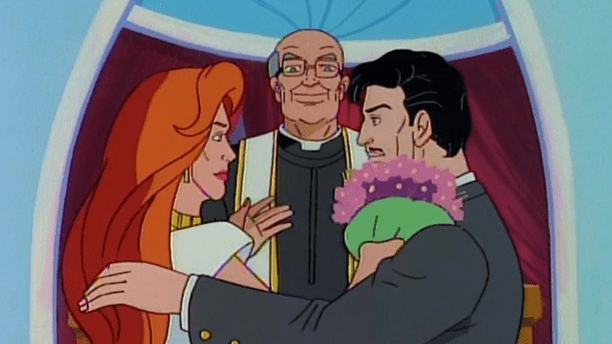
It begins with a wedding. Tony Stark and Julia Carpenter stand at the altar, surrounded by friends, allies, and the quiet hum of celebration. But even in this moment of joy, Tony’s mind drifts – back nine days, to the moment everything began to unravel. MODOK, ever the schemer, deployed an animatronic raven to spy on Stark Enterprises. The surveillance worked. And when Mandarin reviewed the footage, he saw through the façade. Tony Stark was Iron Man. The game changed.
In the present, the newlyweds set off on their honeymoon, only to be pursued by Mandarin’s aircraft. Tony radios Hawkeye, instructing him to prepare the armour. Moments later, Mandarin strikes. The car crashes. Tony is taken. Force Works mobilises, clashing with the villains in a desperate attempt to recover their leader. But then Iron Man arrives – mid-battle, fully armoured, and very much active. The implication is clear: Tony Stark isn’t Iron Man. Not anymore.
The battle is fierce. Force Works holds the line, pushing back against the villains’ assault. The tide turns. And when the dust settles, the truth is revealed. The Iron Man who fought was piloted remotely. The Tony Stark who stood at the altar was a robot. The real Tony orchestrated the entire deception, using the wedding as bait, the armour as misdirection, and the chaos as cover.
Tony Stark, ever the strategist, proves once again that the man behind the mask is always thinking three steps ahead. The curtain falls – not with a bang, but with a twist. And the legacy of Iron Man remains intact.
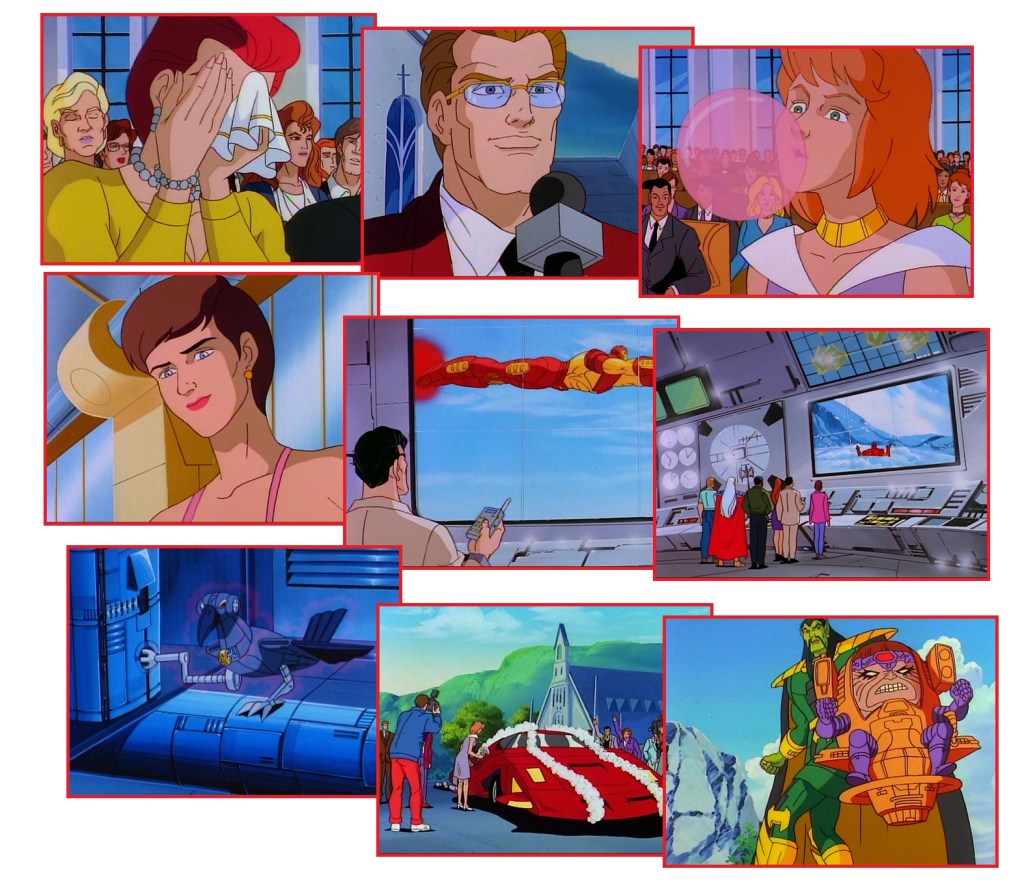
Wanda, who’s not in on the plan, is genuinely devastated at the wedding, crying and sobbing. Physiotherapist Veronica Benning, making her final appearance, doesn’t look too thrilled either. Sam Jaggers is also reporting on the wedding – last seen in Enemy Within, Enemy Without, and Rachel Carpenter is her mom’s bridesmaid.
There’s flashbacks to Silence My Companion, Death My Destination, The Defection of Hawkeye, The Origin of the Mandarin and The Origin of Iron Man. The team finally discover how the Mandarin has been watching their every move via MODOK’s raven.
The car that Julia used in The Defection of Hawkeye is used as her and Tony’s wedding car.
When the villains react in surprise to Iron Man’s arrival, the Mandarin is insistent that he can’t be there as Stark is on the ground below. MODOK suggests someone tries telling Iron Man that – seconds before a hit.
COLD TECH, COLDER CHOICES

Blizzard’s never been the loudest name in Iron Man’s rogues gallery, but he’s stuck around longer than most. First appearing as Gregor Shapanka in Tales of Suspense #45 (1963), he was a Stark Industries scientist with a fixation on cryogenics and a knack for theft. When his obsession got him fired, he built a suit that could generate intense cold and went full supervillain. The name “Blizzard” came later, but the pattern was set: brilliant mind, bruised ego, and a tendency to freeze things when life got too hot.
Over time, the mantle passed to Donnie Gill, a younger, brasher version who inherited the tech and the name. Gill’s Blizzard was more mercenary than mastermind – he bounced between villain teams, got recruited by the Thunderbolts, and occasionally tried to go straight. His arcs often flirted with redemption, but never quite committed. He’s the kind of character who’s always one bad day away from relapse, and one good mentor away from a turnaround.
Animation gave Blizzard a few nods. He showed up in Iron Man: Armoured Adventures as a teenage antagonist, reimagined with a sleeker design and a more sympathetic backstory. Later appearances in Avengers Assemble leaned into the tech angle, often pairing him with other gadget-based villains. He’s not a heavy-hitter, but he’s visually striking – ice blasts, frozen terrain, and the kind of power set that plays well in motion.
Donnie Gill appeared briefly in Agents of S.H.I.E.L.D., reimagined as a rogue asset with cryokinetic abilities. It was a blink-and-you’ll-miss-it adaptation, but it proved the concept works. A tech-based villain with emotional baggage and elemental flair? That’s fertile ground – especially in a post-Stark world.




 X-Cess Minutiae
Leave a comment