


This episode hums with energy – literal and philosophical. Arthur Dearborn believes the Star Well can save mankind. Not just as a power source, but as a promise. A future unshackled from fossil fuels, from scarcity, from the slow decay of planetary compromise. It’s a bold vision, delivered without sermonising. Dearborn never preaches. He simply believes. And that belief, voiced with quiet gravitas by David Warner, gives the episode its pulse.
Sunturion, his radiant counterpart, voiced by W. Morgan Sheppard, adds weight. There’s a duality here – man and machine, idealist and enforcer, dreamer and guardian. The space station isn’t just a setting. It’s a crucible. Iron Man enters with suspicion. Rhodes with loyalty. The ensemble fractures. The stakes rise. And when the station begins to fall, it’s Dearborn who chooses sacrifice over survival. Not for glory. Not for redemption. But because someone had to.
The episode doesn’t just explore energy – it interrogates control. Who owns power? Who decides its purpose? AIM wants weaponization. SHIELD wants containment. Stark wants accountability. And Dearborn? He wants hope. That tension drives every scene, every choice, every line of dialogue. It’s mythic without being melodramatic.
Cell of Iron doesn’t shout. It resonates. And in a season built on escalation, it offers something rare: a moment of clarity, voiced by giants, powered by conviction, and sealed with sacrifice.
SHIELD operative Dum Dum Dugan arrives at Stark Enterprises with orders to seize control of the facility, citing international fallout. Tony refuses, but Dugan presents evidence: a Stark factory in China, a school engulfed in flames, and a government demanding accountability. AIM claims responsibility, but the damage is done. The threat escalates – ten major population centres are now at risk. Stark takes to the sky.
Iron Man infiltrates AIM’s satellite, navigating its defences and encountering Sunturion – a radiant guardian with power drawn from the station’s core. Stark reaches Arthur Dearborn, who introduces him to the Star Well, a fusion engine capable of planetary-scale output. Stark suspects Dearborn of weaponising the Star Well, but Dearborn insists AIM tampered with the test. The truth remains murky.
An AIM fleet approaches. Stark urges shutdown. Dearborn refuses, revealing his dual identity – he is Sunturion. The confrontation ignites. As the ships attack, Iron Man and Sunturion fight side by side, but the station destabilises. Gravity shifts. Trajectory falters. Earth looms below. Stark’s power reserves dip too low to prevent impact.
Sunturion makes the call. He sacrifices himself to destroy the station, sparing New York and silencing the threat. The cost is immense. The fallout, global.
And far from the wreckage, Mandarin retrieves another of his rings – quietly, in a tent in China.

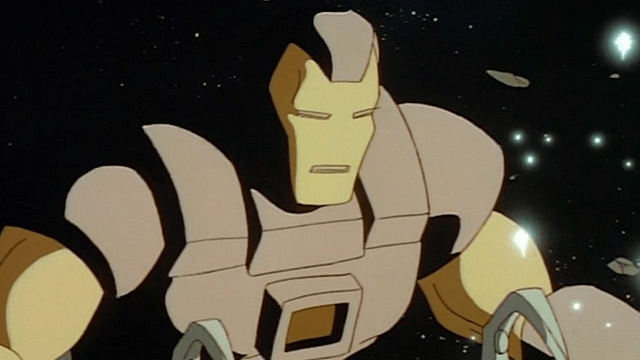
Armour Watch: Tony is using his deep space armour in this episode.
Dun Dum Dugan is Nick Fury’s right hand man (or LMD depending on the story). He first appeared in 1963’s Sgt. Fury and the Howling Commandoes #1. He’s voiced this season by W. Morgan Sheppard. On the big screen, he’s played by Neal McDonough – who voiced Firebrand in the previous episode.
Tony is mistakenly called Anthony B. Stark, though his middle name is typically Edward.
The story of Arthur Dearborn and Sunturion’s story comes from Iron Man #143.
Iron Man makes note of SHIELD’S Mandroid Armour, which he’ll come up against in The Armour Wars (Part 1).
A.I.M. – THE SCIENCE THAT FORGOT ITS SOUL
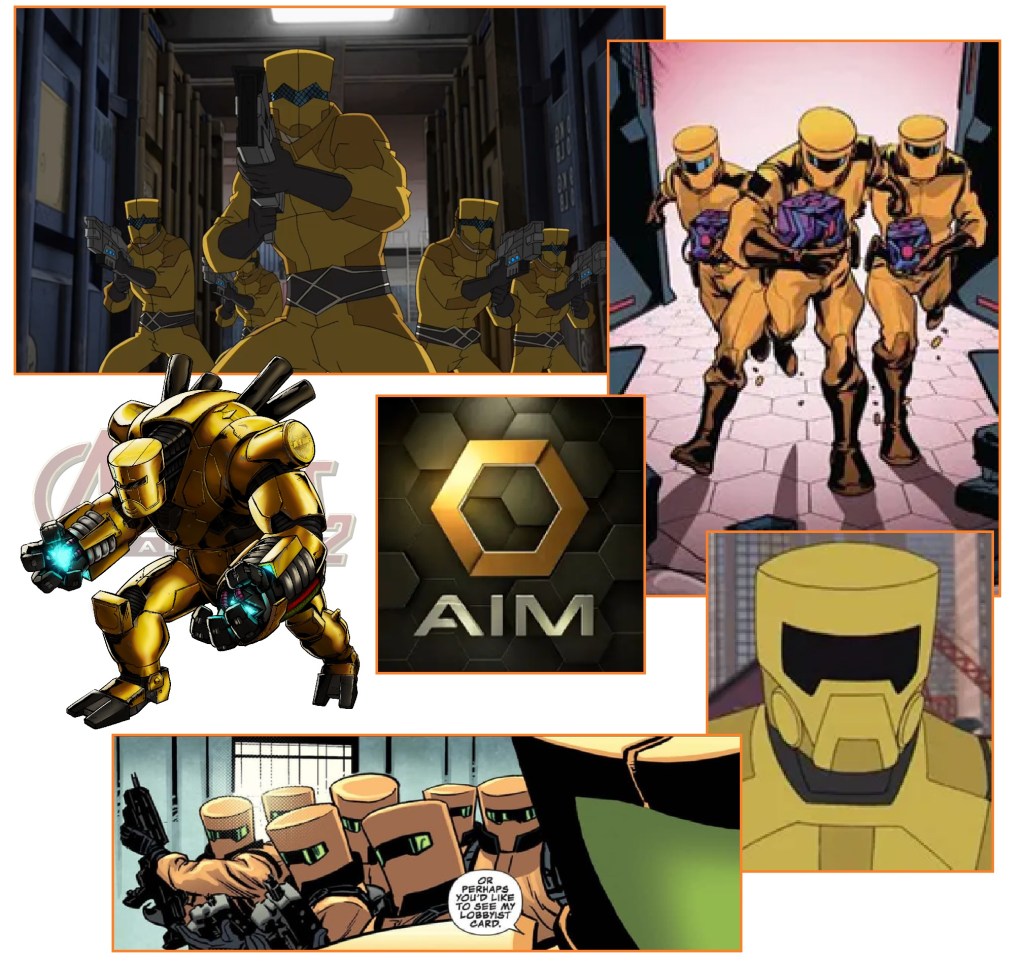
Advanced Idea Mechanics was never built to conquer. It was built to solve. A think tank turned paramilitary syndicate, AIM began as a splinter of Hydra – scientists who believed intellect should be weaponised, not shackled. Their debut in Strange Tales #146 (1966) positioned them as faceless minds in yellow suits, but the threat was never in their uniforms. It was in their philosophy: that progress, unchecked, could reshape the world.
AIM doesn’t chase power the way other villain groups do. They chase possibility. They build cosmic cubes, engineer bio-weapons, and rewrite neural architecture. They created MODOK – a living computer with a grotesque head and a mind that outpaces morality. They’ve clashed with SHIELD, the Avengers, and especially Iron Man, whose tech they covet, reverse-engineer, and corrupt. Every encounter is a mirror: Stark builds to protect; AIM builds to dominate.
Their evolution across decades is jagged. Sometimes they’re corporate saboteurs. Sometimes they’re rogue scientists. Sometimes they’re a full-blown nation-state (AIM Island, anyone?). In Secret Avengers, they become a sovereign power. In Avengers World, they’re a global threat. And in MODOK: Head Games, they’re a punchline with teeth. The tone shifts, but the core remains: intellect without ethics is a weapon waiting to be aimed.
In animation, AIM often plays the long game – lurking behind the scenes, manipulating tech, and unleashing MODOK when subtlety fails. In Iron Man, they’re the architects of escalation, stealing Stark’s designs and cloning his legacy. In the MCU, they surface in Iron Man 3 as the think tank behind Extremis, rebranded but still recognisable: science with a grudge.
AIM isn’t Hydra. They’re not the Hand. They don’t worship gods or chase immortality. They believe in the supremacy of thought. And that’s what makes them dangerous.




 X-Cess Minutiae
Leave a comment