


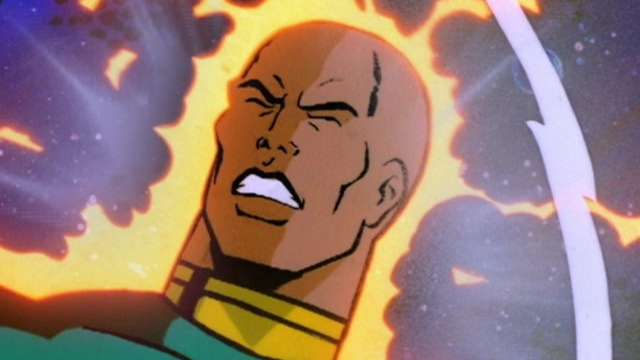

This opener doesn’t explode – it mourns. The Watcher’s narration sets the tone: solemn, distant, already grieving. The universe is vast, but the pain is intimate. Zenn-La is a world of peace, of stillness, of enlightenment. And Norrin Radd is the one man who cannot sit still. His yearning isn’t reckless – it’s mythic. He wants to know. To see. To matter. And when Galactus arrives, that yearning becomes sacrifice.
The animation is breath-taking. Celestial vistas stretch across the screen like painted myths. Galactus moves like a force of nature, not a villain. Zenn-La glows with serenity, and the transformation of Norrin into the Surfer is rendered with operatic weight. This isn’t just animation – it’s visual poetry. The series looks like it was carved from Kirby’s dreams and coloured with reverence. It’s grown-up without being grim, mature without condescension. It never talks down to children – it lifts them up.
The Marvel cosmos comes alive here. Kree and Skrull wars rage in the background. The Watcher observes. Galactus feeds. And the Surfer begins his descent. The continuity threads are masterful – woven with care, never forced. The season doesn’t just tell stories. It builds a mythos. Every choice echoes. Every sacrifice lingers.
This isn’t just an origin story. It’s a cosmic elegy. And in a season that shines from start to finish, The Origin of the Silver Surfer sets the tone with grace, grandeur, and the quiet horror of becoming something you no longer recognise.
The Watcher speaks. The universe unfolds. Kree and Skrull clash across galaxies, locked in endless war. But something older, hungrier, arrives – Galactus, the devourer of worlds. He is not evil. He is necessity. And his shadow falls on Zenn-La.
Zenn-La is a world of peace, of stillness, of enlightenment. But Norrin Radd is restless. He yearns for the stars, for the courage of explorers past. Shalla-Bal loves him, but cannot anchor him. When Galactus begins to feed, the planet’s leaders plead for mercy. They fail. The Kree and Skrull attack. They are erased. And Norrin, desperate, makes a bargain.
He offers himself. His life. His memory. In exchange for Zenn-La’s survival. Galactus accepts. Norrin becomes the Silver Surfer – herald of destruction, stripped of history, tasked with finding worlds for his master to consume. He leaves Shalla-Bal behind. He leaves himself behind.
The transformation is brutal. The cost, incalculable. And as the Surfer begins his journey, the Watcher watches still – silent, sorrowful, and bound by oath. The universe turns. The hunger continues. And the man who was Norrin Radd begins to forget why he ever chose to save his world.

This series cannot be part of the same universe as the other series set in the same continuity, unless it’s a divergent timeline caused when Thanos winds back time in The End of Eternity. No prize, anyone?
The tree-creatures at the beginning of the episode, who are enslaved by the Kree, are Groot’s people, the Flora colossi. That makes the planet his homeworld of Planet X, which first appeared in Tales to Astonish #13 (which predates the Marvel Universe, printed in 1960).
The show’s animation style is based on Jack Kirby’s artwork, although the Silver Surfer’s first solo series was predominantly drawn by John Buscema.
James Blendick, the voice of Galactus in this series, also voiced Apocalypse in episodes of X-Men. Shalla-Bal is voiced by Camilla Scott, who voiced Lilandra. Due to where the voice work was done, many of the X-Men cast members play various roles throughout this season.
In an ironic line, the Skrull Commander Husserl only joins the battle against Galactus to prevent his world, Skrullos, from becoming a target. In Fantastic Four #257, Galactus consumed the Skrull homeworld.
There’s a Nova Corp member behind the Kree and Skrull delegates.
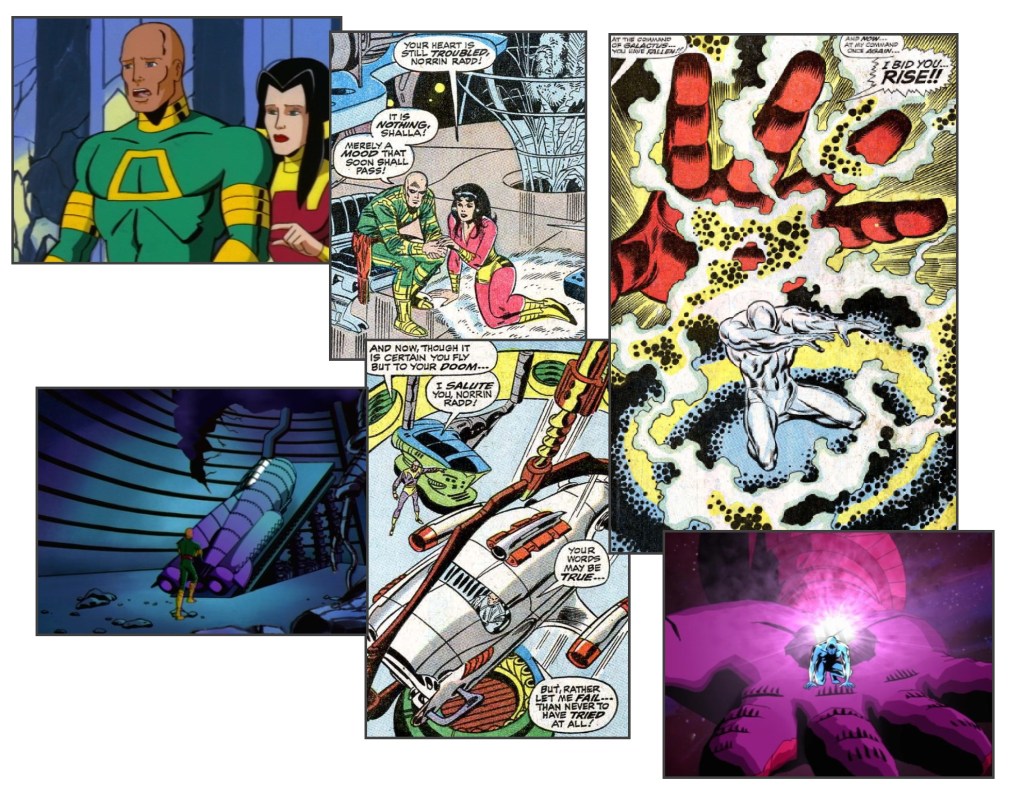
The transformation of Norrin Radd into the Silver Surfer is taken from Silver Surfer #1. The tagline for the series, ‘The Sentinel of the Space-Ways’, is partially spoken in this episode.
In what becomes a catchphrase that sticks, the Surfer calls out “To me, my board,” for the first time in this episode.
“THIS TASK BRINGS ME GREAT JOY… AND GREAT SORROW.”
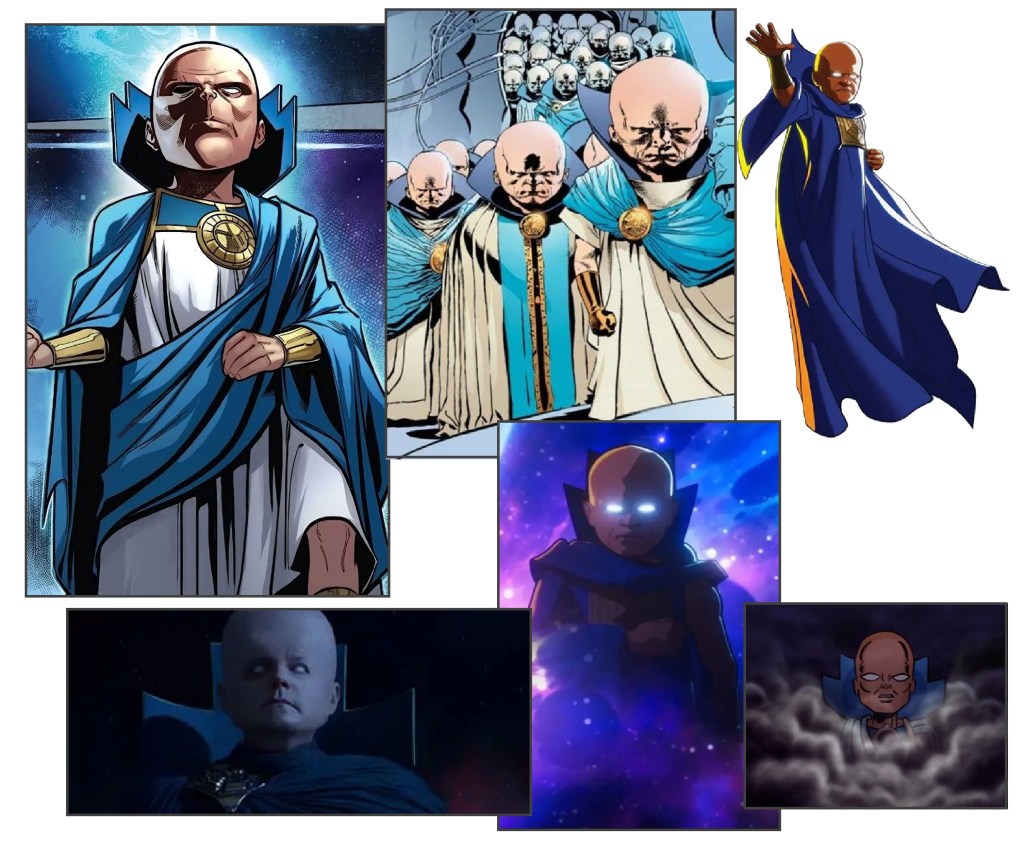
The Watcher doesn’t interfere. That’s the oath. That’s the burden. Uatu, stationed on Earth’s moon, sees everything – every choice, every fracture, every moment where intervention might save a life, or doom a world. But he watches. Solemn. Silent. Bound by a promise made by his race after they once tried to guide a civilisation, only to see it collapse into ruin. Knowledge without action. Compassion without touch. It’s not just a role – it’s a punishment.
First appearing in Fantastic Four #13, Uatu quickly became Marvel’s cosmic narrator. He’s not a god. He’s not a judge. He’s a witness. He’s there when Galactus arrives. When Phoenix burns. When universes fold. And when he breaks his oath – as he does in Infinity Gauntlet, Original Sin, and countless What Ifs – it’s never without cost. His death in Original Sin isn’t just a plot twist. It’s a reckoning. The man who saw too much, and finally said too much.
On screen, The Watcher has flickered in and out of Marvel’s animated canon for decades. He appears in Silver Surfer, voiced with quiet gravitas, narrating the fall of Zenn-La and the rise of the Surfer. He’s there in What If…? (2021), voiced by Jeffrey Wright, finally given form and agency, watching the multiverse fracture and – eventually – stepping in. That version, weary and wide-eyed, captures the ache of cosmic responsibility. He’s not omnipotent. He’s overwhelmed.
The Watcher isn’t part of the ensemble. He’s the frame. The lens. The reminder that every story is being seen, even if no one intervenes. He’s mythic, yes, but also deeply human – curious, conflicted, and quietly grieving. His presence elevates the narrative. His silence deepens the stakes. And when he speaks, it’s never casual. It’s always earned.
The tale is filled with great joy… and great sorrow. And The Watcher sees it all. Not because he wants to. But because someone must.




 X-Cess Minutiae
Leave a comment