


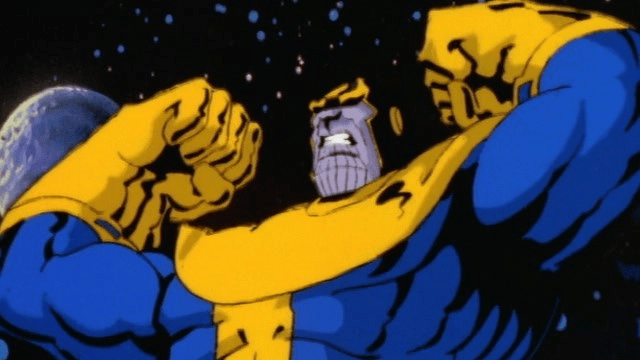

The Surfer, still tethered to Galactus, begins to fracture – emotionally, morally, cosmically. The illusion planet, the artificial nova, the descent into Ego’s living labyrinth – it’s all theatre. And at the centre of it, Thanos. Unhinged, operatic, and finally animated. His first appearance outside the comics is a masterstroke: wild-eyed, poetic, and terrifyingly devout.
Thanos doesn’t just worship Lady Death – he romanticises annihilation. His voice, his posture, his obsession – it’s all mythic madness. And it lands. The Surfer, trapped in illusion, begins to remember. Zenn-La. Shalla-Bal. The sacrifice. The pain. The cost. And Thanos recoils. Not from power, but from truth.
Paul Essiembre’s voice work as the Surfer is quietly brilliant. Familiar, yes – grounded, aching, and just detached enough to feel alien. His delivery carries the weight of someone who’s lost everything but doesn’t know it yet. The memories return. Then fade. The tragedy isn’t just in forgetting – it’s in remembering too late.
Visually, the episode continues to stun. Ego’s terrain is surreal and hostile. The Marvel cosmos breathes – alive, dangerous, and vast. The continuity threads tighten. The tone matures. And the season, already luminous, begins to burn.
The Silver Surfer searches. Galactus hungers. Worlds fall. But something stirs in the Surfer – a flicker of doubt, a shadow of memory. He arrives on a mechanical planet, rich in energy, and calls his master. The inhabitants resist. Their weapons fail. Their courage does not. The Surfer hesitates. He feels sorrow. But he does not stop.
Galactus feeds. The Surfer watches. And elsewhere, Thanos watches too. Obsessed with Galactus, he sets a trap – an artificial nova, a world of illusions, a living planet named Ego. The Surfer is cast adrift, hurled into impossibility. Lava, ice, storms, voids. The planet attacks. Ego offers sanctuary. The Surfer refuses.
Thanos strikes. He invades the Surfer’s mind, searching for the secret to control Galactus. But the Surfer’s memories are sealed. Until they break. Zenn-La returns. Shalla-Bal returns. The sacrifice returns. The Surfer remembers. And Thanos recoils. Ego intervenes. The trap collapses.
The Surfer escapes. But the memories fade. Galactus waits. And the Surfer, now aware of what was stolen – his past, his love, his soul – vows a reckoning. He finds Galactus above a new world. A world rich in life. A world called Earth.

The Watcher, unnamed as Uatu, narrates episodes of this series, just as he does in another Marvel property, What If…?
Lord Glenn’s race, the Draconian, are unique to the series. They’re a cybernetic race, which may explain why their planet so greatly resembles Cybertron from Transformers. X-Men‘s Forge was voiced by Marc Strange, who voices Lord Glenn.
Another version of the planet Ego appeared (and was destroyed) in the Fantastic Four episode To Battle The Living Planet. For more on Ego, see here.
In a difference to the previous version seen in The Silver Surfer and the Coming of Galactus (Part 1), Galactus finds the Earth himself.
THANOS: THE MAD TITAN

Thanos doesn’t want power. He wants meaning. Born on Titan, a moon of Saturn, he’s a child of privilege and prophecy – ostracised for his appearance, feared for his intellect, and consumed by a love that no one else can understand. That love is Death. Not metaphor. Not mourning. The literal embodiment of the end. And Thanos, in his twisted devotion, seeks to impress her – not with flowers, but with extinction.
Created by Jim Starlin in Iron Man #55 (1973), Thanos quickly transcended his origin. He’s not just a villain. He’s a philosopher of oblivion. The Infinity Gauntlet saga cements his legacy: wielding all six Infinity Gems, erasing half of all life, and still failing to win Death’s affection. His stories are operatic – cosmic scale, intimate pain, and the recurring truth that even gods can be lonely.
On screen, Thanos first appears in Silver Surfer, voiced with manic brilliance and terrifying clarity. Lady Death becomes Lady Chaos, thanks to censors, but the intent is unmistakable. He’s unhinged, poetic, and utterly devout. It’s his first animated outing, and it lands. Later, he surfaces in Avengers Assemble, Guardians of the Galaxy, and What If…?, each version echoing the same rhythm: power as proxy, destruction as devotion.
The MCU reimagines him with quiet menace. Josh Brolin’s Thanos is colder, more calculated, and driven by balance rather than worship. But the ache remains. Whether courting Death or correcting the universe, Thanos is always reaching for something that cannot love him back. His snap in Infinity War isn’t just an act of genocide – it’s a prayer.
Thanos is the Mad Titan. Not because he rants. But because he believes. He’s the one who reminds us that obsession, once sanctified, becomes its own kind of religion.
The Origin of the Silver Surfer (Part 1) | The Origin of the Silver Surfer (Part 3)




 X-Cess Minutiae
Leave a comment