


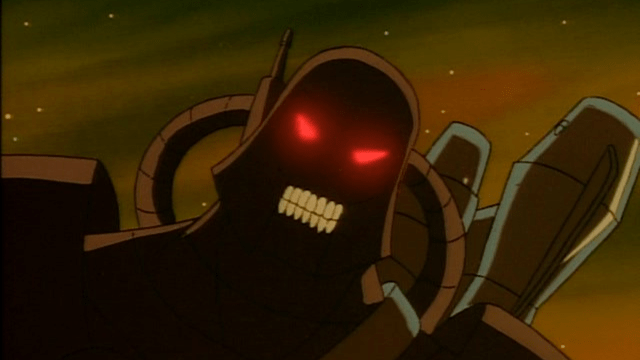
Distant Boundaries talks about guilt – not the kind that fades, but the kind that reshapes. Tony Stark feels it first. He let Dark Aegis go. He didn’t stop him. And now an innocent world lies in ruins, scorched by nuclear fire and arrogance. Aegis is armoured, powered, and utterly indifferent to life. He’s not just a villain – he’s a consequence. And Tony, for all his brilliance, can’t undo what’s been done.
Rhodes feels it too. The War Machine armour sits idle, and he can’t bear to wear it. Not because he’s weak, but because he’s afraid of what it means – of what it demands. His guilt isn’t about failure. It’s about identity. About whether the armour still fits, and whether he still fits inside it. The hesitation is quiet, but it echoes through the arc.
And then there’s Titanium Man. Once a symbol of control, now a man broken by the cost of it. He sees the innocents lost. He sees the power misused. And he switches sides – not for redemption, but for responsibility. His final act, a seeming sacrifice, isn’t just noble. It’s necessary. He doesn’t die a hero. He dies trying to be one.
This episode doesn’t just explore guilt. It weaponises it. Across the ensemble, across the arc, across the wreckage left behind. And in a series built on armour, this is the episode that asks what happens when the shell cracks – and the fallout begins.
A fireball streaks toward Malibu – an object falling fast from orbit. Rhodes alerts Stark, who suits up and intercepts, only for his armour to fail mid-flight. The descent is brutal. Rhodes, piloting a helicopter, diverts the ship into the ocean and pulls Stark from the brink. The vessel is alien, damaged, and carrying a message: Dark Aegis has conquered Elysian. The planet is lost. The ship will return in two hours.
Iron Man and War Machine board the vessel, unaware of the extra weight in the cargo bay. Titanium Man reveals himself, attacking and casting Rhodes into space. Stark retrieves him, and the ship lands on Elysian – a world scorched by nuclear fire. Dark Aegis greets them with an offer: rule beside him, reshape the cosmos, and watch the moons fall. Stark refuses. Another moon is destroyed.
Rhodes, struggling with failing life support, encounters Titanium Man again. But the Russian turns – disgusted by Aegis’s annihilation. He offers Rhodes a chip to stabilise his systems. The three unite. The battle is fierce, the force-field unrelenting, but they break through. Aegis retreats, fleeing into the stars. Titanium Man hands over a module, allowing Stark and Rhodes to return home. He remains behind, chasing the warlord into deep space. A blinding explosion is seen from the planet’s surface, both villains apparently destroyed in the blast.
Back on Earth, specifically Ireland, a group of thieves tries to flee with their bundle. Then a man approaches them, scaring them away. Fishing through their dropped booty, the Mandarin secures another ring.

Armour Watch: This episode has HOMER specifically test the armour’s transformation capabilities, so throughout this episode, we see Samurai mode, Radiation mode, Deep Space mode and Inferno mode.
Iron Man remembers battling Dark Aegis during an unseen battle from season one. He’s an armoured maniac who ended up exiled to space with advanced weaponry, which he used to rule the planet Elysian by force. He’s an original character, created for the series.
Titanium Man was lost in space in the pilot episode And the Sea Shall Give Up Its Dead.
Iron Man creates claws that resemble Wolverine’s out of energy.
TITANIUM MAN – THE IRON CURTAIN IN COMBAT
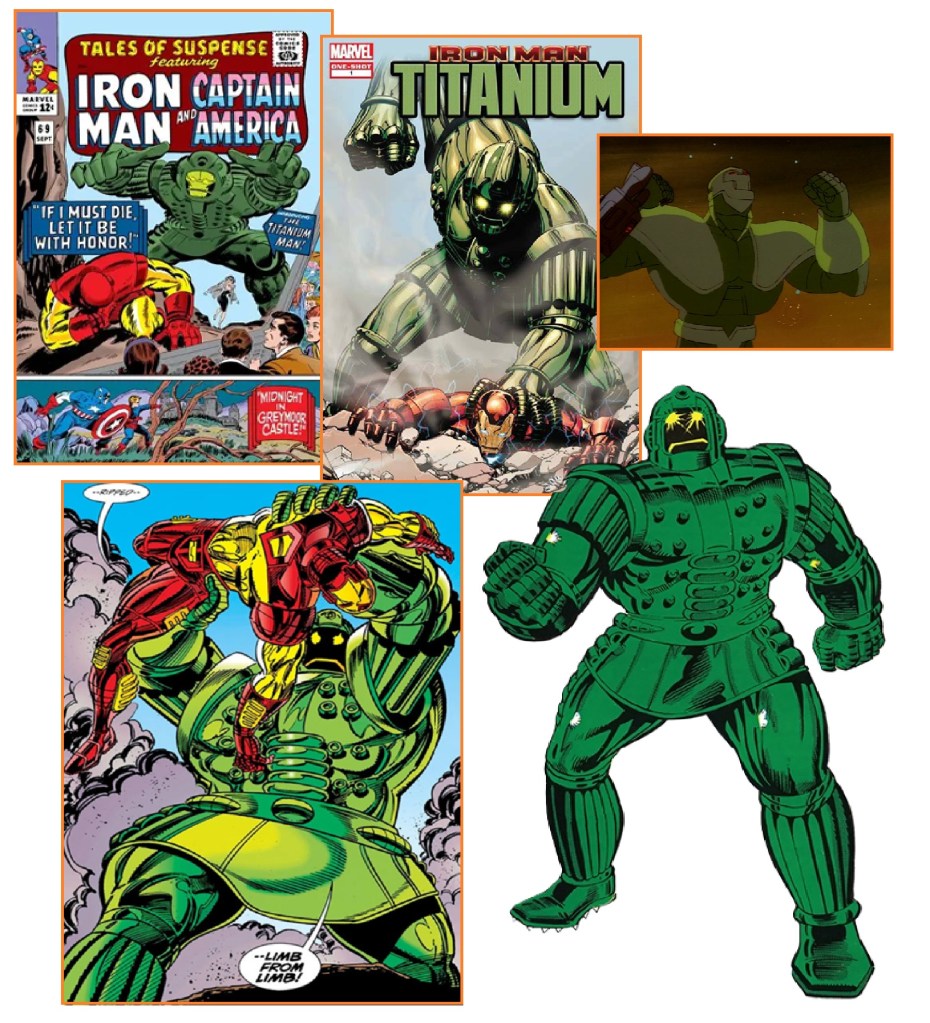
Titanium Man was never just a villain. He was a symbol. Created in Tales of Suspense #69, Boris Bullski was a Soviet official who saw Iron Man’s armour not as innovation, but as provocation. In a bid to restore his standing with the Kremlin, he commissioned his own suit – larger, heavier, and unmistakably green. Titanium Man was born not from genius, but from ideology. He wasn’t trying to outthink Stark. He was trying to outlast him.
Bullski’s early appearances are pure Cold War theatre. He’s brash, nationalistic, and utterly convinced of his superiority. But the suit is flawed. Slower, bulkier, and reliant on brute force. His defeats are frequent, but his symbolism endures. Over time, the mantle passes – first to Kiryov, then to Gennady Ovinnik, and even to a rogue AI. Titanium Man becomes less a person and more a programme: the idea that state-sponsored power can rival individual brilliance.
On screen, Titanium Man flickers in and out of Marvel’s animated canon. He appears in Iron Man: Armoured Adventures, reimagined as a sleek Russian mercenary. In Iron Man, he’s voiced with gravel and menace, clashing with Stark in a battle of tech and temperament. The suit glows green, the ideology simmers, and the rivalry feels earned. He’s not just a bruiser – he’s a relic of a world that never stopped competing.
The character’s legacy deepens in the comics. He’s part of the Soviet Super-Soldiers, clashes with the Crimson Dynamo, and even joins the Thunderbolts under duress. But the core remains: Titanium Man is the state’s answer to Stark’s autonomy. Where Tony builds to protect, Titanium Man is built to enforce. It’s not personal. It’s political. And that tension gives every encounter its edge. He wears his ideology like a badge – and that makes him dangerous.




 X-Cess Minutiae
Leave a comment