


This isn’t just a crossover – it’s a handoff. A soft pilot for The Incredible Hulk animated series, echoing the same structural baton pass as Nightmare in Green did for Fantastic Four. Matt Frewer makes a strong debut as the Leader, bridging continuity with voice and menace, laying groundwork for what’s to come. But the heart of the episode isn’t in the setup. It’s in the sorrow.
Tony Stark wants to help. Not with tech. Not with armour. With time. He sees Bruce Banner’s pain, sees the monster that haunts him, and tries to rewrite the origin. It’s not arrogance – it’s empathy. But time travel doesn’t bend for good intentions. The past holds. The mutation remains. And Tony, for all his brilliance, can’t fix what’s already broken.
The episode doesn’t linger on failure. It lingers on effort. On the gesture. On the idea that trying to help – even when you know you’ll fail – is still worth doing. Stark doesn’t save Banner. But he tries. And Banner, for once, isn’t alone in the attempt.
Hulk Buster is a reminder that some things can’t be undone. But they can be witnessed and learnt from. And as the Leader will tell you, knowledge is a superpower.
In the desert, Bruce Banner is trapped within a lattice of light beams – energy drawn from one of Mandarin’s rings. Julia Carpenter touches the field and vanishes. Iron Man deduces the beams are temporal, sending anyone who contacts them back through time. Unseen, the Leader watches. Already in possession of one ring, he dispatches drones to claim the second. Iron Man resists, but the ring is taken.
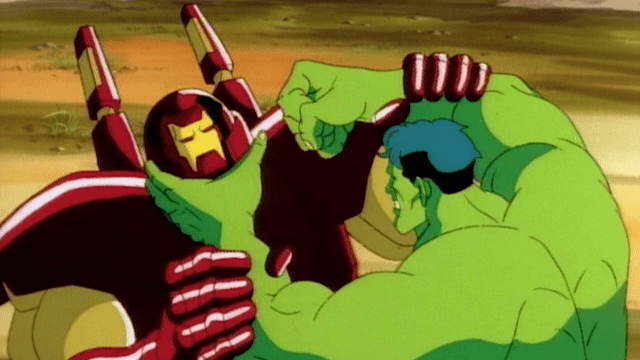
Banner, now free, joins Iron Man and Rhodes. He reveals the truth: the Leader was once a lab assistant, mutated by gamma exposure and now obsessed with rewriting history. With both rings, the Leader intends to travel back and eliminate the younger Banner – claiming the Hulk’s power for himself. Iron Man and Banner confront him, but the moment Banner transforms, the ring reacts. Hulk and Iron Man are cast into prehistory.
Rhodes forces the Leader to retrieve them, bargaining the rings in exchange. But the portal misfires. Hulk and Iron Man are scattered across time. Stark tries to reach him, urging Hulk to surrender the ring to save Julia. The Leader regains control, gathers the trio, and sends them to the moment of the gamma bomb – the origin point. Stark suggests Hulk save Banner from the blast. Hulk refuses. Rage ignites. The battle begins.
Rhodes sends reconfigured Hulk-Buster armour through the portal. Iron Man dons it mid-fight. Julia recovers the ring, but the Leader seizes it. As he prepares to kill the young Banner, Hulk intervenes – choosing to preserve the moment that made him. The paradox holds. The timeline stabilises. Rhodes repairs the portal and brings them home. The Leader is left behind.
After the battle, an archaeologist digs at the site, hoping to uncover more. He finds the two rings, buried in the past, recovered now in the present.
The Mandarin comes from behind him, out from nowhere. His final rings have been accounted for at last…
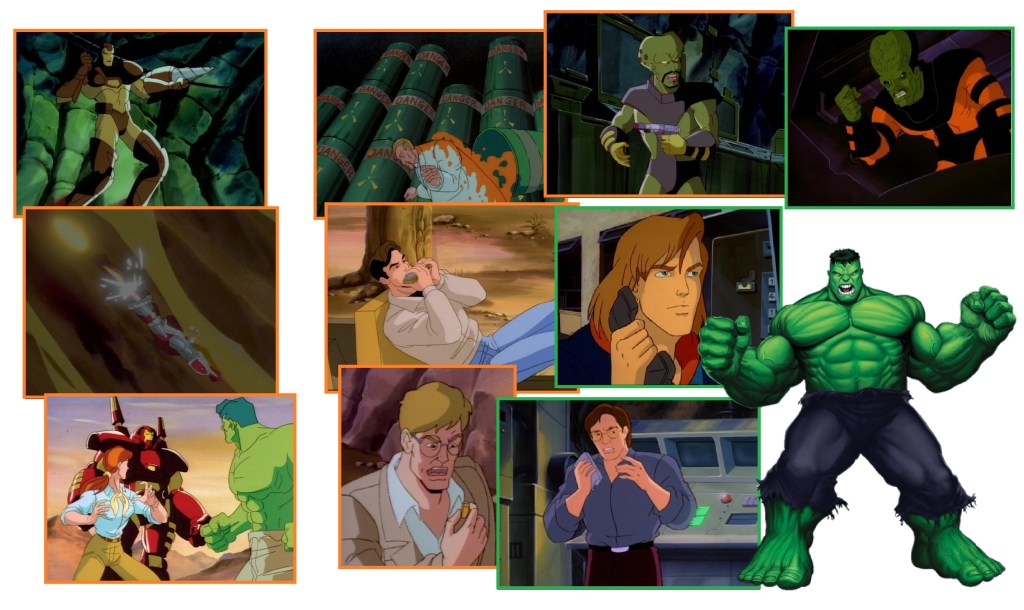
Armour Watch: In the desert, Tony needs his Drill armour. When stuck in a dangerous volcano in the past, he uses his Lava mode to dive after the ring. The Exo-armour is reconfigured into Hulk Buster armour to tackle the Green Goliath.
We see a flashback to the origin of Samuel Sterns and how he became the Leader. This will be expanded on in The Incredible Hulk. His plan in this episode, to combine his intellect with the Hulk’s awesome power, is one he’ll attempt again in that series’ first season.
Quite how the Leader returns to the present day is unrevealed, but he’ll turn up again in The Incredible Hulk. Matt Frewer also voices the character in that series.
Rick Jones resembles Bruce Banner more than Bruce himself does in this episode. He’s also unnamed. The Leader, on the other hand, is one colour shade away from his eventual appearance.
Julia mentions the failed wedding from The Wedding of Iron Man in her usual snarky style: “It’s never easy to get a ring from Tony.” She gets some awesome action scenes in this episode, kicking the Hulk in the face at one point!
IRON MAN VS THE INCREDIBLE HULK

They’re not enemies. Not really. But when Iron Man and the Hulk clash, it’s never just fists – it’s philosophy. Tony Stark builds to contain. Bruce Banner breaks to survive. One armours up to stay in control. The other loses control to stay alive. Their battles aren’t about victory. They’re about limits. And every time they collide, something breaks – sometimes a city, sometimes a friendship.
In the comics, their first major clash comes early – Tales of Suspense #84 (1966) – a misunderstanding, a test of strength, and a reminder that even allies can become threats. Over the years, the fights escalate. World War Hulk (2007) sees Stark deploy the Hulkbuster armour in a desperate attempt to stop a returning Banner, fuelled by grief and vengeance. It’s not just a fight – it’s a reckoning. Stark helped exile the Hulk. Now he has to face what came back. The Hulkbuster suit becomes iconic, but the emotional fallout is deeper: guilt, fear, and the knowledge that sometimes the smartest man in the room still loses.
On screen, the rivalry flickers across formats. In this Iron Man series, the Hulk appears in the episode as a one-off that leans into brute force and tech escalation. Stark builds a suit specifically to counter Banner’s rage, and the battle is pure spectacle – armour versus fury, containment versus chaos. It’s not subtle, but it’s effective. Later, Avengers: Earth’s Mightiest Heroes and Avengers Assemble explore the dynamic with more nuance, showing the tension between Stark’s precision and Hulk’s unpredictability.
The MCU crystallises the conflict. Avengers: Age of Ultron (2015) gives us the definitive Hulkbuster moment – Tony’s “Veronica” protocol, the towering suit, the brutal street-level brawl. It’s thrilling, yes, but also tragic. Banner is out of control. Stark is desperate. And the destruction is staggering. It’s not a victory. It’s damage control. And the friendship, already fragile, begins to fracture.
Iron Man vs The Incredible Hulk isn’t a rivalry. It’s a warning. About unchecked power. About the illusion of control. About what happens when two men, both broken in different ways, try to fix each other with fists.




 X-Cess Minutiae
Leave a comment