


Force Works are scattered, battered, and barely holding the line. The Mandarin’s anti-tech mist is rising, and this time, he’s not facing Iron Man. He’s facing Tony Stark – unarmoured, vulnerable, and very much human. Not that Mandarin notices. He’s too busy monologuing like Doom on a sugar rush, proclaiming dominion over continents while his prisoner quietly walks out the back.
The ensemble gets their moment. Wanda holds off the Mandarin for a while (must be all of Jarvis’ cooking!). Rhodey and MODOK form the strangest buddy duo ever.
The animation hits its peak, the action never lets up, and the dialogue sparkles with pulp precision.
MANDARIN: Goodbye, Asia! G’Day, Australia. They’re dropping like flies!
[IRON MAN crashes through the nearest wall]
IRON MAN: You know what flies are attracted to, don’t you Mandarin?
And MODOK? He spends most of the episode wheeling around in a cooking pot, delivering one of the most bizarrely tender lines in the series: “Mandarin makes me laugh! I like him.” It’s almost sweet. Almost.
The Mandarin falls – not to fists, but to ego. His power turns inward. His empire collapses. And he’s left in the dust, surrounded by bandits, forgotten by the very world he tried to rewrite. The heroes don’t gloat. They smile. Because as Tony says, there will always be new roads to travel. And if not? They’ll build them.
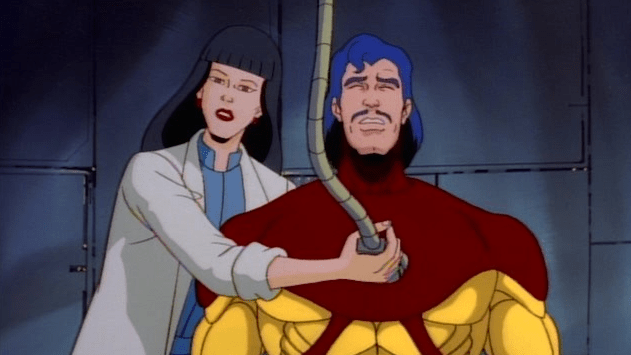
Force Works crashes hard near Mandarin’s stronghold. All but War Machine are captured, bound near the Heart of Darkness – a device that feeds on life-force to sustain its power-dampening mist. Rhodes slips through the wreckage, infiltrates the base, and frees Stark. MODOK intercepts them, but when offered life support, he lets them pass. The alliance is transactional. The stakes remain.
The two reach Stark Enterprises in Hong Kong, skirmishing with mountain bandits en route. There, Dr. Su Yin introduces a breakthrough: a bio-energy microprocessor immune to the mist’s effects. It’s installed into a new suit, but before activation, a fire erupts. The heat triggers the armour. Stark stabilises the blaze and takes flight – armoured, focused, and ready.
The Mandarin escalates. The villains are bound, their life-force offered to the Heart. Iron Man arrives, breaks through, and frees Hawkeye mid-battle. He connects directly to the Heart, reversing Mandarin’s assault and destroying the device. The mist dissipates. The world breathes again.
The Mandarin, furious, dons his own Exo-Armor. The final clash begins. Stark disables the circuitry, leaving Mandarin to the mercy of the bandits. The enemies are arrested. Force Works is freed. And in the quiet aftermath, Iron Man kisses Spider-Woman – a moment of connection after the storm.
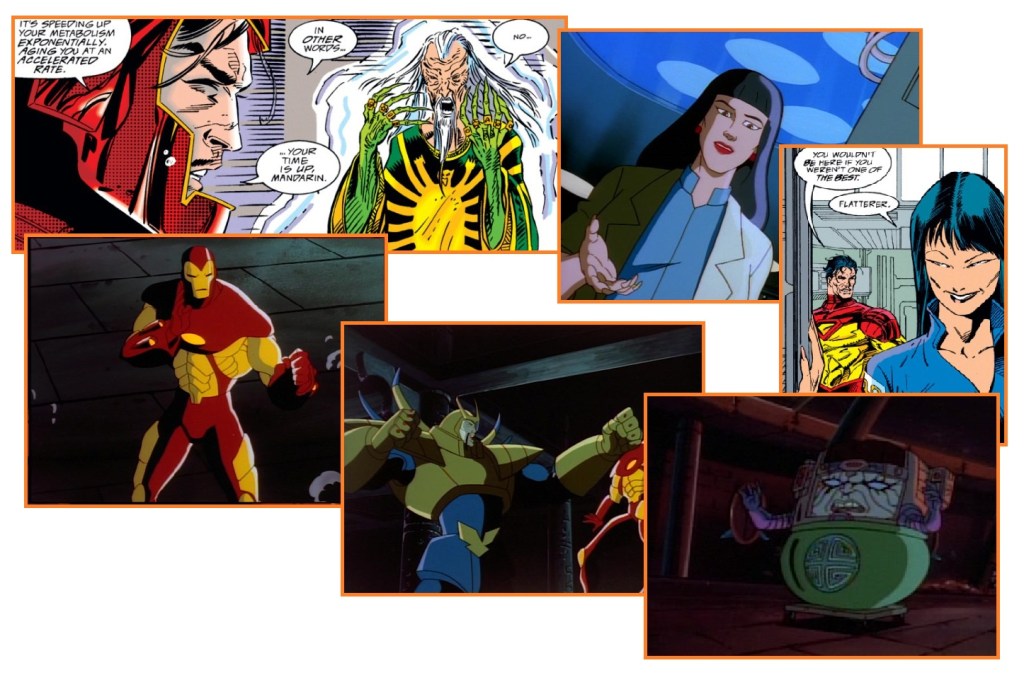
In the original comic story, in Iron Man #312, the Mandarin ages to death and crumbles into dust. It didn’t last – he eventually came back. In this episode, his rings are stolen by bandits – by means of slicing off his hands. Ouch.
Su Yin comes straight from the comic books, and first appeared in Iron Man #270. She’s a neuro surgeon who worked on new ways to help Tony with his heart – in more ways than one!
Armour Watch: Tony dons his final armour of the series, a souped up new version of his modern armour. The Mandarin also sports his own suit of armour in the final battle scenes. MODOK even gets in on the act – he wears a cooking pot!
THE FURTHER ADVENTURES OF IRON MAN
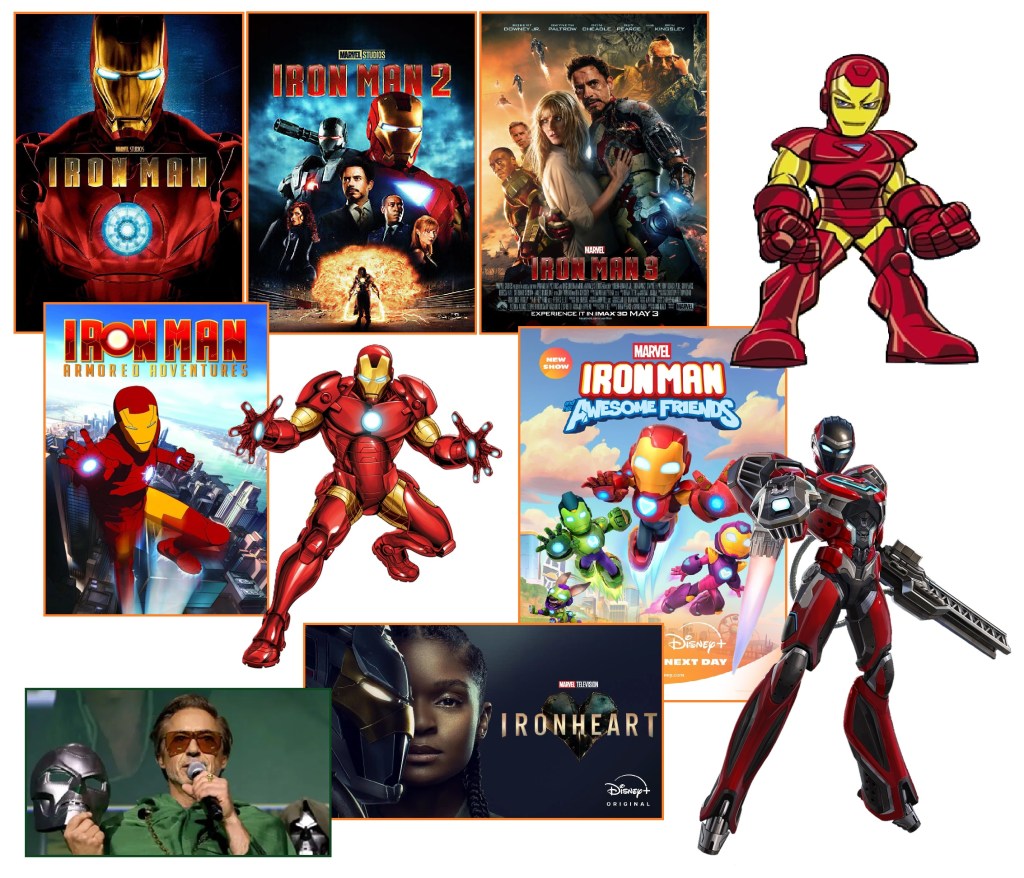
After 1994, Iron Man didn’t fade – he recalibrated. The animated series closed its arc, but the character kept evolving. The Superhero Squad Show gave us a comedic riff, all quips and exaggeration. Avengers Assemble leaned into synergy, folding Stark into a team dynamic that echoed the MCU’s rhythm. And Iron Man and His Awesome Friends brought him back to the Saturday morning spotlight – sleek, smart, and still learning.
But it was 2008 that changed everything. Iron Man, directed by Jon Favreau and powered by Robert Downey Jr.’s career-redefining performance, didn’t just launch a franchise – it launched a universe. Stark became the cornerstone of the MCU, the flawed futurist who built suits to protect others and walls to protect himself. Iron Man 2 explored legacy. Iron Man 3 cracked the shell. And the Avengers films turned him into a myth – sacrificing, recalibrating, and finally falling to save the world he helped shape.
The legacy didn’t end with Endgame. It multiplied. Riri Williams stepped forward in Ironheart, a new mind in a new suit, carrying the weight and wonder of Stark’s legacy without the baggage. And now, in a twist of casting alchemy, Robert Downey Jr. returns – not as Stark, but as Doom. The man who built the MCU now wears the mask of its most complex villain. It’s not just casting. It’s commentary.
None of these projects are just versions or sequels. They’re echoes. Reinventions. Refractions. Stark’s story became a blueprint – for heroism, for hubris, for heart. And whether it’s Riri in the lab, Doom in the shadows, or a new suit on a new screen, the myth continues. Not because of the armour. But because of the man who dared to build it.




 X-Cess Minutiae
Leave a comment