


By 1996, the Hulk had become more than a comic character. He was a cultural pressure point — a symbol of rage, repression, and resilience. He wasn’t just smashing tanks. He was smashing the idea that heroes had to be clean, controlled, and comfortable. Banner broke. Hulk endured. And somewhere between the two, Marvel found one of its most enduring truths.
Putting the Hulk back on television wasn’t a hard choice — the success of X-Men and Spider-Man had impressed creatives — but the Hulk show would have something that set it apart from its forebears, especially his cameo appearances in Iron Man and Fantastic Four. This show had darkness.
From the opening titles, you knew something was different: gone was the bumpy Wasserman ride that X-Men gave us — indeed, the opening theme of The Incredible Hulk echoes Danny Elfman’s Batman more than anything Marvel had done before. But it works.
Showcasing Banner’s life with Betty and twisting his dreamscape into the Hulk’s permanent fury as the title card kicks in, it’s the perfect companion to this first season of episodes.
There’s a lot to introduce in this first episode. But Return of the Beast (Part 1) is action-packed and doesn’t let up or let you breathe. Every single act ends with a weapon being fired at the Hulk, leaving us with a cliffhanger that begs us to return.
A strong start to an excellent first season. In fact, one could even call it a smash hit!
Major Glenn Talbot calls General Thunderbolt Ross in the dead of night — Banner’s stealing power for a hidden lab in the desert. Betty Ross, shaken from sleep by a nightmare of Bruce and the Hulk, overhears and pleads with her father to leave Bruce alone. But Ross won’t hear it. To him, Banner is a ticking bomb — a menace to the world that must be stopped.
Deep in the desert, Bruce is seconds away from completing his experiment — a cure for the Hulk. But Talbot cuts the power, sabotaging the process. The failure triggers the transformation. Bruce loses control. The Hulk erupts, destroys the lab, and leaps into the night. Ross and his forces are waiting near Gamma Base. Heavy artillery rains down. Hulk fights back, but is eventually trapped in a reinforced super-cell.
Betty arrives as the Hulk begins to break free. She pleads with him to calm down — to stop so the army will stop hurting him. He listens. The rage subsides. Banner returns. Ross locks him away in Gamma Base, but Banner begs for one more chance to finish the experiment — to rid the world of the Hulk. Betty, a scientist in her own right, uses a sample of Bruce’s blood to prove the cure is viable. Ross secures clearance from the White House. The experiment is back on.
But the Leader is watching. Through a micro-bot fly, he spies on the lab — and he wants the Hulk for himself. He sends the Abomination to kidnap Banner and abort the operation. The monster infiltrates the base through the sewers, tears through the army, and storms the lab. Ross and Talbot are powerless to stop him. Betty tries — and the Abomination grabs her, ready to kill. That’s all it takes. Bruce transforms, the Hulk returns, and he hurls the Abomination out of the lab.
Ross grabs the Omega Laser — the base’s most powerful weapon — and fires. He misses. The Leader orders the Abomination to retreat, and the monster vanishes into smoke. Now Ross turns the Omega Laser on the Hulk. But the Hulk doesn’t move. He just stands there, staring at the General.
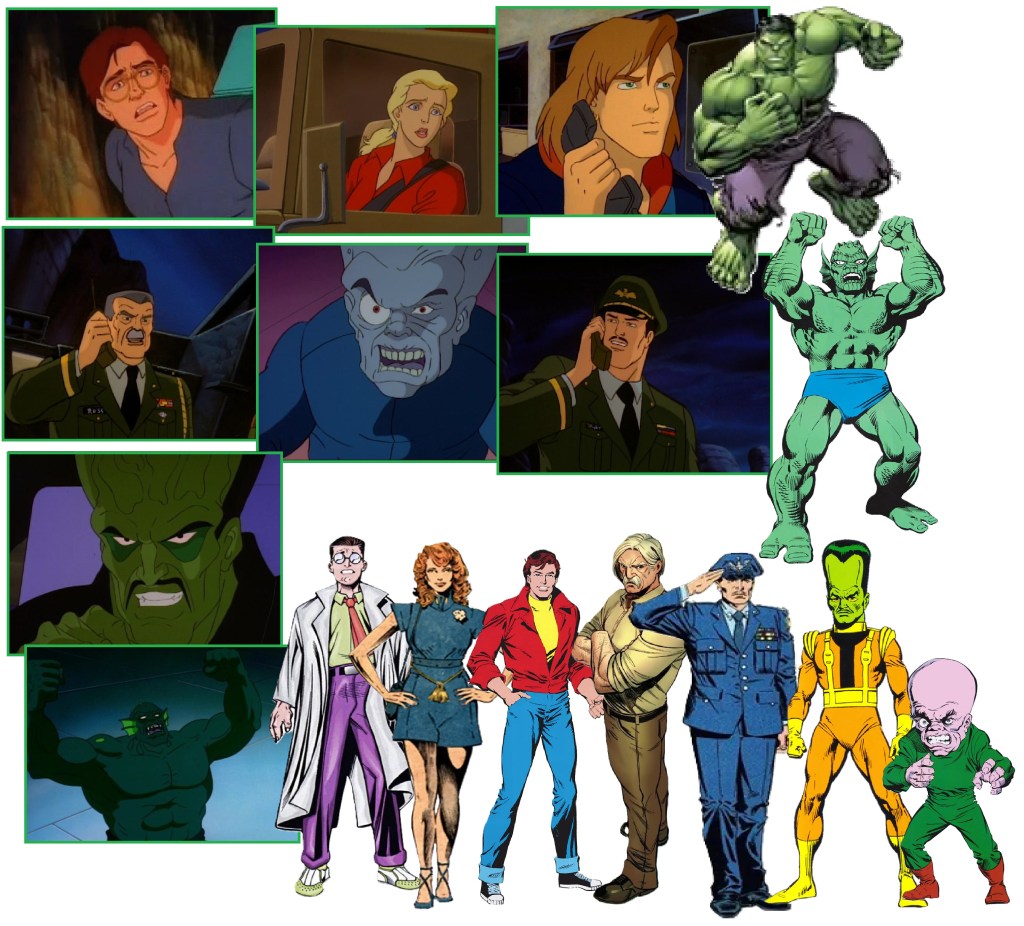
This episode introduces many characters taken straight from the comics: Bruce Banner, Betty Ross, Rick Jones, General Ross and Gargoyle all come from Incredible Hulk #1, while Glenn Talbot first appeared in Tales to Astonish #61, a year later. The Leader first appeared an issue later in #62. Abomination first appeared in Tales to Astonish #90.
The voice cast on this show is… well, Incredible! Neal McDonough, aka Dum Dum Dugan in the Marvel Cinematic Universe, is the voice of Bruce Banner, while Lou Ferrigno voices the Hulk, reprising his role from the 1978 live-action series.
Other cast members include Genie Francis (Mrs. Jonathan Frakes!) as Betty Ross, Beverley Hills 90210 star, the late Luke Perry as Rick Jones, Mark Hamill as Gargoyle, John Vernon as Thunderbolt Ross and Matt Frewer, reprising his role from the Iron Man episode Hulk Buster.
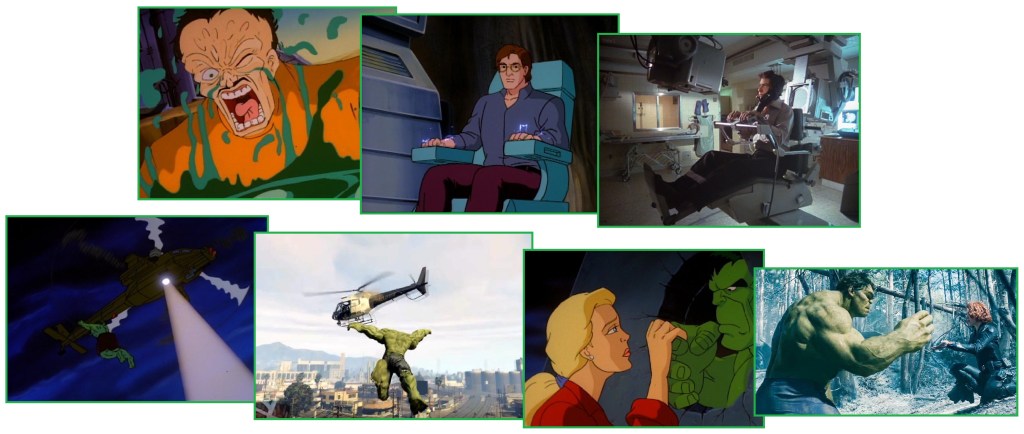
Speaking of the Leader, we get a slightly different origin in this episode than we did in his previous appearance, during which he was stranded in the past. By the looks of him, he’s slightly older, not to mention unhinged – perhaps he had to relive a few years before resurfacing? It certainly doesn’t seem to have been that long since the Hulk was created, going by Rick’s look alone. The Leader’s plan – to use Hulk’s strength with his superior intellect – is the same plan he had in Hulk Buster.
This episode was written by Bob Forward and directed by Richard Trueblood, who worked together on He-Man and the Masters of the Universe, along with producer Tom Tataranowicz.
The chair that Bruce is on while conducting his experiment, is similar to the one seen in the credits of the 1978 TV show.
At one point, Hulk grabs and spins a helicopter. Similar scenes have happened before, such as in 2003’s Hulk by Ang Lee.
Betty calms the Hulk down by talking to him. Black Widow did the same in Avengers: Age of Ultron.
“YOU WOULDN’T LIKE ME WHEN I’M ANGRY…”
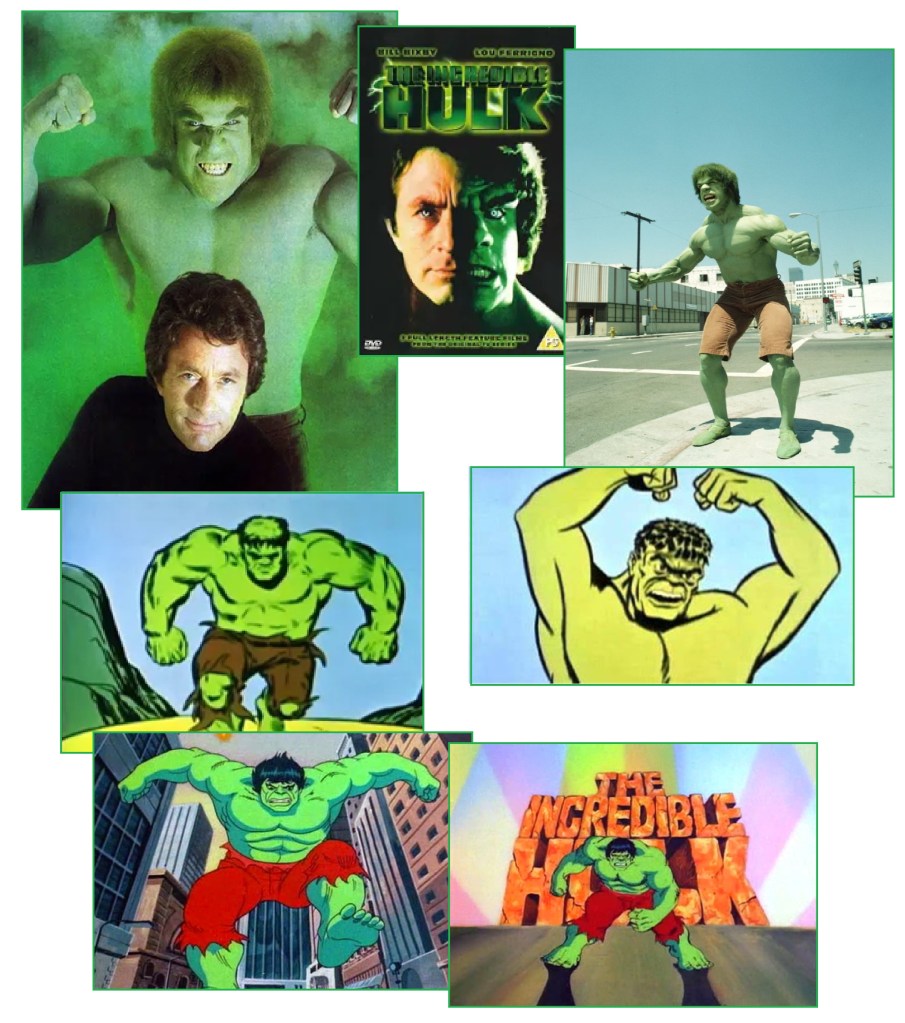
The Hulk smashed his way into comics in The Incredible Hulk #1 (May 1962), created by Stan Lee and Jack Kirby. Inspired by Frankenstein, Jekyll and Hyde, and Cold War anxieties, the story introduced Bruce Banner — a brilliant but emotionally repressed physicist — who saves a teenager from a gamma bomb test and absorbs the radiation himself. What follows isn’t just mutation. It’s fracture. Banner becomes the Hulk: a creature of uncontrollable rage, triggered by stress and emotion, embodying everything Banner cannot express. From the outset, Marvel didn’t frame him as a hero. He was a warning. A walking consequence.
The early comics struggled to contain him. Cancelled after six issues, Hulk found new life as a guest star — clashing with the Fantastic Four, joining the Avengers, and eventually anchoring Tales to Astonish. His popularity surged not because he fit the mould, but because he broke it. Hulk was raw emotion, unfiltered power, and a metaphor for everything America feared: nuclear fallout, psychological instability, and the violence lurking beneath civility. By the ’70s and ’80s, writers like Len Wein and Bill Mantlo began threading deeper psychological nuance into the mythos, laying groundwork for the layered takes that would follow.
Outside the comics, Hulk’s cultural footprint widened dramatically with the 1978 live-action television series. Bill Bixby’s David Banner (renamed for the show) was a soft-spoken fugitive, wandering from town to town, trying to cure himself while helping others. Lou Ferrigno’s silent, green-skinned Hulk brought physicality and pathos — a monster who didn’t speak, but always felt. The series ran for five seasons and spawned several TV movies, including crossovers with Thor and Daredevil. It wasn’t flashy, but it was formative — embedding the Hulk into pop culture as a tragic icon.
Animation kept Hulk in circulation. He appeared in The Marvel Super Heroes in the ’60s, Spider-Man and His Amazing Friends in the ’80s, and various ensemble projects. These versions leaned into spectacle — Hulk as a force of nature, often misunderstood, occasionally heroic. But the core remained: a man at war with himself, a monster born of mercy, and a myth that refused to settle.




 X-Cess Minutiae
Leave a comment