



Everyone wants something in this story — and none of them get it easily. Bruce longs for sanctuary, but the Hulk is hounded without pause. Betty searches for a cure, bringing in Doc Samson, whose own gamma scars complicate the mission. Ross clings to his Hulkbusters dream, desperate to prove control. Gabriel Jones, side lined and fading, tries to stay relevant in Fury’s shadow. And then there’s Mitch.
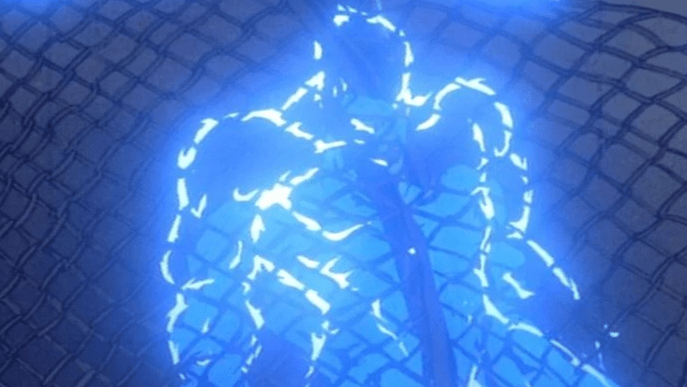
Mitch is the quiet tragedy. An operations manager with a Star Trek mug and a head full of unspoken dreams. He’s never been taken seriously — not by his peers, not by himself. He wants to matter. He wants to be seen. And when the gamma surge twists him into Zzzax, he finally has the power to strike back. It’s the rage of the overlooked, the fury of the forgotten. He doesn’t want to destroy the world — he just wants it to notice.
The battle is brutal. Hulk meets Zzzax head-on, not as a monster, but as someone who understands. Mitch is short-circuited back to himself — not by violence, but by recognition. Hulk sees him. Calls him friend. And then leaps away, leaving behind something stronger than fists: grace.
This isn’t just an episode about power. It’s about the ache of invisibility, the cost of being ignored, and the quiet miracle of being acknowledged. In the end, love — or something like it — wins.
General Ross ramps up his Hulkbuster programme, training troops with robotic simulacra of the Hulk — preparing for war, not understanding. SHIELD‘s Gabriel arrives under Fury’s orders, adding another layer of control. Meanwhile, in the desert, an ordinary man named Mitch stumbles into a live skirmish between Hulk and the robots. Mistaken for a threat, Mitch nearly dies — but Hulk spares him. Mitch tells his story, but no one believes him. Ridicule replaces empathy.
Back in the desert, Hulk dismantles the last of the machines and wanders toward Mitch’s workplace. Mitch finds him again — and this time, learns the truth. Hulk is Banner. The two men, strangers bound by circumstance, begin working on a cure. At the base, Ross intensifies his hunt, now joined by Gabriel and Doc Samson. The pursuit is relentless.
Inside the plant, Mitch hides Banner in a steel drum. They attempt the cure — but it fails catastrophically. Mitch is caught in an electrical surge and transformed into Zzzax, a being of pure energy and rage. He destroys the plant, fuelled by years of resentment, and drains the generator to recharge. Banner, fearing a meltdown, becomes Hulk and confronts him. Their battle drains Zzzax, who flees to the dam.
The Hulkbusters arrive and trap Hulk in an energy cage. He breaks free. Betty pleads with him — if Zzzax destroys the dam, nearby towns will flood. Hulk races to the dam, fights Zzzax, and tackles him into the river. The impact purges the energy, and Mitch returns to himself. Hulk pulls him from the water, then leaps away before the Hulkbusters can strike again.

Mitch McCutcheon is an original character created for the television series. In the comics, Zzzax was created in Incredible Hulk #166, the result of an accident during a terrorist attack at a New York electrical plant. The creature is living energy rather than a human. Mitch also appears to be a Star Trek fan – his mug is the same as the ones used in Deep Space Nine.
Gabe Jones, called Gabriel only in this episode, is one of Nick Fury’s Howling Commandoes, who first appeared in comics in Sgt. Fury and his Howling Commandoes #1 in 1963. He wears the same SHIELD uniform that Nick Fury wears in his animated appearances.
Doc Samson has been part of the Hulk’s supporting cast since his first appearance in comics in Incredible Hulk #141.
DOC SAMSON: GAMMA THERAPIST
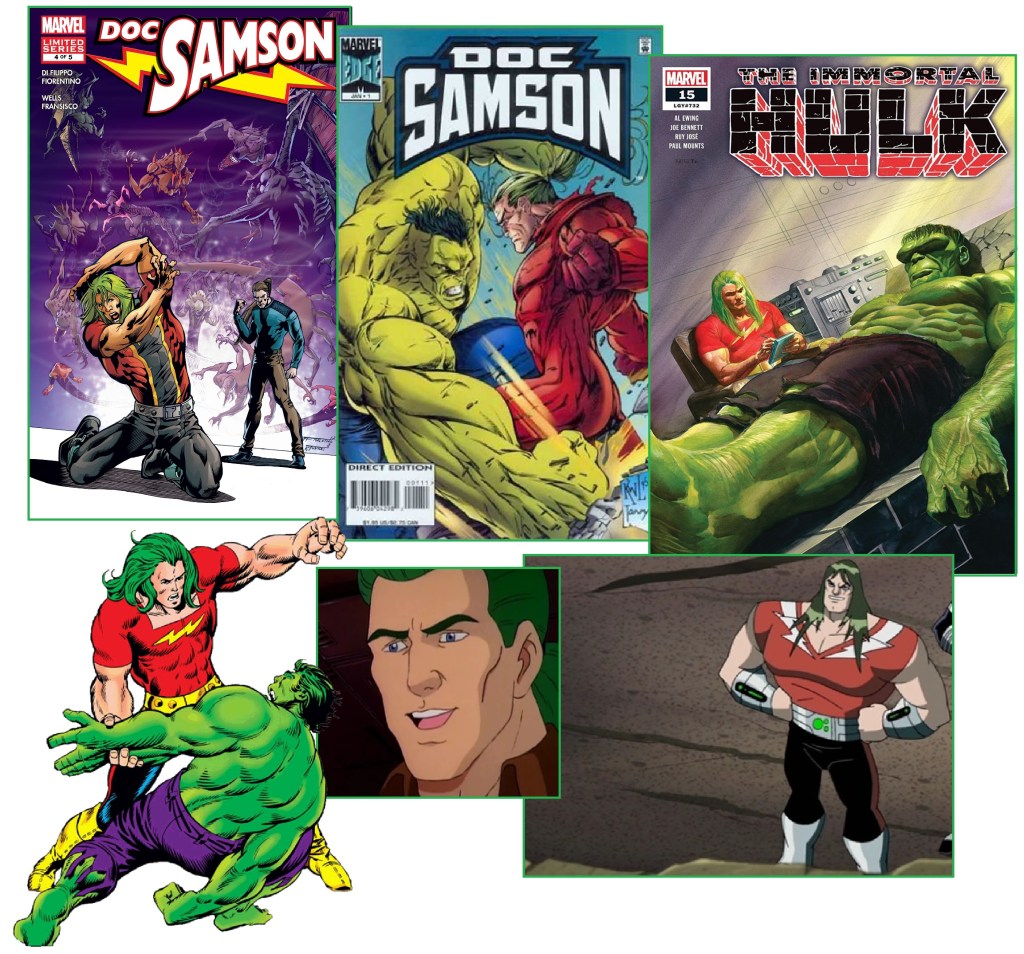
In the comics, Leonard Samson is a study in paradox — psychiatrist turned gamma-powered strongman, forever caught between intellect and impulse. His origin is classic Marvel: exposed to residual gamma radiation while treating Bruce Banner, he gains superhuman strength and a mane of green hair, but retains his mind. That duality defines him. He’s not a monster, but he’s not untouched. He’s a man trying to fix others while barely holding himself together.
Samson’s role shifts across decades — therapist, government agent, occasional rival, and reluctant ally. He’s often the one who tries to “solve” Hulk, but the irony is baked in: his own gamma exposure makes him part of the problem. His best arcs lean into that tension — especially when he’s forced to confront the limits of therapy in the face of cosmic trauma.
On screen, Samson’s presence is more spectral. He appears briefly in The Incredible Hulk (2008), played by Ty Burrell — a civilian, a romantic rival, but not yet the gamma-powered figure fans know. The adaptation trims his complexity, but the seed is there: a man who sees Bruce not as a threat, but as someone worth saving. The animated series gives him more room — a scientist with strength, a conscience, and a tendency to get in over his head.
Samson’s legacy lies in the question he keeps asking: can you heal what you’ve become? And in every version, the answer is never simple.




 X-Cess Minutiae
Leave a comment