


This instalment’s hard to pin down — not because it lacks clarity, but because it aches. Bruce wants solitude, a quiet life away from the world’s noise. His moment with the nun — gentle, human — hints that compassion still exists. But when she screams at the sight of Hulk, it shatters him. Even kindness recoils.
Jealousy slithers in. Talbot breaks protocol, poisons Hulk, and risks Banner’s life — not for duty, but for Betty. His love is misplaced, unwanted, and dangerous. He’s punished by fire. Ghost Rider makes him feel Bruce’s pain — every betrayal, every wound. It’s not vengeance. It’s reckoning.
But the heart of this episode is loneliness. Hulk stares at a stone gargoyle and envies it — because stone doesn’t feel. His friends lie to him, trying to provoke rage to purge the poison. It works. But it breaks something. Hulk believes they hate him. And maybe, in that moment, he hates himself too.
Betty and Rick carry the weight. Their lies save Bruce, but cost them trust. By the end, they’re heartbroken. Hulk walks away, convinced he has no friends. And the wind doesn’t argue.
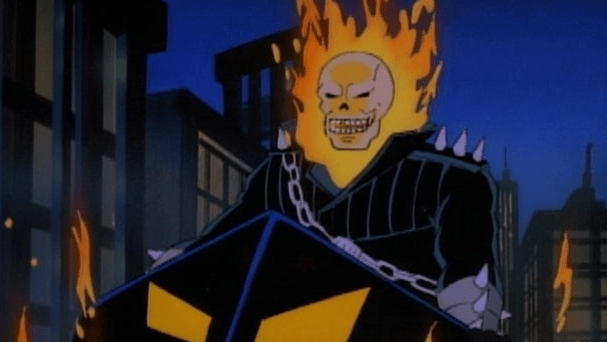
Of course, we can’t not talk about the Ghost Rider, making his second-ever animated appearance, which was clearly a trial run for the character. It might have been a bit too intense for regular Saturday morning TV, but you have to admire the effort to feature him and grab fans’ attention. After all, that’s exactly what guest appearances are all about.
Bruce finds momentary refuge in a soup kitchen recording his thoughts, trying to make sense of the transformation that haunts him. Memories of Ross and Talbot’s previous assaults stir his anger, until a nun’s quiet compassion pulls him back. But peace is short-lived. A pipe bursts. Fire spreads. Bruce is injured trying to help. Fury takes hold. He becomes Hulk. Yet it’s not him who saves the sister — a mysterious figure does, untouched by flame.
Rick rides into the city, searching for answers. A firefighter blames Hulk for the destruction. Rick sets off to find his friend. Meanwhile, the Leader watches Hulk through insectile drones. On a bridge, Rick sees a burning rider — sulphur in the air. He follows. It’s Ghost Rider, come to deliver vengeance. Rick tries to intervene, but fails. The Rider is relentless.
At Gamma Base, Betty and Doc Samson study Bruce’s blood, baffled by his survival. Betty learns Ross is planning another strike and demands he stand down. He agrees — then secretly sends Talbot with the Nuclear Tranquilliser Ray. In the city, Bruce calms — a photo of Betty softens him. But Ghost Rider attacks, triggering the transformation. Hulk fights back. Talbot arrives and fires the ray. Hulk weakens, reverts. Rick confronts Ghost Rider, who sees Rick’s purity and hesitates.
Betty and Samson arrive with a warning: if Bruce stays calm, the ray will kill him. The Leader and Gargoyle continue spying, manipulating from afar. The group scrambles to reignite Hulk’s fury. Rick fakes an attack. Ghost Rider and Samson provoke him. Still not enough. Betty and Rick deliver the cruellest blow — they say they don’t love him, that he’s ruined their lives. Hulk snaps. He destroys a train. Ghost Rider confronts Talbot, forcing him to see the damage he’s done.
Hulk, broken and betrayed, declares that no one cares — not even Betty. They try to explain it was all a ruse to save him, but he doesn’t believe them. He flees, alone. On a rooftop, one of the Leader’s bugs watches. Hulk smashes it. “I have no friends,” he says — and the words land heavier than any punch.
GHOST RIDER: SPIRIT OF VENGEANCE
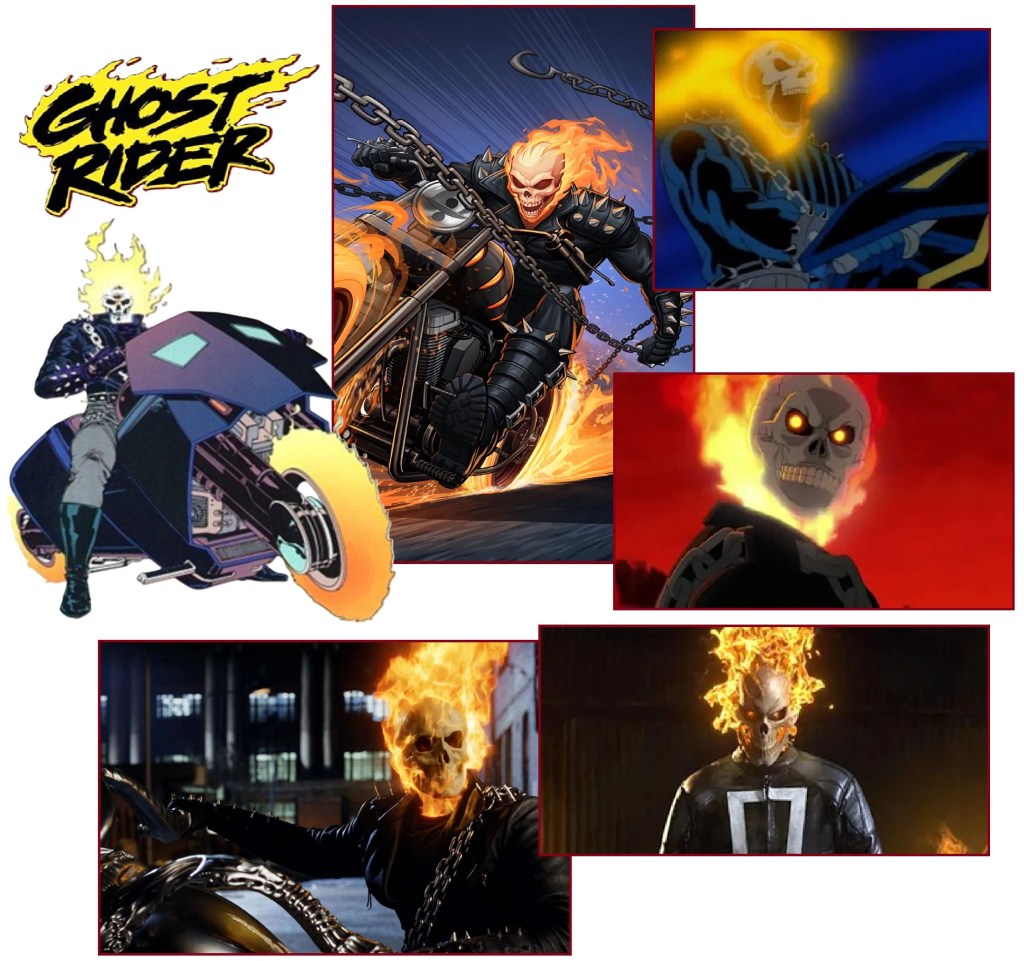
Ghost Rider is vengeance incarnate — a spectral rider bound to the Hell Cycle, eyes burning with judgement, soul tethered to something older than justice. In the comics, it begins with Johnny Blaze: stunt motorcyclist, orphaned by fate, who makes a deal with Mephisto to save his surrogate father. The price? Possession by the Spirit of Vengeance. Blaze becomes the first modern Ghost Rider — flaming skull, leather jacket, and the Penance Stare, which forces evildoers to relive every pain they’ve inflicted.
But Blaze is only the beginning. The mantle passes — to Danny Ketch, Alejandra Jones, Robbie Reyes — each with their own curse, their own context. The lore expands: Zarathos, the demon within; the Blood, ancient warriors; the Midnight Sons, Marvel’s occult ensemble. Ghost Rider isn’t just a character — he’s a mythic archetype, a warning, a reckoning.
On screen, his legacy flickers. The 1994 Fantastic Four animated series introduces him in When Calls Galactus — voiced by Richard Grieco. He arrives in fire and fury, confronting Galactus with the Penance Stare, forcing the cosmic devourer to feel the torment of extinguished souls. It’s a moment of pure myth — a mortal (or demon) standing against a god.
Grieco reprises the role in The Incredible Hulk. Again, Ghost Rider appears when innocent blood is shed, this time targeting Hulk. The episode functions as a backdoor pilot — designed to launch a solo animated series. But the series never materialised. Despite strong reception, the project was shelved. Reasons vary: Marvel’s financial instability in the late ’90s, shifting network priorities, and the looming uncertainty around live-action adaptations. Grieco’s performance remains a cult favourite — spectral, solemn, and strangely tender.
Live-action brought Blaze to the fore in Ghost Rider (2007) and Spirit of Vengeance (2011), with Nicolas Cage leaning into the madness. The films are uneven, but the iconography endures. More recently, Robbie Reyes appeared in Agents of SHIELD, driving a muscle car instead of a bike — a modern twist on the myth.
Ghost Rider’s story is one of fire and fracture — a man consumed by vengeance, yet still capable of mercy. Whether animated, live-action, or inked in shadow, he rides not for glory, but for reckoning. And somewhere in the dark, the wind still carries the echo: “I am summoned when innocent blood is shed.”




 X-Cess Minutiae
Leave a comment