


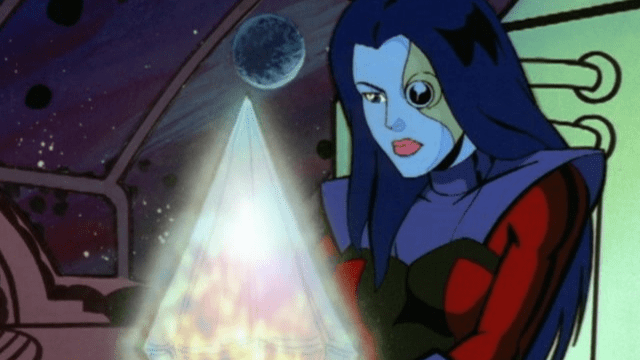
This episode unsettled me. The Virals — hulking, liquefied, ten-storey nightmares — are pure body horror. Watching them merge, slimily and without resistance, was enough to make me look away. But beneath the grotesque visuals lies a deeper twist: those who seek knowledge for selfish ends are transformed. Nebula, greedy for profit, and Mentor, obsessed with vengeance, fall without hope of return — reduced to monstrous bacteria, stripped of identity and consumed by the very data they craved.
Only Pip remains untouched. He’s there to help, not to take. Even Silver Surfer, driven by longing for Zenn-La, is judged selfish and transformed. But his punishment is different. The other Virals refuse to merge with him — even in assimilation, he’s feared. The Power Cosmic marks him as other, as dangerous, as unknowable. It’s a moment of eerie isolation, where even the hive rejects him.
And yet, it’s that same power that saves him. The Surfer purges the virus, not with rage, but with clarity. It’s a lesson writ large: knowledge can be used to find home, to build weapons, to chase profit — but it comes at a cost. Sometimes, it’s wiser to know your place in the cosmic order than to try and rewrite it. The Library doesn’t reward ambition. It punishes it.
The episode threads horror with philosophy. The transformations are grotesque, but the emotional fallout is worse. Mentor’s fall is tragic. Nebula’s greed is her undoing. Even the Surfer’s yearning is suspect. Only Pip, simple and sincere, walks through unscathed. Drax barely survives. The Library itself feels haunted — not by ghosts, but by the consequences of curiosity.
Learning Curve (Part 2) doesn’t just creep. It confronts. It asks what we’re willing to risk for knowledge, and whether the pursuit itself can become a contagion. The Surfer, Pip, and Drax escape — but not unchanged. And the silence that follows is louder than any scream.
Silver Surfer, Mentor, Drax, and Pip the Troll arrive at the Universal Library — a legendary archive hidden within the Watchers’ domain. Their journey, sparked by Nebula’s theft of a beacon, leads them through cosmic peril to a world in ruins. Each seeks something: vengeance, home, profit. But the Library offers no easy answers — only silence, decay, and the weight of forgotten knowledge.
The Library’s structures are vast memory chips, storing the wisdom of galaxies. Yet its grandeur is marred by monstrous green Virals — mutated Watchers born from a failed act of compassion. Uatu, the last unaffected, warns that all who enter are doomed. As the group explores, Drax falters, and Nebula demands access, hoping to sell secrets to the Kree and Skrulls. But the Library is no longer a sanctuary. It is a trap.
One by one, the group begins to transform — Mentor, Nebula, even Silver Surfer — merging into a Viral hive. Pip remains untouched, watching as identity dissolves into unity. Within the hive, Surfer confronts visions of Galactus and the Power Cosmic, urged to surrender his selfhood for collective knowledge. But he resists, choosing individuality over assimilation.
Surfer reclaims his form, purges the virus, and declares his freedom — from Galactus, from the hive, and from the illusion that knowledge without action is enough. The Virals retreat. Drax recovers. Pip endures. Together, they depart aboard Nebula’s ship, leaving the Library behind as a monument to good intentions gone wrong.
In the aftermath, Surfer chooses solitude. He reflects on the selfish motives that led most to the Library and concludes that only those who came to help were spared. Watched by Eternity and Infinity, he continues his journey — not merely to find Zenn-La, but to understand what home truly means.
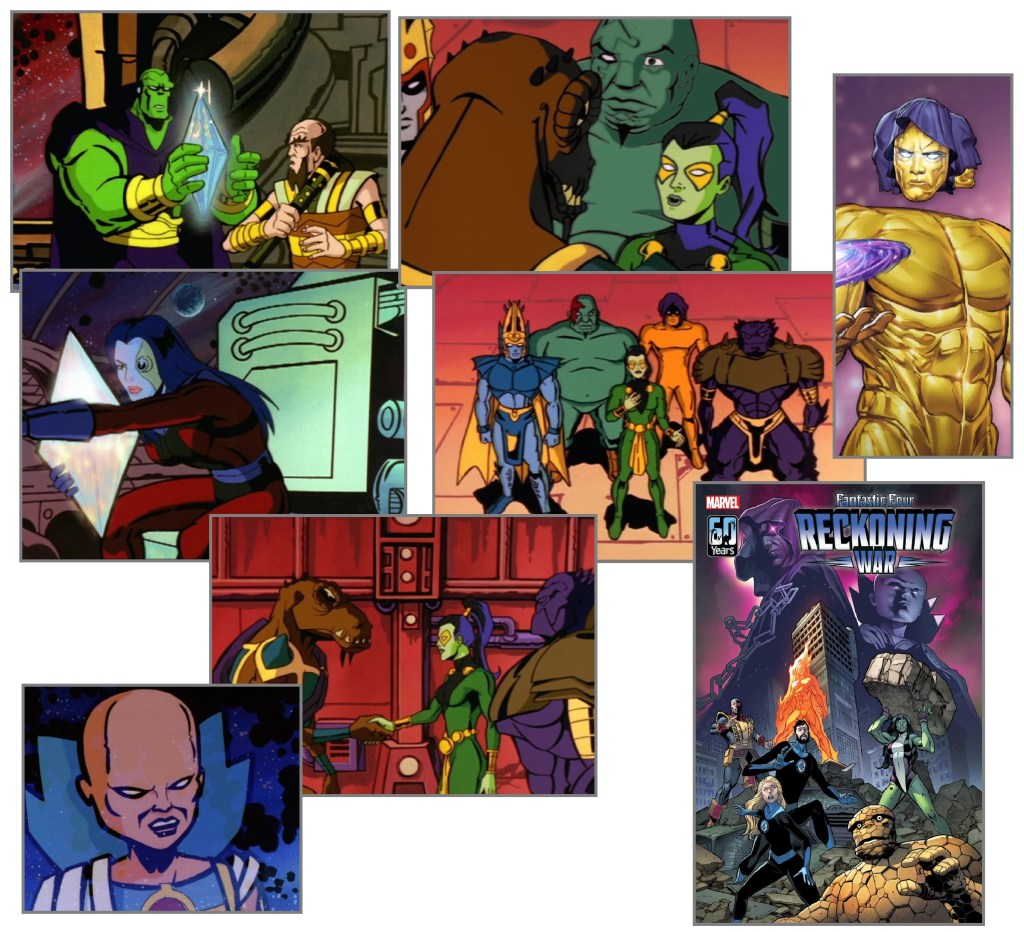
Cedric Smith voices Mentor in this two parter, and Norm Spencer voices Drax. They’re voices are instantly also recognisable as Professor X and Cyclops from X-Men. Jennifer Dale also voiced Mystique, as well as Nebula.
In the comic books, the Watchers give advanced technology rather than a cure. The effect is the same: the species is wiped out. In the comics, this caused The Reckoning War.
The Draconian race is named in this episode for the first time. It also marks the first appearance of Gamora, who’ll make a number of appearances.
One of Gamora’s fellow Wanderers appears to be the Living Tribunal.
GRIEF MADE FLESH: THE QUIET FURY OF DRAX
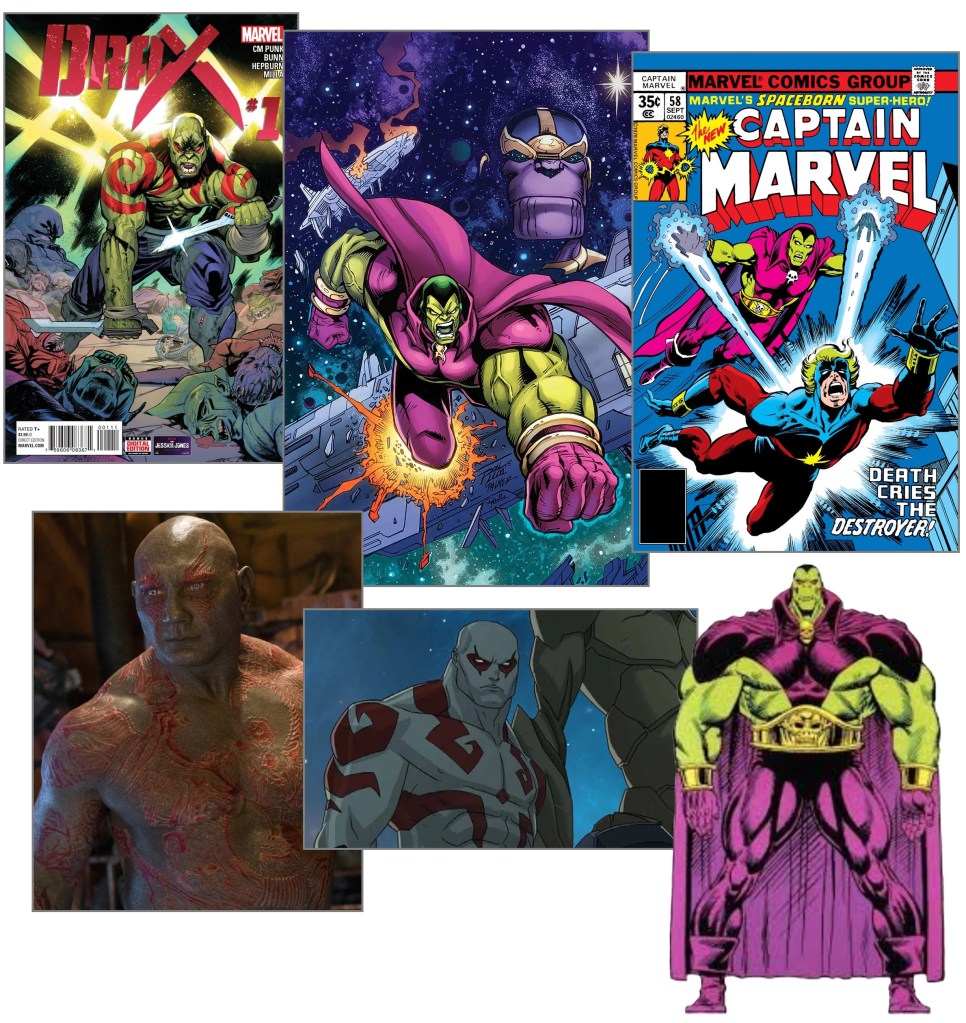
Drax was born from grief — not metaphorically, but literally. In Iron Man #55 (1973), Jim Starlin introduced Arthur Douglas, a human father whose family was murdered by Thanos during a drive through the Nevada desert. Kronos, the cosmic entity, resurrected him as Drax the Destroyer: a being of immense strength, limited intellect, and singular purpose — to kill Thanos. His early comic appearances are tragic and blunt, a man stripped of identity and rebuilt for vengeance.
Over time, Drax’s form and mind evolved. The 2005 Annihilation event redefined him — leaner, sharper, more emotionally resonant. He became a protector, especially to the young telepath Cammi, and his rage was tempered by a growing sense of responsibility. This version of Drax was no longer just a weapon — he was a man trying to reclaim agency, even as the universe kept pulling him back into conflict. Starlin’s cosmic tapestry gave him scale, but later writers gave him soul.
Drax’s comic history is deeply ensemble-driven. He’s fought alongside Adam Warlock, Gamora, and the Guardians of the Galaxy. He’s died, been reborn, and wrestled with the question of whether vengeance can ever truly satisfy. His arc is one of transformation — not just physical, but emotional. He begins as a blunt instrument and becomes a reluctant philosopher, a warrior who questions the cost of violence. His strength is never in doubt, but his purpose is always in flux.
On screen, Dave Bautista reimagines Drax in the Guardians of the Galaxy films. The MCU leans into his literalism and deadpan humour, but the grief remains. His family is gone. His heart is broken. And beneath the jokes, there’s a man who still mourns. The films soften his edges, but never erase the ache. Drax isn’t just comic relief — he’s comic tragedy, and the laugh is often a mask. His bond with Mantis, his quiet moments of reflection, hint at the depth beneath the bravado.
Drax’s legacy lies in the tension between rage and redemption. He was created to destroy, but he chooses — again and again — to protect. He reminds us that grief doesn’t vanish. It transforms. And sometimes, the strongest warriors are the ones who carry their sorrow quietly.




 X-Cess Minutiae
Leave a comment