


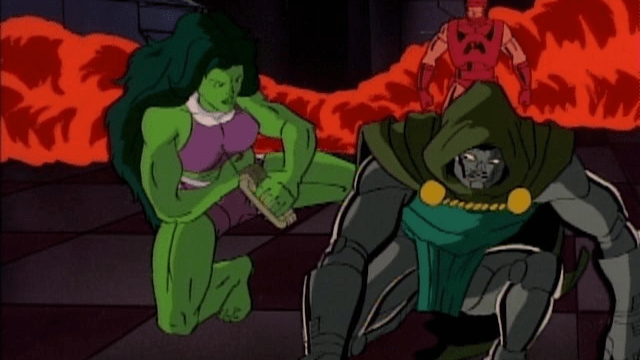
This episode is a treat – a crossover with teeth. Doctor Doom arrives in full regalia — imperious, theatrical, and utterly convinced of his own brilliance. His plan is grandiose even by Latverian standards: enshroud Washington DC in an impenetrable dome and destroy the Capitol from within, using a brainwashed Hulk as his instrument. It’s not just villainy. It’s performance art. Doom doesn’t whisper. He declares.
He’s brash, overconfident, and allergic to humility — as ever. The episode leans into his operatic menace, letting him monologue and manipulate with flair. But beneath the bravado is a fatal flaw: Doom never plans for failure. He assumes control, assumes victory, and when the Hulk begins to slip his leash, Doom’s arrogance becomes his undoing. It’s not just a battle of strength. It’s a battle of will — and Doom’s is brittle beneath the armour.
Enter Jennifer Walters. After a blood transfusion from Bruce, she becomes She-Hulk — emerald, assertive, and gloriously unfiltered. Her debut is a tonal shift: sass, confidence, and a refusal to be sidelined. She’s not just a female Hulk. She’s a lawyer with fists, a woman who speaks her mind and backs it up with gamma-powered punchlines. Her arrival adds ensemble texture, balancing Bruce’s brooding with Jen’s bravado.
The episode threads spectacle with character. Doom’s dome is a metaphor — control, isolation, the illusion of invincibility. Hulk breaks through it not just physically, but emotionally. He resists manipulation, reclaims agency, and reminds Doom that power without empathy is hollow. She-Hulk, meanwhile, proves she’s not just backup. She’s a force in her own right — and she’s here to stay.
Doomed isn’t subtle. It’s bold, brash, and beautifully unhinged. But beneath the explosions and declarations, it’s about control — who has it, who loses it, and who refuses to be defined by it. And in the end, it’s not Doom who walks away victorious. It’s the Hulks — plural, powerful, and finally, not alone.
The journey leads Bruce to the capital, where machines descend without warning. First come the robots — then Ross and his Hulkbusters. But the robots turn on the soldiers, revealing their true intent: they want Banner. Stress ignites the transformation. Hulk crushes the Hulkbusters and escapes. When calm returns, Bruce seeks out Jennifer — cousin, confidante, and one of the few who still sees the man beneath the monster.
But peace is fleeting. The robots strike again, forcing Bruce and Jennifer to flee. Hulk emerges mid-chase, and the car crashes. He destroys the attackers, but reinforcements arrive. Jennifer is wounded and taken aboard a massive aircraft. Hulk follows — to a castle cloaked in shadow, ruled by Doom. Elsewhere, the Leader and Gargoyle watch, always watching.
Inside the fortress, Hulk finds Jennifer — dying, surrounded by explosives. He reverts, helpless, and gives her his blood. Doom seals the castle, locking out the army. Then he turns Hulk into a weapon, unleashing him on the capital. The destruction is vast. Back in the castle, the blood takes hold. Jennifer rises — changed, but whole. She is She-Hulk now, mind intact. She breaks free, battles Doom’s machines, and reaches Hulk. Her voice cuts through the brainwashing.
Hulk returns, furious. Doom has hurt her. Together, they tear through the castle. Doom escapes, but not unscathed. The next morning, Bruce and Jennifer leave — not as victims, but survivors. She is no longer just kin. She is something more.
Far away, the Leader begins his next move. The cloning vats stir. Gamma Warriors are coming.
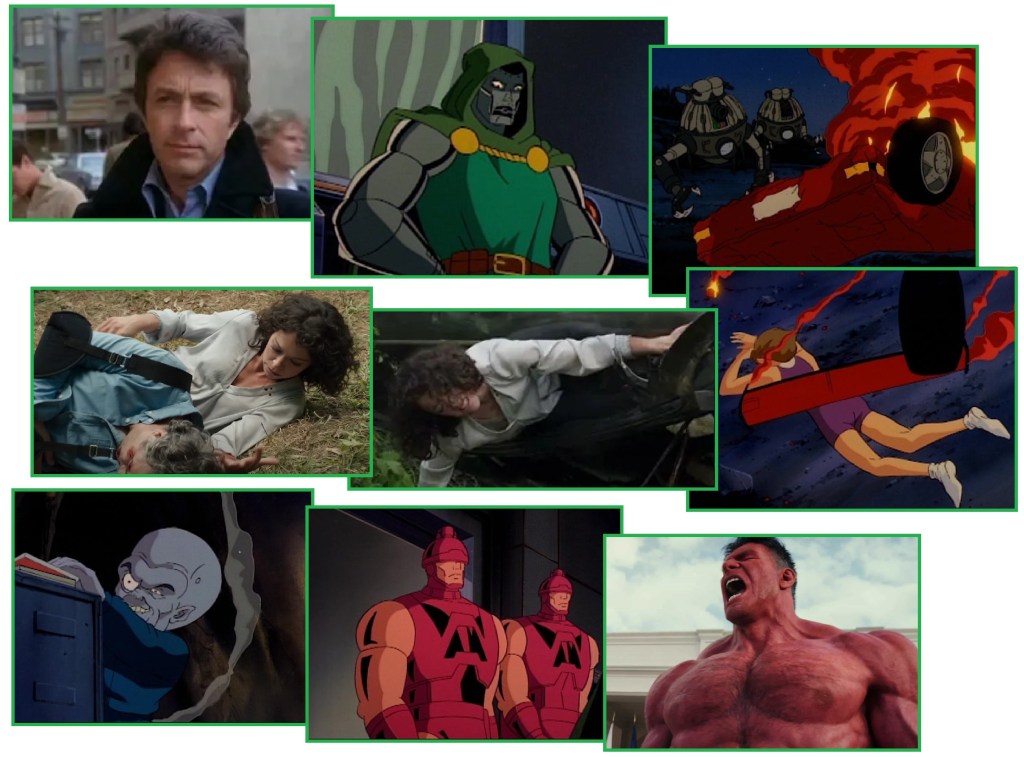
Bruce gives his full name as Robert Bruce Banner in this episode, using his full name from the comics. The 1978 live-action series famously swapped out ‘Bruce’ for ‘David’ — for reasons that would be totally weird today.
Simon Templeman returns in this episode as Doctor Doom, having voiced him throughout his appearances in Fantastic Four season 2. He still has all the best lines: when the Hulk smashes into the embassy base, Doom ironically tells him that “There was a doorbell outside, you know.” He also talks down to the Hulk (“Boom, Boom!”). Doom’s line when She-Hulk taunts him: “I abhor attitude.”
Jennifer and Bruce getting injured in a car accident is also the precursor to her becoming the She-Hulk in her Disney + series.
As he did in the pilot, when he packs to leave the Leader’s side, Gargoyle steals information and technology from him.
Doom’s purple robots, seen in Fantastic Four‘s And A Blind Man Shall Lead Them, reappear in this episode.
Hulk is ordered to attack the Capitol Building in Washington DC in this episode. In Captain America: Brave New World, a Hulk of a different colour almost destroys the White House.
Liza Zane voices the She-Hulk for her two guest appearances this season. She’ll be voiced by Cree Summer in season two when the character becomes a regular and is added to the titles. She was also the voice for Madame Masque in Iron Man.
STRENGTH WITH STYLE: THE SENSATIONAL SHE-HULK
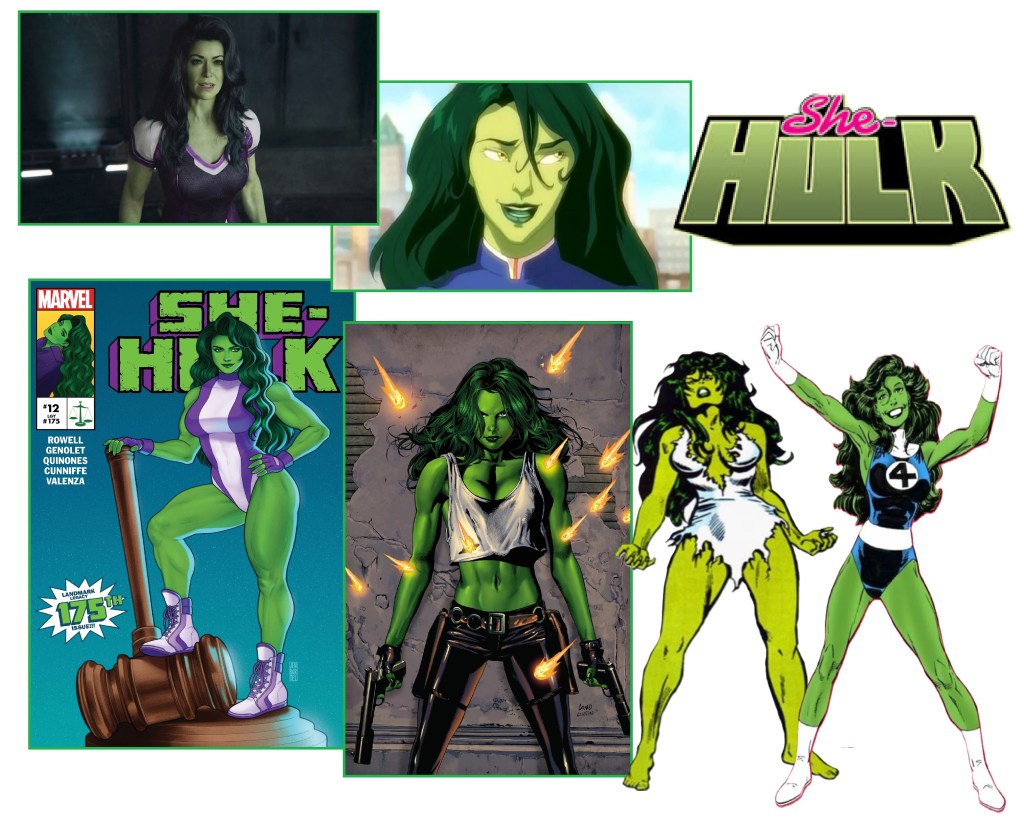
Jennifer Walters entered the Marvel universe in Savage She-Hulk #1 (February 1980), created by Stan Lee and John Buscema in a moment of strategic brilliance — a last-minute addition to secure rights before television producers could invent their own female Hulk. But Jen was never just a derivative. From the outset, she was a lawyer, a thinker, and a woman who refused to be defined by the rage that transformed her. After a blood transfusion from her cousin Bruce Banner, she gained gamma powers — but unlike Bruce, she retained her intellect and emotional clarity.
Her comic history is a study in tonal elasticity. Early stories leaned into courtroom drama and super heroics, but it was John Byrne’s run that redefined her — breaking the fourth wall, blending satire with sincerity, and turning She-Hulk into one of Marvel’s most self-aware characters. Later writers like Dan Slott and Charles Soule deepened her emotional arc, threading trauma, identity, and professional resilience into her narrative. Jen became a symbol of control — someone who could wield power without losing herself.
She-Hulk’s ensemble ties are rich. She’s served with the Avengers, the Fantastic Four, and the Defenders. Her friendships — with Patsy Walker, with Carol Danvers, with Hawkeye — are textured and often laced with wit. She’s a mentor, a confidante, and a woman who navigates the tension between appearance and truth. Her stories often explore the cost of being taken seriously — in court, in combat, and in life. She’s not just strong. She’s strategic.
On screen, Tatiana Maslany brings her to life in She-Hulk: Attorney at Law (2022), a Disney+ series that honours the comic’s tonal range. The show leans into meta-humour, legal drama, and emotional fallout, threading Jen’s journey through dating, career, and gamma-powered chaos. It’s bold, self-aware, and emotionally grounded. The series doesn’t shy away from the absurd — but it never loses sight of Jen’s humanity. Her dynamic with Bruce, her clash with Titania, and her quiet moments of reflection all echo the comics’ best instincts.
She-Hulk’s legacy is one of balance. She’s a Hulk who doesn’t break — she bends, she adapts, she endures. Whether in ink or on screen, she reminds us that strength isn’t just about smashing. It’s about standing your ground, knowing your worth, and rewriting the rules when they don’t serve you. And in every version, Jen Walters does exactly that.




 X-Cess Minutiae
Leave a comment