


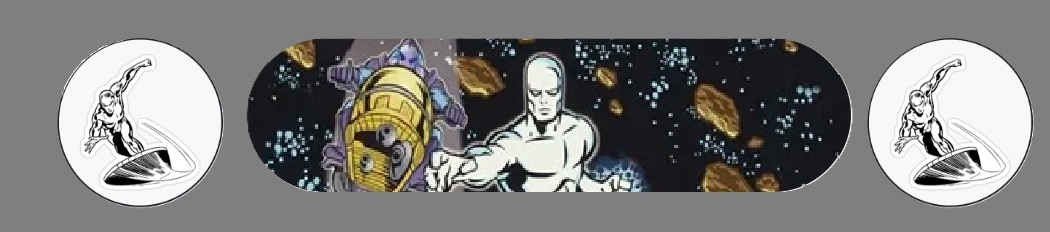
This one’s written by Harlan Ellison — the legendary science fiction author behind the best episode of Star Trek: ‘The City on the Edge of Forever’ and countless genre-defining works. His presence here brings literary weight and moral ambiguity to the cosmic scale. Galactus is dying, and Nova turns to the Silver Surfer in desperation. If Galactus falls, the universe may fracture. He’s a World Devourer, yes — but also a necessity. A being forged to maintain balance. Life is a cycle. He has to eat.
The Surfer agrees to help, on the condition that Galactus sends him to Zenn-La. It doesn’t happen. Galactus doesn’t even acknowledge the promise. And when the Surfer succeeds — when he saves his former master’s life — he’s met not with gratitude, but with cold dismissal. It’s a bitter reckoning. The Surfer begins to question whether saving Galactus was an act of duty, or delusion.
Meanwhile, the Wanderers — an alliance of worlds destroyed by Galactus — finally converge. They’ve been forming all season, and now their purpose is clear. Should they help the being who ruined them? Should they stand by while he’s healed? The space battles are epic, but the real turmoil is internal. Loyalty, vengeance, survival — all collide in the shadow of Galactus’ fading light.
Ellison threads the narrative with confrontation, not comfort. Galactus is monstrous, but essential. The Surfer is noble, but used. The Wanderers are justified, but fractured. There’s no easy answer — only the question of what it means to uphold balance when the cost is unbearable.
This episode doesn’t resolve. It reverberates. The Surfer survives. Galactus endures. But the ache of betrayal and the weight of cosmic duty linger. This isn’t just storytelling. It’s Ellison — sharp, unflinching, and unforgettable.
The best episode of the show’s run.
Galactus, the devourer of worlds, lies dying. His immense form, once a symbol of cosmic inevitability, now drifts in space – ravaged by an unseen scourge. Nova, his newly appointed herald, seeks out the Silver Surfer, imploring him to aid his former master. Though burdened by past betrayals, the Surfer agrees, striking a solemn bargain: he will save Galactus, but in return, Galactus must reveal the fate of Zenn-La.
Galactus consents, and the Surfer is granted entry into the very body of the cosmic entity. Within, he encounters a surreal and hostile environment – an internal universe teeming with antibodies and corrupted energies. The Surfer must navigate this living labyrinth, confronting manifestations of Galactus’ own defences turned against him. Each encounter is a test of will and purpose, as the Surfer battles not only physical threats but the lingering resentment he harbours toward his former master.
Outside, Nova defends Galactus’ vessel from the relentless assault of the Wanderers – cosmic marauders who seek to destroy the weakened titan. Her resolve is fierce, but the odds are grim. Within, the Surfer presses deeper, uncovering the truth behind Galactus’ affliction: a virulent force born of his own imbalance, threatening to consume him from within. The Surfer channels the Power Cosmic to purge the infection, risking his own essence to stabilise the being who once enslaved him.
In the heart of Galactus’ consciousness, the Surfer confronts a final revelation. Galactus, in a fit of rage, had cast Zenn-La so far across the cosmos that even he cannot locate it. The Surfer’s hopes are dashed – his bargain fulfilled, but the answer hollow. Yet in this moment of despair, he finds clarity. Zenn-La may be lost, but its ideals endure within him. He is no longer merely a seeker of home, but a bearer of its legacy.
Emerging from Galactus’ body, the Surfer finds Nova bloodied but unbowed. The Wanderers retreat, and Galactus stirs once more, his strength renewed. Though the Surfer’s quest for Zenn-La remains unresolved, he has preserved a force that, for all its cruelty, maintains cosmic balance. Nova, once brash and impulsive, now regards the Surfer with newfound respect, recognising the depth of his sacrifice.
As the stars reclaim their silence, the Silver Surfer departs once more, his board slicing through the void. He carries no map, no promise of reunion – only the memory of a world that taught him compassion, and the burden of choices made in its name.
But he does have a new companion – as Nova agrees to help him find his way home…
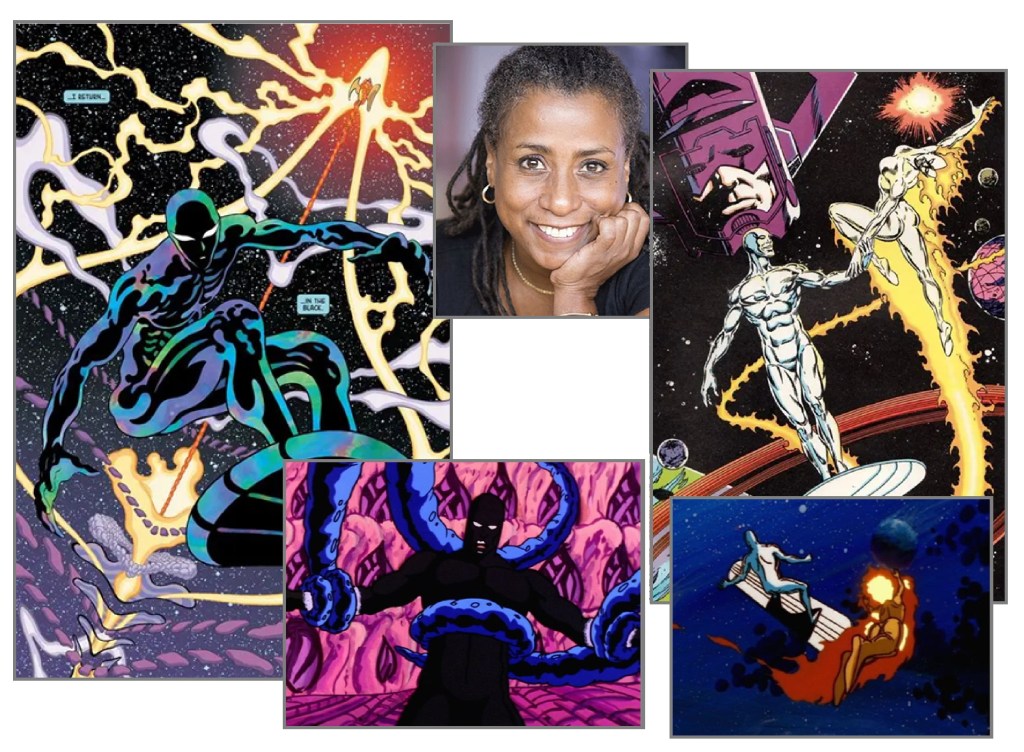
Gamora is now voiced by Alison Seely-Smith, better known to X-Men fans as the voice of Storm. Ironically, in this episode Gamora works with Lord Glenn, who is voiced by Marc Strange – who voices Storm’s love interest Forge in the same show. Gamora seeks vengeance on Galactus for her homeworld’s destruction in this series, and not Thanos, as in the MCU.
The Silver Surfer turns jet black whilst inside Galactus. Decades later, while fighting Knull, the King in Black, the Surfer would also change colour.
At the end of this episode, Nova decides to travel with the Surfer for a while. In the comics, this time together led to a short, and ultimately tragic, romance.
THE BLADE THAT CHOSE MERCY: GAMORA’S PATH TO SELFHOOD

Gamora enters Marvel’s mythos in Strange Tales #180 (1975), crafted by Jim Starlin as part of his cosmic tapestry. She is introduced as the last of her species, adopted and weaponised by Thanos — trained to be the deadliest woman in the galaxy. Her origin is brutal: a child of genocide, raised by the architect of death. But even in her earliest panels, there’s a flicker of resistance. Gamora is not just a killer. She’s a survivor.
Her comic arc is one of reclamation. She joins Adam Warlock and the Infinity Watch, fights alongside the Guardians of the Galaxy, and slowly begins to unpick the trauma of her upbringing. Gamora’s strength is never in question — but her emotional clarity is what defines her. She’s fiercely loyal, often guarded, and always wrestling with the question of who she is without Thanos. Later stories deepen her complexity, threading guilt, autonomy, and the ache of self-definition.
Gamora’s relationships are ensemble-driven. With Peter Quill, there’s tension and tenderness. With Nebula, there’s rivalry and shared pain. With Rocket and Drax, there’s camaraderie forged in chaos. She’s not the heart of the team — she’s the spine. Her presence grounds the Guardians, reminding them (and us) that found family is often built from broken pieces. Her arc is never sentimental, but it’s always sincere.
On screen, Zoe Saldaña brings Gamora to life in Guardians of the Galaxy (2014) and throughout the Infinity Saga. The MCU version threads humour and heartbreak, especially in her dynamic with Quill. Her death in Infinity War and resurrection in Endgame fracture her continuity — the Gamora who returns is not the one who loved. But the emotional truth remains: she is not defined by Thanos. She is defined by the choice to walk away, and the courage to begin again.
Gamora’s legacy is one of defiance. She was made to kill, but she chooses to protect. She was raised in silence, but she speaks with clarity. Whether on screen or off, she reminds us that redemption is not a destination — it’s a decision, made daily, often painfully. And in every version, she walks that path with strength.




 X-Cess Minutiae
Leave a comment