


Thor makes a guest appearance in this episode, voiced once again by John Rhys-Davies, with all the gravitas you’d expect — but the emotional weight belongs to, believe it or not, the small and rather misunderstood Gargoyle.
Ill and desperate, Gargoyle unleashes a disease by mistake, and what follows is quietly devastating. His mutation begins to reverse, his humanity flickers back — and then he gives it up, choosing death over survival if it means protecting others. It’s a rare moment of villainous clarity, and it hits hard.
There’s legacy here too. Two years after this aired, Betty Ross would contract gamma sickness in the comics, die, and rise again as Red She-Hulk. But this story came first. And here, it’s Bruce who makes the choice — sacrificing his own chance at a cure to save Betty’s life. It’s quiet, unshowy heroism, and it deepens the emotional faultline between them. Bruce sees the gamma gift as a curse. Betty, like Jen, becomes a mirror to that belief — and a challenge to it.
Even Emil Blonsky gets a moment. The Abomination’s true personality is restored — and while he’s still a jackass, he’s himself. And that matters. Everyone’s entitled to their own mind, even if it’s unpleasant. Gargoyle says it best: “I just wanted to be normal.” We’ve all felt like that. And when he tells Bruce that in another lifetime, they might have been respected colleagues — just before threatening to kill him next time — it’s not just villain banter. It’s grief, twisted into survival.
The episode balances cosmic guest stars with grounded emotional fallout. Thor’s presence adds grandeur, but the heart is in the quiet choices — the cure not taken, the life saved, the identity reclaimed. It’s bittersweet, and it almost redeems the henchman.
Almost.
A gamma-born virus spreads through Detroit, mutating fast and striking deep. Betty is summoned to help, but the symptoms — green lesions, hallucinations, coma — defy her reach. She calls for Bruce, knowing only his altered blood might hold the key. Donald Blake, stunned to learn Banner still lives, agrees to help find him.
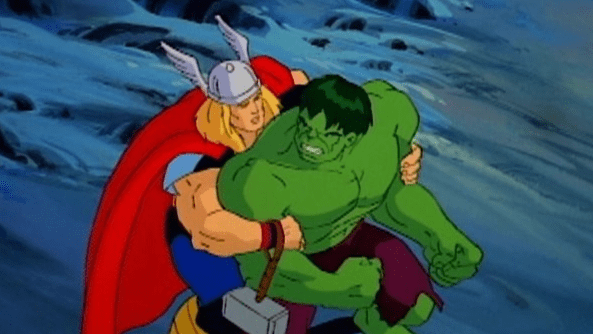
In the Black Hills, Banner is hunted. Hulk erupts to escape Ross’s trap, but Blake summons the storm — and Thor intervenes. He frees Hulk and brings him to Detroit. Panic erupts. Hulk clashes with Thor on the bridge, but Blake invokes Betty’s name, and Hulk follows.
In the city, Hulk finds an infected man and brings him to the hospital. Bruce reunites with Betty and offers his blood. But during a scuffle, Betty is exposed. Her condition worsens. Beneath the city, mutated insects feed the virus. Gargoyle and Abomination, both infected, are tied to its origin.
Abomination kidnaps Bruce, dragging him to Gargoyle’s lair. Gargoyle, desperate for a cure, agrees to help. Bruce realises the serum might purge the Hulk — but he chooses Betty. The formula is ready. Abomination injects himself first, triggering chaos. Bruce transforms. The caverns collapse.
Thor returns. Together, they battle Abomination and seal the breach before the city floods. Hulk asks to be taken to Betty. He comforts her, quietly. Bruce re-emerges, shattered, as Donald says the serum won’t be ready in time. But Gargoyle arrives with a final dose — a gesture of grace.
Betty survives. Bruce prepares to flee. But she promises to fight for their future, refusing to let love be the casualty.
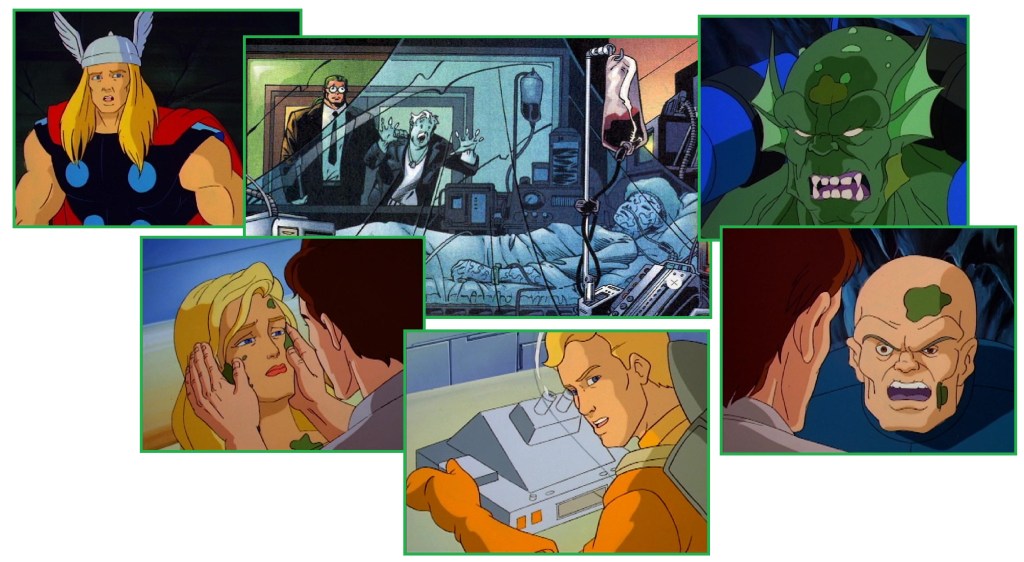
John Rhys-Davies reprises his role as Thor from the Fantastic Four episodes To Battle the Living Planet and When Calls Galactus.
In the comics, Betty Ross died at one point, exposed to gamma radiation. In Incredible Hulk #466, by the late, great Peter David, Betty falls ill and a race against time to save her begins. Although they were unsuccessful, her father placed her body in cryogenics – and the Leader resurrected her as the Red She-Hulk years later.
For those who are unfamiliar, Donald Blake was an identity Odin created for Thor when he was originally exiled to Earth.
The reason behind Gargoyle’s thefts is revealed: it’s all in an attempt to cure himself. The Abomination also regains his own personality in this episode. In the comics, it was Blonsky who poisoned Betty Ross (see above).
GARGOYLE: THE FIRST FOE
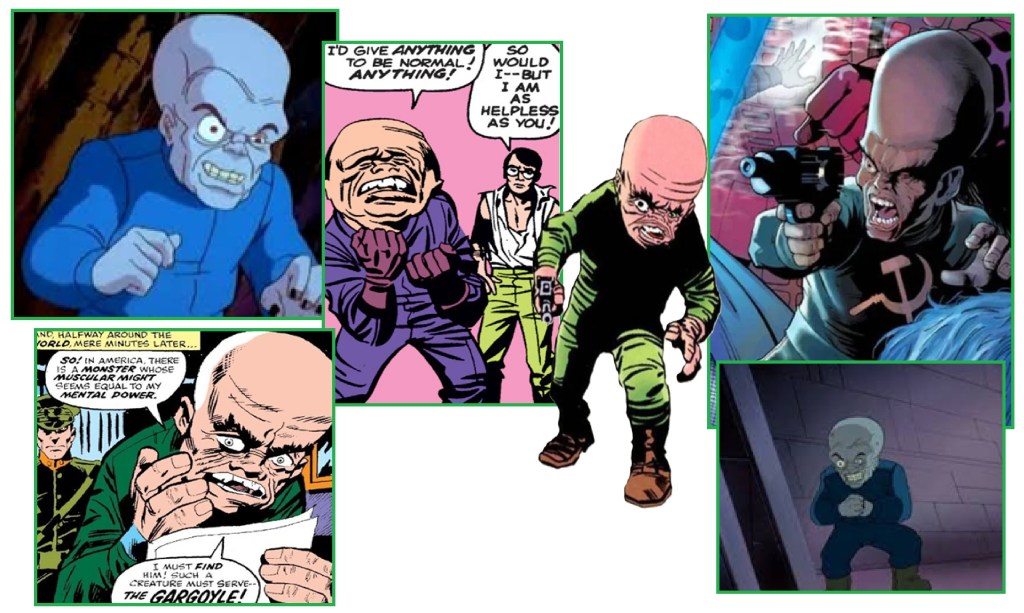
Gargoyle holds a unique place in Hulk’s mythos — not just as a villain, but as the very first. He debuted in Incredible Hulk #1, created by Stan Lee and Jack Kirby, making him the inaugural antagonist in Bruce Banner’s tragic saga. Igor Drenkov, a Soviet scientist twisted by fear and ambition, becomes the Gargoyle after exposure to radiation. His grotesque appearance masks a brilliant mind, and his encounter with the Hulk ends not in battle, but in unexpected empathy. Moved by Bruce’s compassion, Gargoyle chooses redemption — a rare note of grace in an origin steeped in Cold War paranoia.
Despite his foundational role, Gargoyle remained largely absent from mainstream continuity. He made sporadic appearances in flashbacks and retellings, but never reclaimed major villain status. His mutation, intellect, and yearning for normalcy were echoed in later characters — notably Emil Blonsky (Abomination) and Samuel Sterns (Leader) — but Gargoyle himself faded into obscurity.
The 1996 Incredible Hulk animated series marks his only significant appearance outside the comics. Here, he’s reimagined with emotional depth, tragic motivation, and a surprisingly tender rapport with Bruce. His arc in Mortal Bounds is one of the series’ most poignant: a villain who doesn’t want power, just peace. His line — “I just wanted to be normal” — distils decades of gamma fallout into a single, aching truth.
Gargoyle’s legacy isn’t in recurring battles or grand schemes. It’s in the quiet tragedy of transformation, the cost of brilliance, and the longing to be whole. He was the first to face the Hulk — and the first to show that even monsters can choose mercy.





 X-Cess Minutiae
Leave a comment