


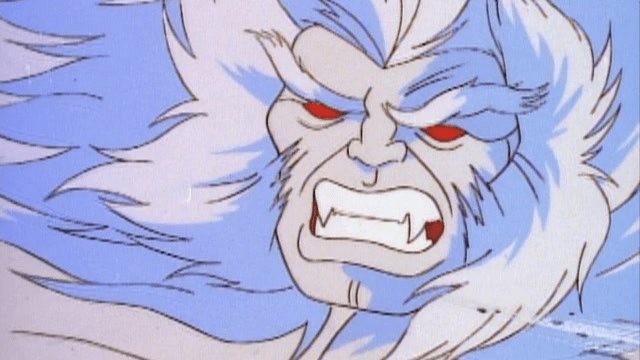

In the shadowed wilds of the Canadian mountains, something is killing the animals — and everyone assumes it’s the Hulk. General Ross is quick to believe it, but Betty’s conviction leads her into danger. She erases all trace of her destination, leaving Ross to discover her disappearance through SHIELD’s surveillance. The tension builds not from spectacle, but from silence — the Wendigo glimpsed only in shadow, until Betty sees his face. The audience sees it with her. And the horror lands.
The heart of the episode lies in an accidental alliance: Hulk and Ross, cuffed together, forced to survive. Ross, ever the soldier, can’t fathom his daughter’s loyalty to the creature. “I just don’t get it,” he mutters — but when he sees the Hulk’s protectiveness, he begins to understand. Briefly. Until the Wendigo is hurled off a cliff, and Ross reverts to hunter once more.
It’s Betty who delivers the final blow — not with weapons, but with words. When Ross asks why she endures the pain, she answers through tears: “You don’t understand, father. It’s not pain. It’s love.”
In the Canadian mountains, small towns are plagued by a rash of animal killings. Ross and SHIELD suspect the Hulk, but Betty, determined to reach Bruce first, deletes the evidence and departs alone. Deep in the woods, she’s captured by a rampaging beast — white-furred, primal, and whispered about in local legend. Wendigo.
Ross launches a rescue. But the Hulk is already in the terrain, and circumstance forces an uneasy alliance. Ross finds himself cuffed to the creature he’s spent years hunting.
As they track Wendigo through the forest, Ross glimpses something beneath the fury — fragments of Bruce. He doesn’t trust it, but he begins to see it.
In the caves, Betty uncovers the truth: Wendigo was once human, twisted by exposure, cursed with hunger and isolation. She tries to reach him, but the mind is too far gone. Her only hope lies in Hulk and Ross finding her before the creature’s rage consumes them all.
The forest becomes a battleground. Hulk and Wendigo clash, shaking the earth. Ross fights to reach Betty. Bruce surfaces briefly, recognising the pain in Wendigo’s eyes. But empathy isn’t enough. Hulk subdues the beast to save her, and the pair fall from a cliff.
Betty is freed. Ross, grudgingly, acknowledges the Hulk’s role. Authorities arrive. There’s no trace of Wendigo. Betty watches the Hulk go. Ross watches her, confused by her love for the man inside.
And somewhere in the silence, as a local shaman sings his ancestor to eternal rest, the wind carries the cry of Wendigo’s spirit.

This episode was originally written to feature a guest appearance from Wolverine, but couldn’t since he was being used by FOX at the time.
The censors must have had a field day on this episode: the whole origin of the Wendigo is changed, as is it’s comic book reasons for the curse.
THE CURSE OF THE WENDIGO

The Wendigo first appeared in Incredible Hulk #162 (1973), conjured from Canadian folklore and Marvel’s darker mythos. The creature isn’t a singular villain, but a curse — passed from person to person when one commits cannibalism in the isolated wilderness. Towering, white-furred, and near-mindless, the Wendigo has clashed with Hulk, Wolverine, and Sasquatch, often serving as a brutal reminder of nature’s wrath and humanity’s descent.
On panel, the Wendigo has been host to multiple identities, each consumed by the curse and stripped of reason. It’s not evil in the traditional sense — it’s tragic, primal, and deeply unsettling. The transformation is irreversible, and the creature’s hunger is eternal. Its legacy is less about villainy and more about inevitability.
In the Incredible Hulk animated series, the origin was softened. The cannibalism angle was replaced with a mystical transformation, sidestepping the horror but retaining the creature’s ferocity. It remains one of the few adaptations of the Wendigo outside comics, and while the tone shifted, the core idea — that isolation and desperation can birth monsters — stayed intact.





 X-Cess Minutiae
Leave a comment