


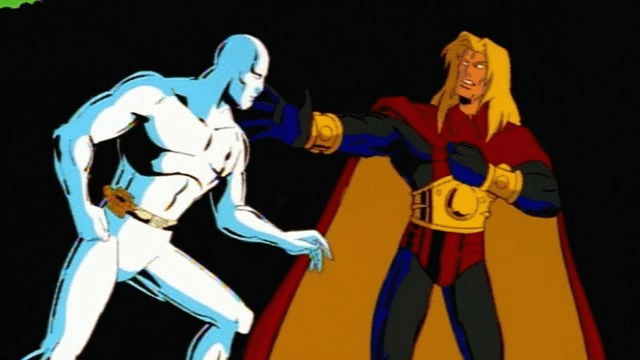
Adam Warlock was created to be a saviour — a genetic superman forged to defend his people from the Kree. But they feared what they built. Admired in theory, locked away in practice, Warlock was cast into a time-looped prison, condemned to fight a war that never ends. He doesn’t know it’s a loop. He believes in the battle. Believes in the cause. All while his real homeworld is wiped out by the next generation of engineered supermen.
It’s an age-old science fiction tragedy: to be destroyed by the very thing we create to save us. And when Warlock is finally freed, the Kree don’t offer redemption. They offer repurposing — a new war, a new weapon, a new use.
But Warlock chooses differently. He returns to the loop. Not out of duty, but out of grief. Out of honour. Out of heartbreak. He would rather live in a fantasy than face the truth — that his people feared him more than they loved him.
It’s a quiet ending. A tragic one. And in that choice, Warlock becomes more than a weapon. He becomes a myth.
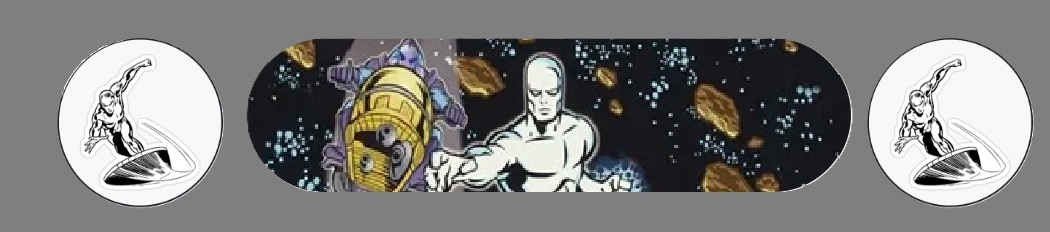
In his ongoing search for Zenn-La, the Silver Surfer seeks an audience with the Kree’s Supreme Intelligence. But access to the Supremor comes with a price. One of their top generals has vanished inside a spatial anomaly, and the Surfer is tasked with retrieving him. What begins as a diplomatic errand quickly spirals into something stranger — the anomaly swallows the Surfer whole, and within its fractured reality, he finds Adam Warlock locked in an endless battle against the Kree.
The Surfer intervenes, freeing Warlock from the cycle, and together they return to the Kree homeworld. But the reunion is short-lived. The Supremor has plans for Warlock — cruel, calculated, and rooted in fear. Warlock learns the truth: he was created to defend his people from the Kree, but they feared him, locked him away, and perished through further experimentation. His legacy is one of betrayal and loss.
The two heroes escape, and the Surfer, moved by Warlock’s pain, asks him to join the search for Zenn-La. But Warlock declines. He chooses to return to the anomaly — to fight his “forever war,” to forget, and to honour the memory of those he was meant to protect.

Adam Warlock’s origin has been changed for this episode. See the Outbox below.
The Kree homeworld is named Kree-Lar in this episode. In the comics, it replaced their original throne world of Hala.
DC Fontana, one of this writer’s episodes, also wrote for Star Trek and wrote the pilot for Star Trek: The Next Generation.
The Kirby Cluster mentioned in this episode is presumably named after the Surfer’s co-creator Jack Kirby.
Kree SENTRY robots can be seen in this episode, looking exactly the same as they did in the Fantastic Four‘s The Sentry Sinister.
David Hemblen – X-Men‘s Magneto – voices the Supreme Intelligence.
ADAM WARLOCK: COSMIC MESSIAH
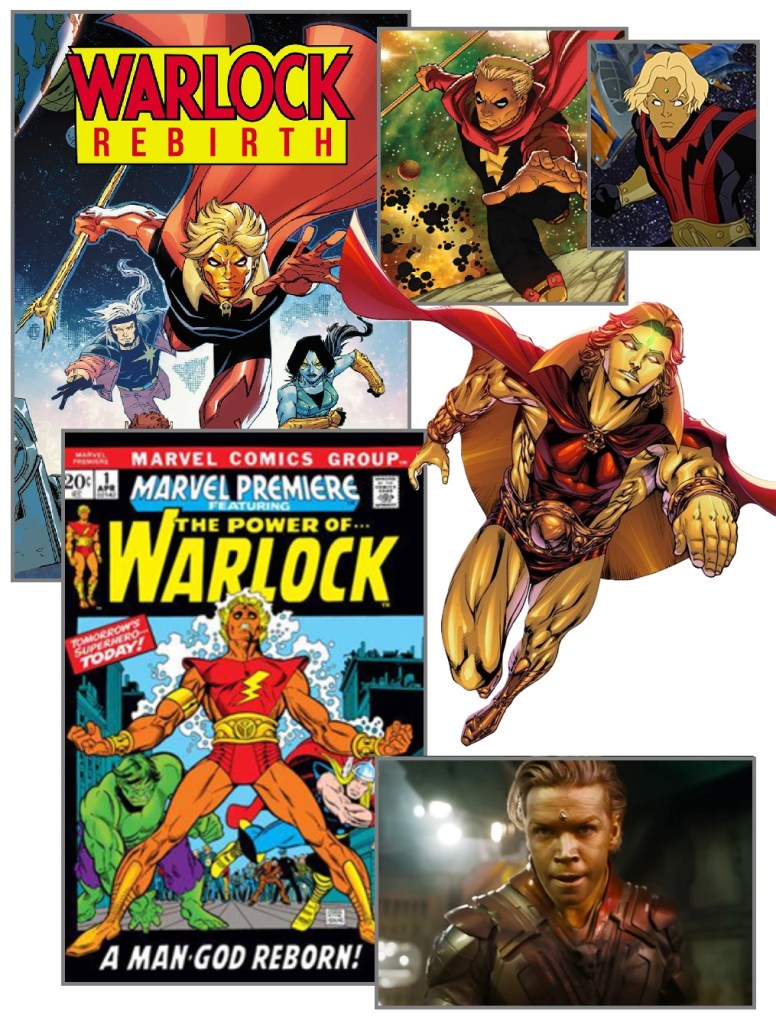
Adam Warlock first emerged in Fantastic Four #66–67, created by Stan Lee and Jack Kirby as “Him” — a golden-skinned artificial being born from science and ambition. His early appearances were enigmatic, more symbol than character, but it was Marvel Premiere #1 (1972) and Warlock #1 that reshaped him into a cosmic messiah. Guided by the High Evolutionary, gifted the Soul Gem, and hurled into existential conflict, Warlock became a figure of prophecy, paradox, and sacrifice.
His saga spans death and rebirth, self and shadow. He’s battled Magus — his own corrupted future self — and stood against Thanos, wielding the Soul Gem with both reverence and dread. Warlock isn’t a hero in the traditional sense. He’s a moral crucible, a cosmic question mark, and a mirror to the universe’s contradictions.
On screen, Adam Warlock debuted in Guardians of the Galaxy Vol. 3 (2023), portrayed by Will Poulter. The film softened his edges, presenting him as powerful but naïve — a far cry from the tortured philosopher of the comics. Still, the seeds are there. And if Marvel leans into his legacy, Warlock could become one of the MCU’s most complex figures — not just a weapon, but a warning.




 X-Cess Minutiae
Leave a comment