


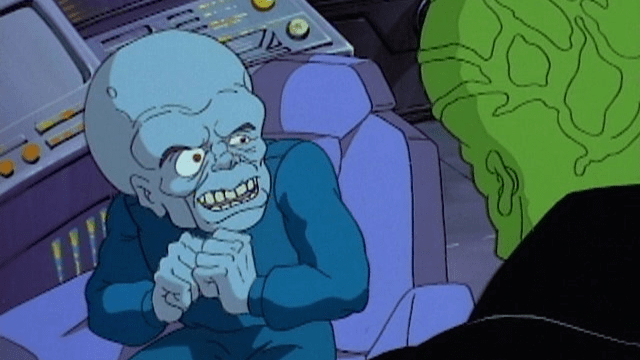

The second chapter of Darkness and Light trades solemnity for chaos — and finds unexpected comedy in the fallout. Gargoyle plays computer games while the Leader rants about world domination, chanting “So says the Leader!” with theatrical menace. The diminutive henchman rolls his eyes, calling him a poseur mid-slogan. Even Ogress joins the farce, blaming her unfinished task on poor television signal in the desert. It’s absurd, and it works — a rare moment where villainy and sitcom timing collide.
But beneath the humour, the episode carries weight. Twice, both Ross and Banner mutter the same line: “It just never ends.” It’s not just repetition — it’s exhaustion. Ross, in particular, is fraying at the edges, his obsession bleeding into instability.
The Leader finally drains the Hulk’s strength, but the creature’s savagery threatens to overwhelm him. Unable to control the mind he’s stolen, the Leader flees — undone not by failure, but by the very rage he sought to harness.
The Hulk presses on, and the final shot is pure tension: Banner, alone, standing in his way. Just the man and the monster, face to face. It’s not resolution. It’s a cliffhanger carved in gamma.
A deranged, unrestrained Hulk tears through the countryside, his mind fractured and his fury unchecked. Rick Jones tries to reach him — to remind him of who he is — but the Hulk doesn’t recognise him. There’s no memory. No anchor. Just rage.
The Leader seizes the moment. He dispatches Ogress and his Gamma Soldiers to capture the Hulk and drain his power. The Hulk fights them off, but the arrival of the Hulkbusters turns the battle into chaos. Three factions collide, and in the confusion, the Leader’s forces prevail. The Hulk is taken.
With the Gargoyle’s assistance, the Leader transfers his consciousness into the Hulk’s body — a grotesque fusion of intellect and brute force. He launches an assault on Gamma Base, intent on capturing Bruce Banner. But the Hulk’s body resists. The Leader loses control, and the creature turns on the Gamma reactor in a fit of rage. Betty intervenes, calming the Leader just long enough for him to retreat.
Back in his own body, the Leader barely has time to recover before the Hulk awakens and destroys the lab. The monster flees into the desert, still untethered, still dangerous — and waiting for him is Bruce Banner, clad in a Hulkbuster suit.

The EXO suit that Ross intends to use in this episode is from the Hulkbusters team debut in Incredible Hulk #318.
This episode hints at the Gray Hulk, first seen briefly in Return of the Beast (Part 1) and who will feature throughout season 2.
THUNDERBOLT ROSS: DUTY AND OBSESSION

General Thaddeus Ross first appeared in Incredible Hulk #1, introduced as the commanding officer overseeing the gamma bomb project — and the man who would spend decades chasing its fallout. His nickname, “Thunderbolt,” wasn’t just military bravado. It was temperament. Ross was relentless, explosive, and utterly convinced that the Hulk was a threat to be neutralised, not understood.
His obsession with Bruce Banner became personal early on. Banner loved his daughter, Betty. Ross couldn’t accept it. What began as a tactical pursuit twisted into a vendetta — one that spanned continents, administrations, and moral boundaries. Ross didn’t just want the Hulk stopped. He wanted him punished. And in doing so, Ross became the very thing he feared: a man consumed by rage.
On panel, Ross’s arc is steeped in irony. He loses Betty, loses command, and eventually loses his humanity — becoming the Red Hulk in Hulk #1 (2008). The transformation was kept secret for months, and when revealed, it reframed Ross not as a hunter, but as a monster. The man who spent years trying to destroy the Hulk had become one.
On screen, he’s been portrayed by Sam Elliott and William Hurt — and now, Harrison Ford steps into the role, bringing gravitas and weariness to a character who’s always been more warpath than wisdom.
Ross’s legacy isn’t just in command. It’s in obsession. In the line he crossed. And in the question that lingers: when you chase a monster long enough, do you become one?




 X-Cess Minutiae
Leave a comment