


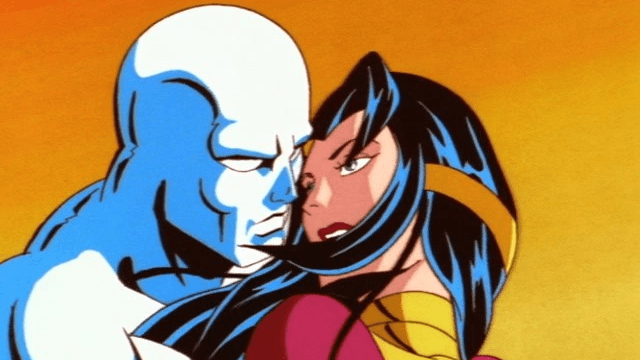
“Home is where the heart is,” or so the saying goes. And after eleven episodes of longing, searching, and cosmic detours, the Silver Surfer finally arrives at the planet of his birth. Zenn-La. The moment is earned. The welcome is warm. He’s hailed as a hero. And we, like him, believe it. Even when he’s asked to surrender the Power Cosmic, this close to the season’s end, it feels plausible. Maybe he’s ready. Maybe he’s found peace.
But twelve minutes in, the illusion shatters. The audience learns the truth alongside the Surfer. It’s not Zenn-La. It’s Ego, the Living Planet — a being so desperate for companionship, he crafts an entire world from the Surfer’s memories. It’s not villainy. It’s loneliness. And it cuts deep.
Both Ego and the Surfer are adrift. Both crave connection. But only one has learned how to live without it. The Surfer, no longer Galactus’ thrall, has embraced his role as cosmic protector. He carries it with reverence. With purpose. And when he departs, it’s not as a victim, but as a saviour. Ego, wounded and repentant, lets him go. They part not as enemies, but as allies.
And in the final moments, the tone shifts. Thanos, maddened and spurned, seeks companionship of his own. But unlike Ego, he will not plead. He will destroy.
While recovering from his encounter with the Kree, the Silver Surfer witnesses yet another clash in the endless war between Kree and Skrull. But amid the hum of battle, a distress call cuts through — a cry for help, broadcast to all combatants. The Surfer answers.
He follows the signal to a world overridden by Fractites — an alien race that freezes before it consumes. With the Power Cosmic, he defeats the creatures and descends to the planet’s surface, where he is greeted by Shalla-Bal. The world is Zenn-La. The Surfer is home.
Celebrated as a hero, the Surfer is unsettled. His people are unified, organised, almost too perfect. Shalla-Bal insists things have changed since he left as Norrin Radd. But when the Surfer questions the absence of conflict — mentions Thanos — the mood shifts. The citizens turn on him, condemning him for abandoning them. Reality begins to warp. The planet reacts to his thoughts. The people demand he surrender the Power Cosmic.
And then they vanish.
The Surfer sees through the illusion. This is not Zenn-La. It is Ego, the Living Planet — his old enemy. After their encounter with Thanos, Ego wandered the stars, only to be trapped by the Fractites. When the Surfer came to his aid, Ego felt companionship. He created the illusion of Zenn-La to make the Surfer stay — to ease his loneliness.
But when the Surfer refuses, Ego lashes out. In the battle, Ego is wounded. And in that pain, he repents. The Surfer, moved by the planet’s sorrow, heals him. They part not as enemies, but as allies.
Elsewhere, in the depths of space, Thanos seethes. Lady Chaos will not speak to him. Spurned, he vows to win her affection — with a new wave of destruction.
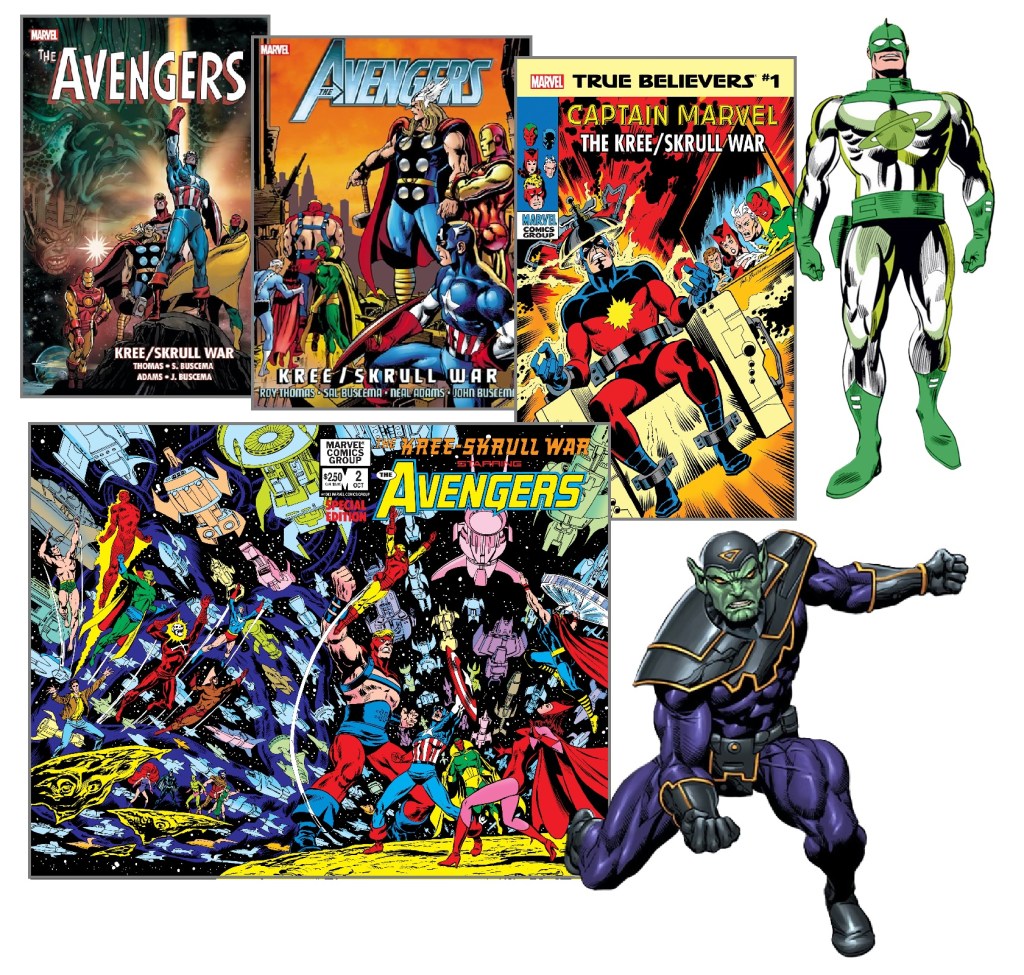
The Kree/Skrull conflict at the beginning of the episode is another skirmish between the two species, known as the Kree/Skrull War, which played out between Avengers #89-97.
The Silver Surfer makes a reference to recovering from his encounter with the Supreme Intelligence in The Forever War.
ETERNITY & INFINITY: THE COSMIC COMPASS
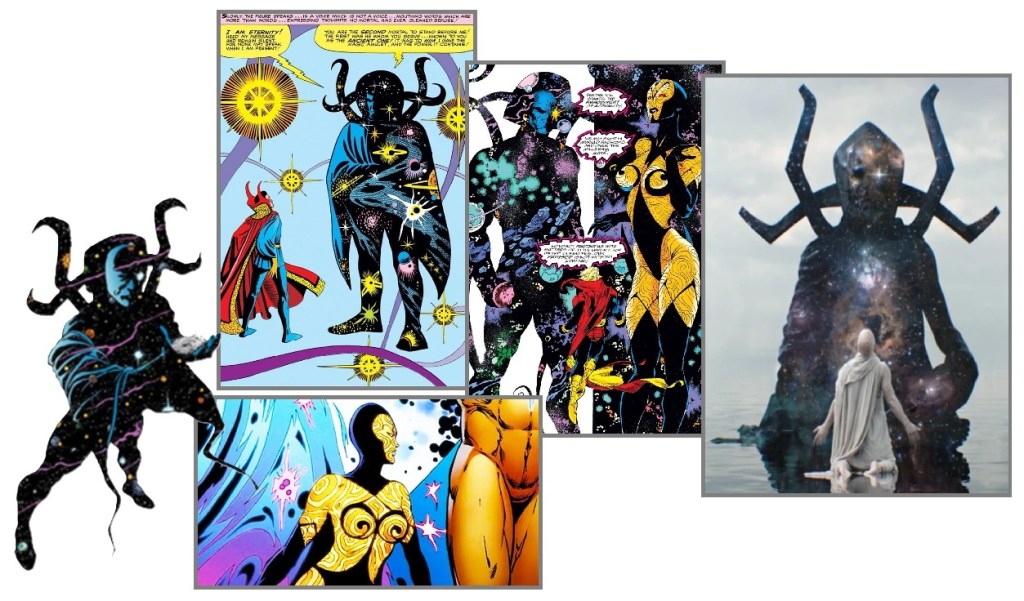
Eternity and Infinity are not gods. They are not rulers. They are the universe itself — its flow, its shape, its breath. Born with the Big Bang, they are twin aspects of existence: Eternity as time incarnate, Infinity as the boundless expanse of space. Together, they form the cosmological compass alongside Death and Oblivion — the four pillars of Marvel’s metaphysical architecture.
Eternity debuted in Strange Tales #138 (1965), crafted by Stan Lee and Steve Ditko during Doctor Strange’s psychedelic ascent. The “Eternity Saga” stretched across seventeen issues, redefining cosmic storytelling. Eternity has since appeared in The Infinity Gauntlet, Secret Wars II and Quasar amongst others, where his multiversal nature was finally revealed. He is not one being, but many — each universe’s Eternity a cell in a greater whole.
Infinity, his sister, emerged later — first as a concept, then as a character. She split from Eternity at the birth of the Seventh Cosmos, defending him against the First Firmament, the living embodiment of the original universe. Where Eternity is time, Infinity is possibility. She is the breath between stars.
On screen, Eternity made his first appearance in Thor: Love and Thunder (2022), a surprise cameo that hinted at Marvel’s deeper cosmic lore. Both entities were also depicted as statues in the Temple Vault on Morag in Guardians of the Galaxy, silent witnesses to the Infinity Stones’ history.
They rarely speak. They rarely act. But when they do, the universe listens.




 X-Cess Minutiae
Leave a comment