


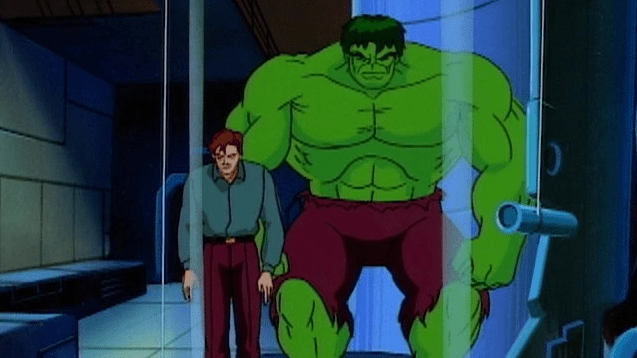
The finale of Darkness and Light lands with unexpected weight. For once, it’s the Hulk who earns our sympathy. Everyone wants him — SHIELD, Ross, Banner — and the man who once sought peace now fights with terrifying fury. Banner brings the Hulk to his knees, but the real horror isn’t the creature’s collapse. It’s Banner’s rage. Unparalleled. Unrelenting.
Ross is another casualty. Once a decorated general, he’s now hallucinating Hulks, waving a laser gun at his daughter’s wedding. Betty calls it out, and the image lingers — a proud man reduced to a sobbing wreck in Talbot’s arms. Almost. Because when the crucial re-merging of Banner and Hulk begins, Ross sabotages it. He damages the equipment. He pushes Rick Jones into the gamma bath.
Gabe Jones gets a standout line: “I only follow orders when they agree with me.” It’s a quiet rebellion in an episode that throws everything at the wall — and most of it sticks. The cliffhanger introduces the long-dormant Gray Hulk, a final twist in a season that never stopped evolving.
It’s a shame season two doesn’t build directly from this. Because this finale? It’s a masterclass in emotional fallout, ensemble tension, and mythic mutation.
Bruce Banner, clad in a mechanical Hulkbuster suit, confronts the Hulk in open combat. He restrains the creature using insight rather than brute force — understanding its rhythms, its triggers — but cannot bring himself to strike. General Ross and Major Talbot close in, while the Outcasts tend to an injured Rick Jones, watching the battle unfold from the margins.
Realising restraint won’t hold, Banner shifts tactics — provoking the Hulk, driving him into a state of escalating fury. The creature suffers sensory overload, teetering on collapse, until Ross arrives with lethal intent. Betty intervenes, halting her father’s assault. In the aftermath, the Hulk makes it clear: he remembers Betty. And then he leaves.
Bruce collapses, his body failing under the strain, and is rushed to hospital. Betty, desperate to preserve the connection, attempts to marry him — but Ross refuses. With Bruce comatose, Doc Samson concludes the only path forward is reunification. Banner and the Hulk must become one again.
Betty and Gabriel Jones locate the Hulk, sheltered by the Outcasts. Together with Samson, they rebuild the nutrient bath. But Ross interferes once more, and in the chaos, Rick Jones falls into the bath. The experiment fails.
Rick emerges as a Green Hulk. Banner, now awake, has become the Gray Hulk.
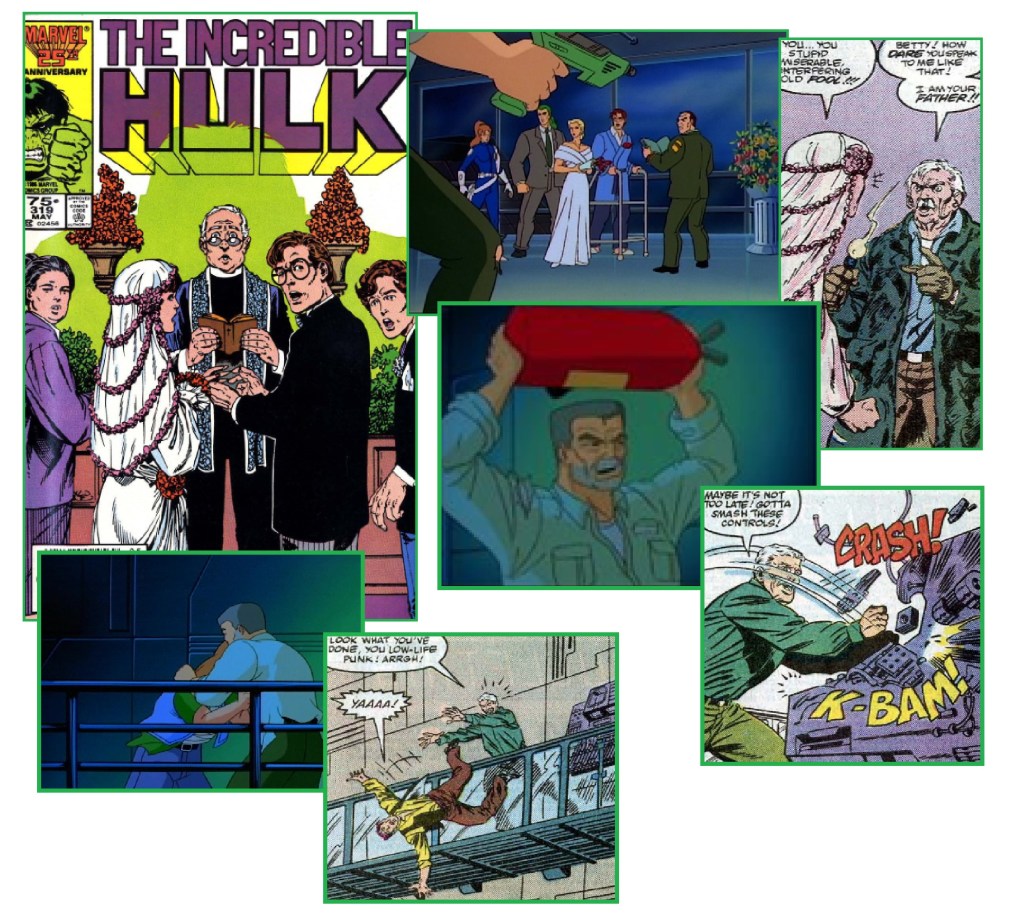
General Ross interrupting the wedding comes from Incredible Hulk #319.
Rick being pushed into the Nutrient Bath by Thunderbolt Ross is taken from Incredible Hulk #324. The Gray Hulk also reappeared in that issue.
CHANGING SHADES
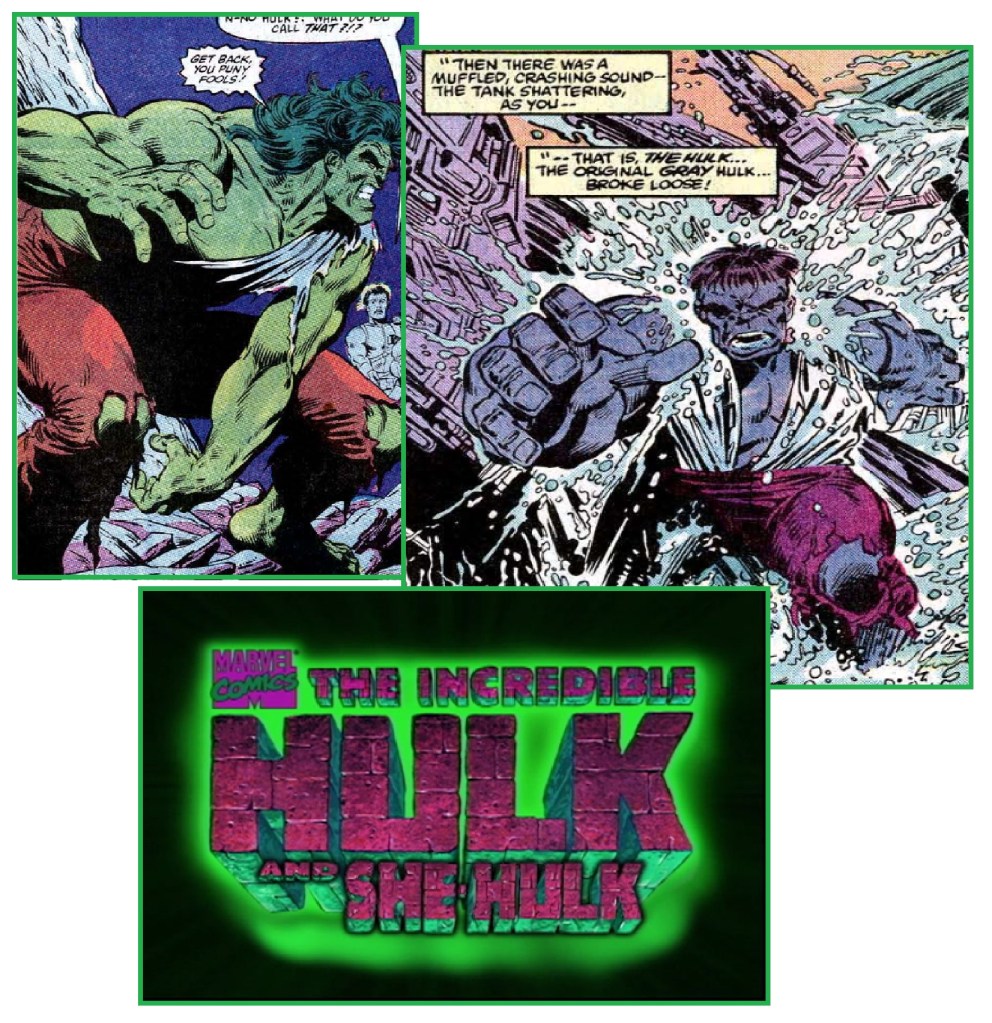
When The Incredible Hulk returned for its second season in 1997, it did so under a new banner: The Incredible Hulk and She-Hulk. The title change wasn’t just cosmetic — it signalled a tonal pivot, a shift in focus, and a recalibration of rhythm. The first season had leaned into gothic horror, psychological torment, and Cold War echoes. Bruce Banner was haunted, hunted, and often alone. The second season softened the shadows.
Jennifer Walters — She-Hulk — stepped into the spotlight, bringing levity, sass, and ensemble energy. Her presence reframed the show’s emotional palette. Where Bruce brooded, Jen bantered. Where the Hulk raged, She-Hulk reasoned. The stories became lighter, more episodic, and often more playful. The horror elements receded, and the season itself was shorter — just eight episodes.
The shift wasn’t universally embraced. Some missed the darker tone. Others welcomed the ensemble rhythm. But the change was deliberate. The second season wasn’t a sequel. It was a reimagining — a chance to explore what happens when the monster isn’t alone anymore.




 X-Cess Minutiae
Leave a comment