


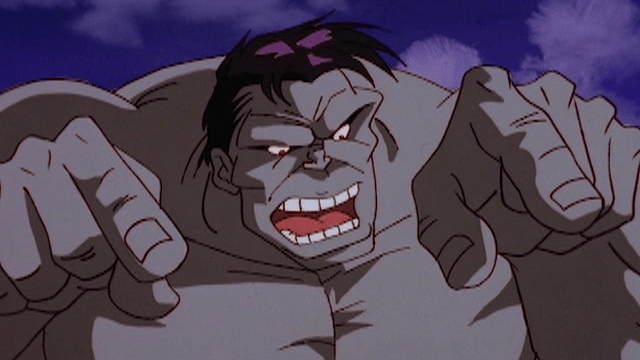
At one point in this episode, mid-battle with the Leader and fresh off meeting She-Hulk, the Gray Hulk spits a line that lands harder than expected: “Banner’s bought his last pair of purple trousers.”
It’s not a headline quote, but it’s telling. Season 2 of The Incredible Hulk mutates into The Incredible Hulk and She-Hulk, a shift born from network discomfort with the darkness of season one. What follows is a truncated, retooled season — a different beast entirely.
Gone is the brooding, solitary figure wandering through gamma fallout. In his place, Bruce finds companionship. But with Jennifer Walters comes a cheeriness and zest for life that jars against the haunted tone that came before. The show trades existential dread for sitcom sparkle — and it shows.
This episode does its best to resolve the cliffhanger, and Bob Forward’s dialogue still crackles. But something’s missing. Urgency. Weight. Betty Ross is sidelined, reduced to passing mentions. Bruce himself fades into the background as the Gray Hulk takes centre stage. Rick Jones vanishes. And the show pivots from moral melodrama and gamma-powered reckonings to high school reunions and fashion shows.
The rest of the season follows suit — and fans of the first run feel the loss. As Gargoyle mutters when the Gray Hulk shifts back into the Green Goliath: “You don’t have to be a genius to see where this is going.”
And he’s right. In chasing humour and light, the series loses what made it unique. What follows is a divisive, much-maligned final stretch — a cautionary tale in tonal whiplash.
The Nutrient Bath experiment doesn’t just stir the gamma waters — it turns Rick Jones into a teenage Hulk. But when General Ross goes hunting for the original, he finds something unexpected: the Gray Hulk. New look, new attitude, same brute strength. Ross attacks anyway, triggers an avalanche, and the Gray Hulk saves him. Ross ends up injured. Banner re-emerges. The military finds Ross unconscious and blames Banner for everything.
She-Hulk steps in to defend him, arguing that Banner and Hulk are one and the same — but not interchangeable. The prosecution counters with a live video feed of a Hulk roaming the desert. Their claim? Banner can’t be the Hulk if the Hulk is out there. What they don’t know: that’s Rick Jones.
Then it gets messy. Gargoyle and the Leader — now human again and significantly less clever — crash the trial and kidnap Banner. The Leader offers a deal: bring him the Rick Jones Hulk, and he’ll separate Banner from the monster once and for all. Gray Hulk agrees.
Back at the base, the Leader drains Rick’s gamma power to restore his own intellect — and then double-crosses Gray Hulk, trying to drain him too. She-Hulk arrives just in time to stop the transfer, but the Leader unleashes his gamma warriors.
Gray Hulk doesn’t take it well. His rage boils over, and he transforms into the classic green Hulk. The base is levelled. The gamma warriors are smashed. And the trial? Betty finds the footage of Ross and the Gray Hulk, clearing Banner’s name.
Banner and She-Hulk leave town. But the damage — physical, emotional, and political — is already done.

The second season picks up immediately with a recap of the season one finale, although there is a significant time jump during the episode. The show has been renamed The Incredible Hulk and She-Hulk, with shots of Jennifer from last season added into the opening. It ruins the dark, brooding aesthetic of the first season.
With a second season comes a new look and the character models for Bruce Banner and She-Hulk are slightly modified, especially with their hair. Cree Summer takes over the role of She-Hulk this season from Liza Zane.
Rick Jones makes his only appearance in the season in this episode, which also makes it his last appearance.
The Gargoyle tries out a catchphrase of his own: “So says the Gargoyle.’ He also complains that it sounds just as stupid when he says it. She-Hulk comes up with the repetitive (and somewhat overdramatic) “This means it’s Situation: Green!” – which she’ll continue to say all season long. Her license plate for her car reads GAMMA GIRL.
THE GRAY HULK: SAVAGERY UNLEASHED!

Before he was green, he was gray.
The Hulk’s original appearance in The Incredible Hulk #1 (1962) featured a gray-skinned brute — not due to creative intent, but a printing error. The gray tone was inconsistent across pages, prompting Marvel to shift to green by issue #2. But the Gray Hulk wasn’t forgotten. He became something else entirely.
In the late ’80s, writer Peter David reintroduced the Gray Hulk as a distinct persona: smarter, meaner, and morally ambiguous. Dubbed “Joe Fixit,” this version operated as a Las Vegas enforcer — a cunning bruiser who preferred suits to smashing. He wasn’t Banner’s rage made flesh; he was Banner’s repression, sarcasm, and survival instinct.
The Gray Hulk’s emergence marked a turning point in Hulk lore: the beginning of multiple Hulk personas, each reflecting fractured aspects of Bruce Banner’s psyche. Green was primal fury. Gray was streetwise cunning. Later, the Savage Hulk, Professor Hulk, and Devil Hulk would follow — but Joe Fixit was the first to challenge the idea that Hulk was just one thing.
He’s resurfaced many times since — in Immortal Hulk, Maestro, and Joe Fixit — often as the wildcard in Banner’s internal war. Not the strongest Hulk. Not the kindest. But maybe the most human.




 X-Cess Minutiae
Leave a comment