


Jennifer Walters used to be invisible. Now she’s fading again.
This episode finds Jennifer caught between identities — not in a gamma storm, but in the quiet erosion of self. Her powers are slipping. Her eyes betray her. And the woman she used to be — clever, loyal, logical — feels like a ghost in her own skin. Unlike Bruce, Jennifer embraced the transformation. She-Hulk gave her glamour, confidence, attention. She liked being seen. Now, she’s terrified of being ordinary.
But the truth is, Jennifer Walters was never ordinary. And when the reunion forces her to face old bullies, collapsing platforms, and a villain who’s devolved into a lovesick joke, it’s not gamma strength that saves the day — it’s Jennifer. Acrobatic, strategic, and fiercely protective. Her humanity isn’t a weakness. It’s the catalyst. And when she chooses to fight, not as She-Hulk but as herself, the green returns. Not as a mask — but as an extension of who she’s always been.
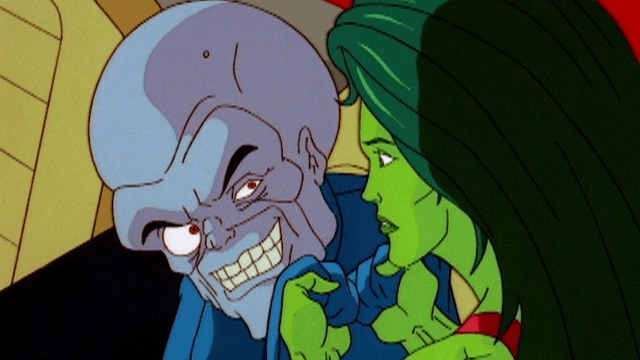
Gargoyle, meanwhile, is a cautionary tale. Once a peer to Banner, now reduced to petty obsession and cartoonish blackmail. His arc doesn’t deepen — it curdles. The show once let him wrestle with science and morality. Now he’s just a punchline in a bad suit.
Still, in a season riddled with tonal misfires and wasted potential, Down Memory Lane manages something rare: a character beat that lands. Jennifer’s arc isn’t perfect, but it’s honest. And in the end, she doesn’t just reclaim her powers — she reclaims herself.
A letter arrives. Jennifer Walters — She-Hulk — is invited to her high school reunion. She’s not thrilled. Before she can decide what to do, Gargoyle steals her car. She gets it back quickly, but the day’s already off to a strange start.
Elsewhere, Bruce Banner loses control. The Hulk emerges and clashes with Abomination in a brutal showdown, commanded by the Leader. She-Hulk intervenes, dragging Hulk to her parents’ house and hiding him in the treehouse. Inside, her parents are stunned to see their daughter in full gamma form. Her mother urges her to rest, then notices something odd — Jennifer’s eyes are brown. They’re supposed to be green.
She-Hulk panics. The colour returns later, but the warning lingers.
Banner reverts and urges her to slow down. She refuses. She’s going to the reunion. She arrives in full She-Hulk form, shocking her old bullies and drawing attention from every corner of the room. But as the night wears on, her gamma levels drop. She reverts to Jennifer Walters and slips away.
Gargoyle confronts her outside, offering to restore her gamma state. Jennifer declines.
Meanwhile, Abomination captures Bruce. He Hulks out and escapes, but the damage is done. Back at the reunion, Jennifer faces off against Ogress. A platform collapses — her old bullies are in danger. She pushes herself, gamma levels spike, and She-Hulk returns. The fight is swift. The villains retreat.
Later, at the house, Bruce explains the truth: her transformation faltered because she’s exhausted. Next time, it might not come back. She-Hulk listens. She accepts the warning.
As they leave town, her former classmates have changed their attitudes towards Jen and wave her off – drenched in green paint — and finally, they show Jennifer some respect.
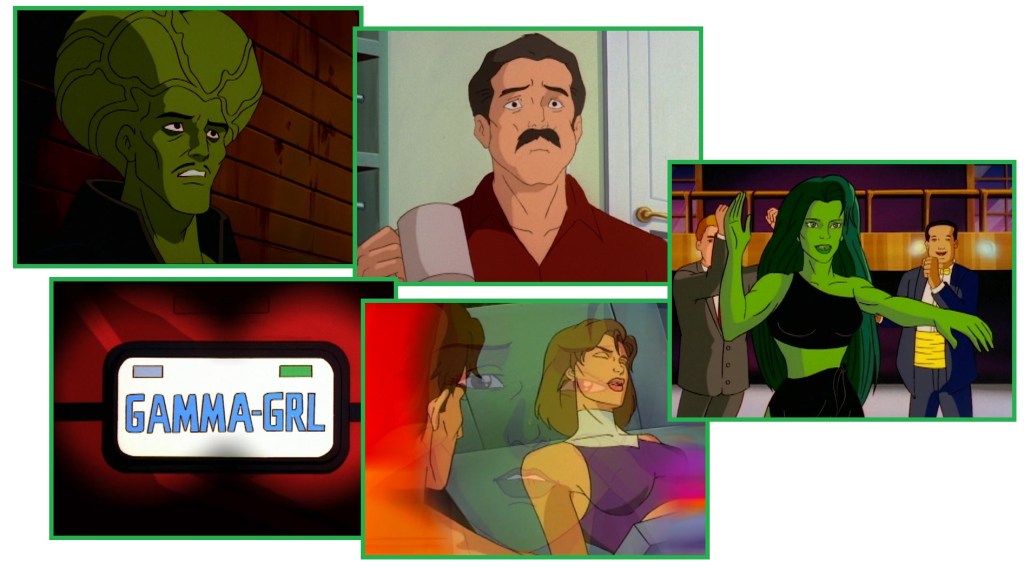
The snappy dialogue is on top form in this episode, especially the bad guys. When the Abomination claims to have the battle with Hulk in hand, the Leader snaps back with this epic: “Yes. Hitting his fist with your face has assuredly been a novel strategy.”
Stan Lee, who created the character of Jen Walters, voices Cliff Walters, her father. We also see her car license plate up-close.
Jennifer has a flashback to her origin from the first season episode Doomed.
Jennifer and her male admirers dance the Macarena at her reunion.
“SO SAYS… THE LEADER!”
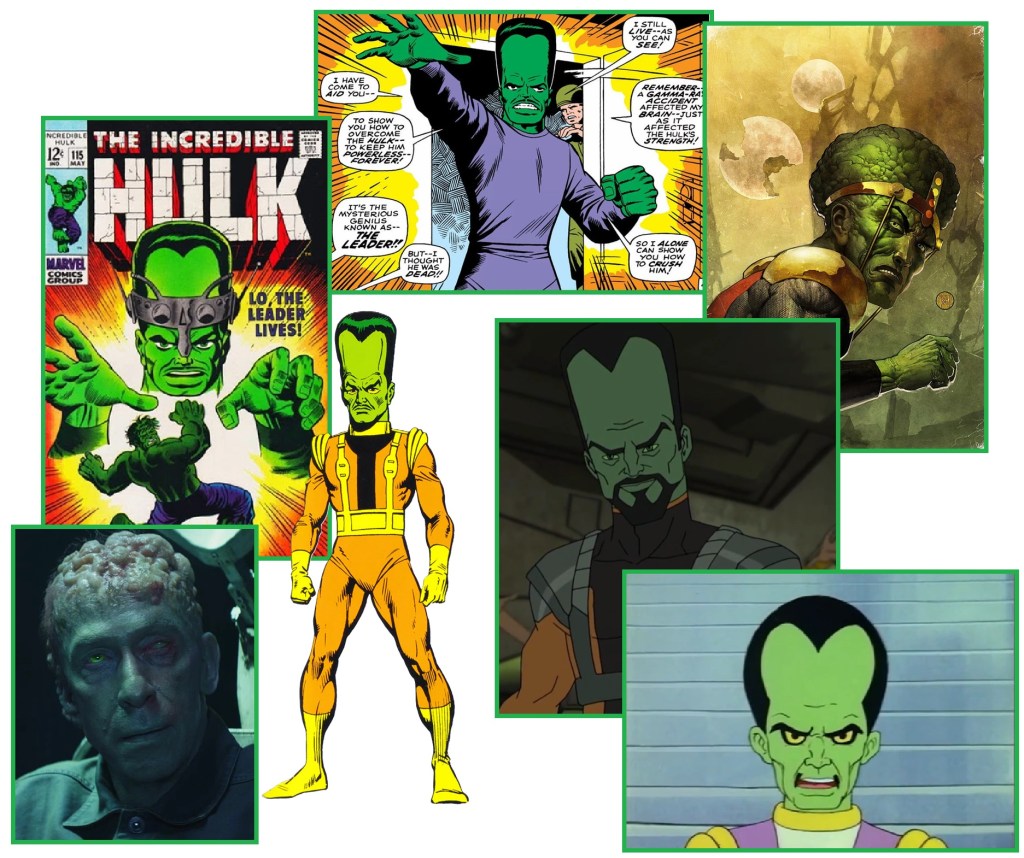
The Leader first appears in Tales to Astonish #62 (December 1964), created by Stan Lee and Steve Ditko. Born Samuel Sterns, he’s a low-level worker exposed to gamma radiation — but unlike Bruce Banner, his mutation doesn’t amplify strength. It expands intellect. His cranium swells, his mind becomes superhuman, and his obsession with control begins. Where Hulk is chaos incarnate, the Leader is cold calculation — a villain who believes domination is destiny.
Sterns sees himself as the natural counterpoint to the Hulk. Not just brains versus brawn, but order versus instinct. He builds armies of gamma-powered enforcers — the Abomination, Gargoyle, Ogress — not to destroy, but to reshape the world in his image. His plans are rarely simple. They involve infiltration, manipulation, and psychological warfare. He doesn’t want to fight the Hulk. He wants to overwrite him.
Over the decades, the Leader evolves from mad scientist to mythic antagonist. In Immortal Hulk, he becomes something far more terrifying — a metaphysical parasite, invading minds and souls, twisting gamma into theology. He’s no longer just a genius. He’s a prophet of annihilation, preaching control through corruption. His intellect is matched only by his cruelty.
In animation, the Leader appears in The Incredible Hulk, Avengers: Earth’s Mightiest Heroes, and Hulk and the Agents of S.M.A.S.H., often as the mastermind behind gamma chaos. He’s a recurring threat, always one step ahead, always scheming. In live-action, he’s introduced in The Incredible Hulk (2008) as Samuel Sterns, played by Tim Blake Nelson. Though his transformation is only teased, his return in Captain America: Brave New World promises a long-awaited reckoning.
The Leader isn’t just a villain. He’s the question behind every gamma mutation: what happens when power isn’t earned, but taken? When intelligence becomes tyranny? He doesn’t rage. He rewrites.
The Leader isn’t the opposite of the Hulk — he’s the consequence.




 X-Cess Minutiae
Leave a comment